Flower Delivery in Chita: Timing, Areas and What Arrives at the Door
Chita sits deep in Transbaikalia, where winters are long, summers are short, and the people who live there appreciate a gesture that travels far to reach them. Whether you are sending congratulations to a colleague, marking a birthday for someone you cannot visit in person, or simply letting a friend know you are thinking of them, flowers land differently when they come fresh and on time. This is what you need to know before you order.
Which Parts of Chita We Deliver To
Chita is a compact city by Siberian standards, but its districts spread across uneven terrain and the road layout is not always straightforward. Turboflora covers the central districts — including the area around Lenin Square, the railway station neighbourhood, and the main residential zones along Chaikovskogo and Amurskaya streets — as well as the newer residential blocks on the city's edges. If the recipient lives in a high-rise on the outskirts or in a private house in one of the suburban streets, that is still within our delivery zone.
When you place an order, enter the full address including the building number, entrance number, and floor. In Russian apartment buildings, the entrance — called a podezd — is a separate door on the outside of the block, and drivers need that detail to avoid waiting in the wrong spot. If the building has an intercom code, add it in the comments field.
For addresses in the very outer edges of the city or in settlements just beyond the city boundary, contact us before ordering so we can confirm coverage and timing. We would rather tell you honestly than have a bouquet arrive late. The goal is always that the flowers reach your person in the same condition they left our preparation room — tight buds, clean stems, and nothing wilted from a long wait in a cold car.
Bouquets we can deliver



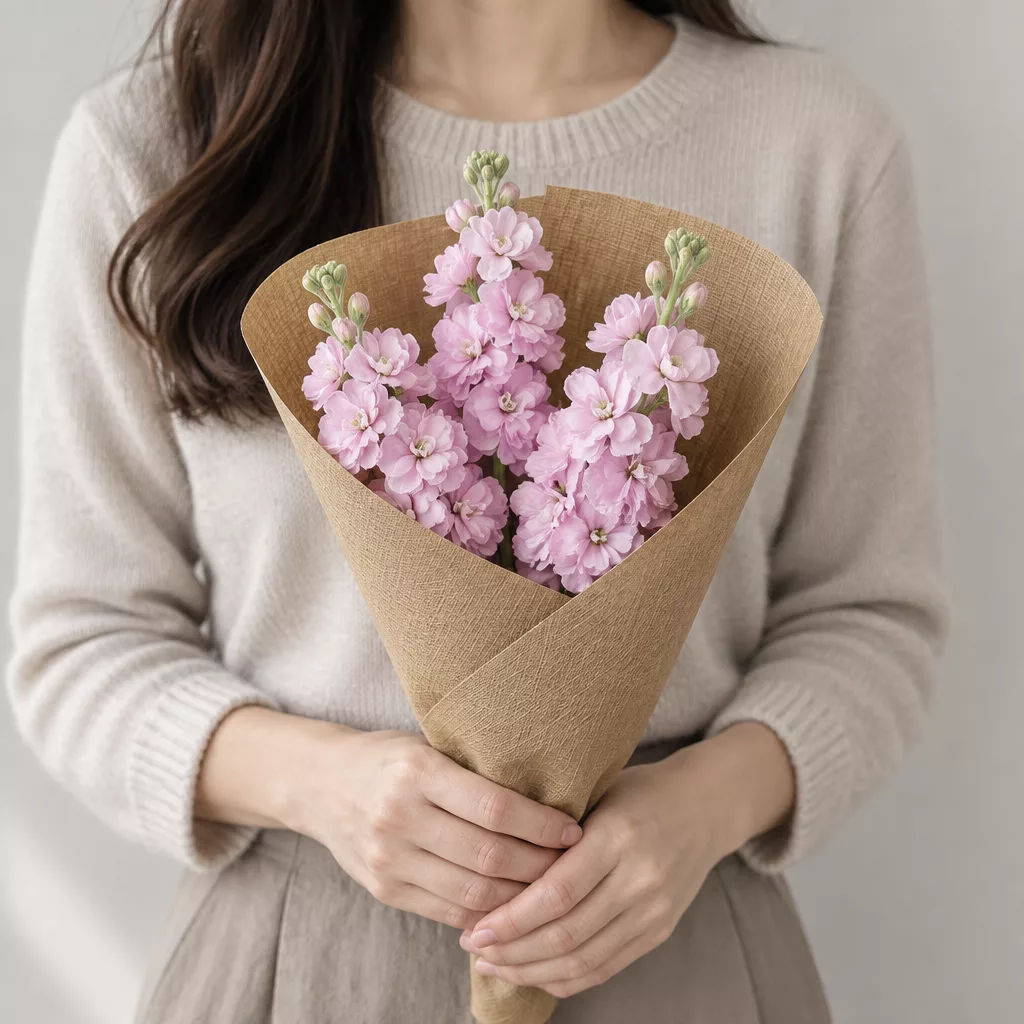
Delivery Timing and What the Chita Climate Does to Flowers
Chita has one of the most continental climates in Russia. Winters regularly drop to minus 30 degrees Celsius, and even spring and autumn bring sharp overnight frosts. Summer is warm but brief. These extremes matter for flower delivery in ways that most people do not think about until something goes wrong.
In winter, every bouquet leaves our preparation room wrapped in insulating paper and placed inside a thermal sleeve. The time between the car and the recipient's door is the most dangerous moment — even a few minutes of exposure to minus 25 can blacken rose petals or cause tulip stems to collapse. We ask that recipients open the door quickly and bring the flowers inside before unwrapping them, letting them adjust to room temperature gradually over fifteen to twenty minutes.
In summer the opposite risk applies. Chita summers can reach 35 degrees Celsius, and a bouquet sitting in a warm car for too long will drink its own water faster than it can absorb it. We schedule summer deliveries with short routes and keep flowers in cool conditions until the last moment.
Standard delivery in Chita runs within one to two hours from the moment you confirm your order. For a specific time window — a surprise at the office at noon, for example — select the timed delivery option and we will organise the route accordingly. The earlier in the day you order, the more flexibility you have in choosing your window.
Choosing Flowers for the Person, Not Just the Occasion
The most common mistake people make when ordering remotely is choosing flowers for themselves rather than for the recipient. Think first about who is receiving them. A woman in her sixties who grew up in Siberia may love a classic arrangement of spray chrysanthemums and alstroemeria — sturdy, long-lasting, and familiar. A young woman in her twenties might be delighted by a monobouquet of garden roses or a loose arrangement of ranunculus and eucalyptus, which feels current and personal.
For a man — and in Russia, flowers for men are entirely normal, particularly for birthdays and professional milestones — consider something architectural: a tight arrangement of anthuriums, or a bold single-variety bouquet of sunflowers or large-headed dahlias in season. Avoid anything that reads as overly romantic unless that is exactly the message.
For a child or a teacher, gerberas are a perennial favourite in Russia. They are cheerful, come in every colour, and hold up well even in a child's hands. Peonies, when in season between May and July, are the bouquet Russians associate most strongly with celebration and warmth. If you are sending for a birthday and peonies are available, they rarely disappoint.
If you are uncertain, write a short note about the person in the order comments — their personality, the colour of their home, whether they prefer bold or delicate things — and we will make a selection that fits. A florist who knows what they are doing can read a person from three sentences.
Budgeting for a Bouquet That Does Not Look Like a Budget Bouquet
The size and impact of a bouquet depend more on how it is composed than on how much is spent. A single variety used in generous quantity almost always looks more intentional than a mixed arrangement where every stem is different and nothing reads clearly. If you are working with a modest budget, ask for a monobouquet: fifteen tulips, a dozen spray roses, or a full bunch of alstroemeria in one colour family. These look deliberate and generous.
At a mid-range budget, combinations start to open up. Roses paired with waxflower or limonium give softness and texture without adding bulk. Lisianthus — sometimes called eustoma — is one of the most underused flowers in Russia despite being available year-round. It resembles a peony or a rose depending on the variety, holds for ten to fourteen days in a vase, and costs significantly less than either. A bouquet built around lisianthus with a few stems of eucalyptus and some seasonal greenery is both beautiful and practical for someone who will be living with it for two weeks.
At a higher budget, consider adding preserved or dried elements for texture, or building around flowers that are genuinely seasonal and therefore at their peak. Peonies in June, dahlias in August, hyacinths in early spring — these are the moments when spending more makes sense because the flower itself is extraordinary. A bouquet that arrives smelling of hyacinth in March communicates something that no other flower can.
What Russian Flower Customs Are Worth Knowing
If you are not familiar with Russian traditions around flowers, a few things are worth knowing before you order. The most important is the odd-number rule. In Russia, bouquets given as gifts contain an odd number of stems — one, three, five, seven, and so on. Even numbers are associated with mourning and are placed at graves. This is not a rigid law, but it is a deeply held convention, and most recipients will notice. When you order from us, our arrangements follow this rule automatically.
Colour carries meaning too, though less rigidly than the odd-number rule. Yellow flowers have historically been associated with separation and bad luck in Russian folk tradition, though this is changing among younger generations in cities. If you are unsure of the recipient's sensibilities, it is safer to choose another colour or to mix yellow with white and green so it reads as a palette rather than a statement.
White flowers are universally appropriate for almost any occasion — they read as elegant and sincere. Red roses carry romantic meaning and should be chosen deliberately. Pink sits comfortably between the two and works for colleagues, friends, and family alike.
When flowers arrive, it is customary for the recipient to unwrap them immediately and thank the sender, often with a photograph sent by message. If you are sending as a surprise, letting us know so we can include a card with your message means the recipient understands who sent them and why — which matters more than people expect.
Keeping Flowers Fresh in a Chita Apartment
Chita apartments in winter are very warm. Central heating in Russian buildings runs at high capacity from October through April, and indoor temperatures often reach 23 to 25 degrees Celsius. This is comfortable for people and hard on flowers. A bouquet that might last twelve days in a cooler European apartment may last eight in a heated Siberian one unless a few simple steps are followed.
First, the vase. Cut stems need clean water changed every two days. Each time the water is changed, recut the stems at a slight angle — about one centimetre — with a sharp knife rather than scissors, which can crush the vascular tissue. Remove any leaves that sit below the waterline, as they rot quickly and contaminate the water.
Place the vase away from direct sunlight and away from the radiator. A windowsill in winter looks like a good spot but is actually one of the worst: the glass is cold, the radiator below is hot, and the flower sits in a thermal conflict. A table in the middle of the room, or a shelf away from heat sources, is better.
Roses and tulips benefit from being kept in a cool room overnight — a hallway or an unheated spare room — and brought back to the main room during the day. This simple practice can add three to five days to vase life. Chrysanthemums and alstroemeria are the most forgiving varieties in heated interiors and need the least management. Lisianthus and carnations also hold well. Peonies, once fully open, are more delicate and should be enjoyed rather than managed.
Making the Order Go Smoothly From Anywhere in Russia
Most people ordering flowers for someone in Chita are doing it from somewhere else — Moscow, Saint Petersburg, Novosibirsk, or from abroad. The time difference matters. Chita is in UTC+9, which is six hours ahead of Moscow. When it is ten in the morning in Moscow, it is already four in the afternoon in Chita. If you want flowers to arrive before a birthday dinner, place the order in the morning Moscow time at the latest — which means mid-afternoon Chita time, leaving enough room for preparation and delivery.
The order form asks for the recipient's phone number. This is used only if the driver cannot locate the address — a common situation in buildings with multiple entrances or in areas where house numbering is inconsistent. We do not call the recipient in advance if the order is a surprise; we simply work harder to find the right door. If the recipient should not know the flowers are coming, mark this clearly in the comments.
For large orders — corporate gifts, multiple addresses, or a significant occasion — contact us before placing the order so we can confirm stock and timing. Chita is far from the main flower wholesale markets, and certain varieties may need to be confirmed for availability. Roses, chrysanthemums, gerberas, carnations, and alstroemeria are reliably available year-round. Peonies, ranunculus, and anemones are seasonal and should be confirmed before you build an expectation around them.
A card with a personal message is included at no extra cost. Write it in Russian or English — we will ensure it is presented correctly with the bouquet.
Sending flowers to Chita is a real gesture of effort — the city is far, the climate is demanding, and the distance between sender and recipient makes the arrival of something fresh and beautiful all the more meaningful. When you order with care, choose for the person rather than the occasion, and give the recipient a few simple tips for keeping the bouquet alive in a warm apartment, the flowers do exactly what you hoped: they say something that a message cannot.
Frequently asked questions
Can I order flowers for delivery in Chita if I am in a different time zone?
Yes, and the time difference is the main thing to plan around. Chita runs six hours ahead of Moscow. For flowers to arrive at a specific time — say, before a birthday dinner — place your order in the morning Moscow time. The order form lets you select a delivery window in local Chita time, so you can set it precisely without doing the conversion yourself.
How do you protect flowers during delivery in Chita's winter cold?
Every winter bouquet leaves our preparation room wrapped in thermal insulating paper and placed inside a protective sleeve. The critical moment is the handover at the door. We ask recipients to open quickly and bring flowers inside before unwrapping, then let them rest at room temperature for fifteen to twenty minutes before placing them in water. This prevents thermal shock to the petals and stems.
Why do Russian bouquets always have an odd number of flowers?
This is a longstanding Russian tradition. Odd numbers are for celebration and living recipients; even numbers are reserved for mourning. Most Russians notice the difference, so all our gift arrangements follow the odd-number rule automatically. You do not need to specify this — it is built into how we compose every bouquet intended as a personal gift.
Which flowers last longest in a warm Chita apartment during winter?
Chrysanthemums, alstroemeria, carnations, and lisianthus are the most resilient in heated interiors and can last ten to fourteen days with basic care. Roses hold well if the water is changed every two days and stems are recut. Tulips are shorter-lived but beautiful. Peonies open quickly in warmth and are best enjoyed fully rather than managed for longevity.
What if I want to send flowers to Chita as a surprise and do not want the recipient called?
Note this clearly in the order comments and we will not contact the recipient in advance. Our driver will use the address details you provide — building, entrance number, floor, and intercom code if applicable — to reach the door without a prior call. Providing complete address information is the most important thing you can do to ensure a smooth surprise delivery.
Ready to send flowers?
Pick the city, choose the bouquet, and a local florist takes it from there.
Choose a city →