Sending Flowers to Dzerzhinsk? Here Is What to Expect
Dzerzhinsk sits close enough to Nizhny Novgorod that people sometimes assume flower delivery there is complicated or slow. It is neither. Whether you are surprising a colleague on a work anniversary, sending roses to a parent, or marking a graduation from a distance, a fresh bouquet can reach almost any address in the city within a reliable window — and the flowers arrive looking as though they were just assembled, because they were.
Which Parts of Dzerzhinsk We Reach and How Quickly
Dzerzhinsk is a mid-sized industrial city in the Nizhny Novgorod Oblast, and its layout matters when you are planning a delivery. The central districts — around Gagarin Square and the main shopping streets — are the easiest to reach and typically see the fastest turnaround. Residential mikrorayons further from the centre, including areas near the chemical plant district and the newer housing estates on the city's eastern edge, are all within our delivery zone, though travel time across those stretches can add twenty to thirty minutes compared to a central drop.
We aim for a one-to-two-hour window from the moment you place your order. That figure is realistic for most Dzerzhinsk addresses during standard hours. Early mornings before nine and late evenings after eight may shift the window slightly, so if the delivery needs to land at a precise moment — say, right before a birthday dinner — order an hour ahead of your target time rather than at the last minute.
Winter road conditions between November and March can slow things down. Dzerzhinsk winters are genuine: temperatures regularly drop below minus fifteen Celsius, and ice on secondary roads is common. We account for that in how we pack and insulate bouquets, but it is worth building a small buffer into your timing during those months. A delivery window of ninety minutes becomes more comfortable than a tight sixty when the roads are icy.
Bouquets we can deliver



Choosing Flowers for the Person, Not Just the Occasion
The most useful question to ask before ordering is not 'what flowers are appropriate?' but 'what will this person actually feel when they open the door?' A bouquet of white peonies and eucalyptus reads as thoughtful and a little romantic. A tight cluster of garden roses in coral and cream feels warm and celebratory without being showy. Bright gerberas and solidago say cheerful energy. Each combination lands differently, and knowing your recipient even slightly will help you choose better than any generic occasion list.
For someone who does not know Russian customs around flowers, here is one practical note: in Russia, odd numbers of flowers in a bouquet are the standard for gifts to the living. Even numbers carry a different association and are traditionally reserved for mourning. This is not a rigid rule that everyone enforces, but it is worth knowing so you can choose confidently. Most pre-made bouquets from a florist already follow this convention.
Age and setting also shape the choice. A twenty-five-year-old receiving flowers at her apartment will respond differently to a loose, garden-style arrangement of ranunculus and lisianthus than to a formal dozen red roses. The roses are not wrong — they are classic for a reason — but they signal a different register. For a teacher, a colleague, or a family elder, something structured and generous, like spray roses mixed with alstroemeria and greenery, often feels more fitting than a single-variety statement bouquet. Think about where the flowers will sit and who will see them.
Seasonal Availability and What Grows Well in Each Month
Dzerzhinsk's climate is continental, and while your flowers are not grown locally, the seasons still shape what is available and what is at its best. Spring — April through June — is the strongest period for tulips, peonies, and ranunculus. Tulips from Dutch growers are at peak quality in March and April; by May they start giving way to peonies, which many florists consider the most generous flower of the warm season. If you are ordering in late May or early June, peonies are almost always the right answer for a celebration.
Summer brings sunflowers, dahlias, and lisianthus in abundance. These hold up well in warm temperatures if they are conditioned properly before delivery, which means re-cutting stems and keeping them hydrated right up until the moment they leave the shop. Chrysanthemums and eustoma (another name for lisianthus) are workhorses of the summer and early autumn period — they last well, travel without bruising, and look full even in modest quantities.
Winter is the season of roses, carnations, and tropical varieties like anthuriums and orchid stems. Roses imported from Ecuador and Kenya are at their most reliable in January and February because the cold chain from grower to shop is easier to maintain. Carnations are underrated in winter — they last ten to fourteen days in a vase, which makes them a practical and genuine gift rather than a short-lived gesture. If someone will not be home immediately to put flowers in water, carnations or alstroemeria are far more forgiving than, say, open garden roses.
How to Order for Someone Who Is Not Expecting a Delivery
Surprise deliveries are some of the most meaningful, and they also carry the most risk of going wrong. The most common problem is a missed delivery: the recipient is out, does not answer the door, or has their phone on silent. Before you order, think about whether the person is likely to be home or at the address you are sending to. A workplace delivery during business hours is almost always more reliable than a home delivery in the middle of a weekday.
If you are sending to a residential address and you are not certain the person will be in, include a phone number for the recipient in your order notes. Our courier will call ahead. This is standard practice and does not ruin a surprise — most people are delighted by an unexpected call telling them something is on its way, not disappointed.
For office deliveries in Dzerzhinsk, specify the floor and department if the building has multiple tenants. Industrial and administrative buildings in Russian cities often have security desks that require a name and company before allowing access. Writing the recipient's full name and the company name in your delivery notes prevents delays at the entrance. If the office has a reception, note that too — the flowers can be left there safely if the person is briefly away from their desk. A small card tucked into the bouquet with a handwritten message (you can write it in the order notes and we will print it) makes the moment personal even when you are hundreds of kilometres away.
Packaging That Protects Flowers on the Road
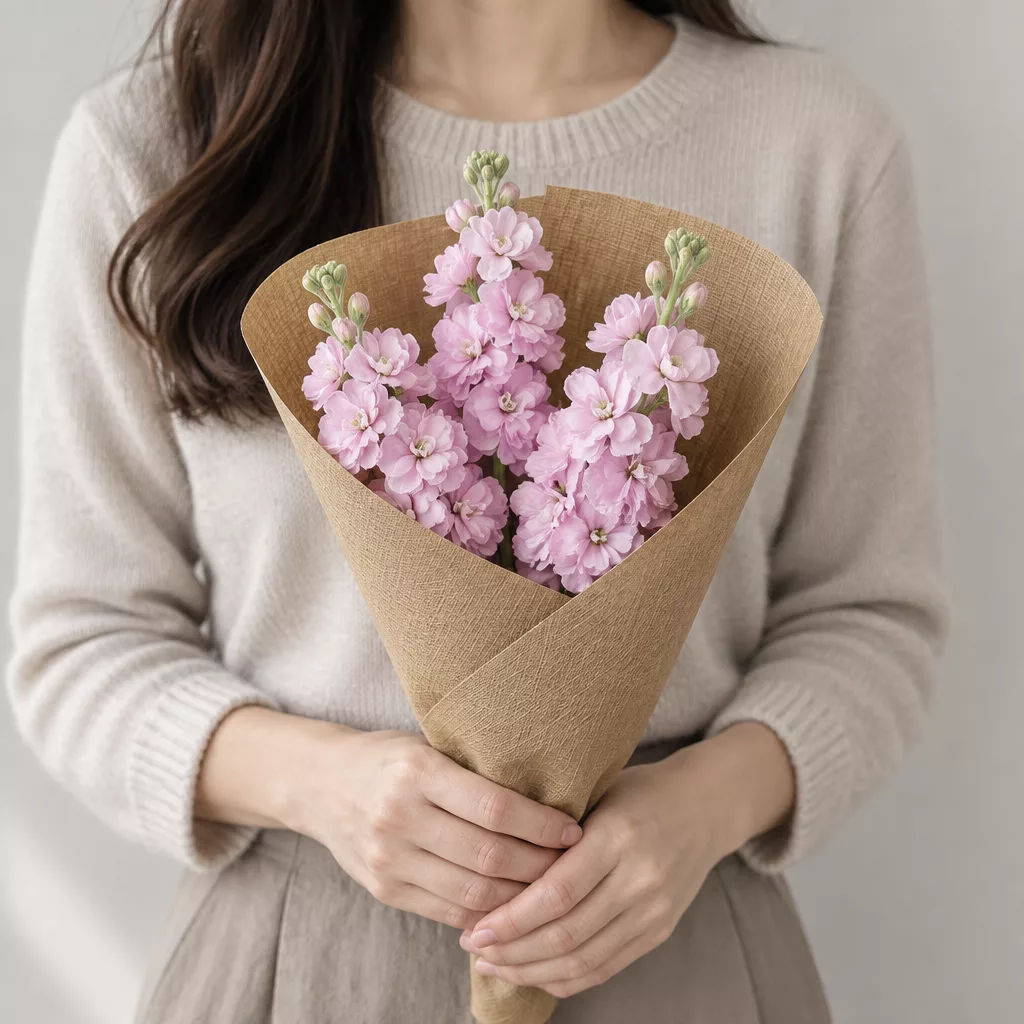
The stretch of road between a florist's workroom and a front door in Dzerzhinsk is where most bouquets are damaged — not through carelessness, but through cold, vibration, and poor wrapping. We wrap stems in damp paper or a water-retaining sleeve for longer journeys, and the outer layer is kraft or matte wrapping paper that protects petals from wind and contact with surfaces in the vehicle.
In winter, we add an insulating layer for flowers that are sensitive to cold. Roses, for instance, will show petal bruising at temperatures below minus five Celsius if they are carried unwrapped. Tropical varieties like anthuriums are even less tolerant of cold and need proper insulation below zero. We do not cut corners on this, but it is worth knowing so you understand why a winter bouquet might look slightly more tightly wrapped than a summer one.
In summer, the risk reverses: heat inside a closed vehicle can wilt open blooms within twenty minutes. We time summer deliveries to avoid leaving flowers sitting in a parked car, and we choose varieties that are naturally more heat-tolerant — spray roses, alstroemeria, and chrysanthemums — for longer routes. If you are ordering a delicate arrangement of open garden roses or peonies in July, a morning delivery is always smarter than an afternoon one, both for the flowers and for the impression they make when they arrive.
Caring for the Bouquet Once It Arrives
A good bouquet is only half the gift — the other half is how long it lasts. The single most important thing the recipient can do is cut the stems immediately, at an angle, and place the flowers in clean, cool water. Stems that have been out of water for even an hour develop an air bubble at the cut end that blocks water uptake. A fresh diagonal cut removes that blockage and lets the flower drink again.
Vase water should be changed every two days. This is not fussiness — bacteria multiply quickly in standing water and shorten vase life significantly. A small amount of sugar in the water feeds the flowers, and a drop of bleach or a copper coin keeps bacteria in check. Most commercial flower food sachets combine these functions, and we include one with every bouquet. If the recipient does not have a sachet, a teaspoon of sugar and a few drops of lemon juice in a litre of water works as a substitute.
Keep the bouquet away from direct sunlight, heating vents, and fruit bowls. Ripening fruit releases ethylene gas, which accelerates petal drop — this is especially true for roses and carnations. A cool room, indirect light, and clean water add two to four days to vase life for most varieties. Tulips are an exception: they continue to grow after cutting and will lean toward any light source, so rotate the vase every day if you want them to stay upright. Peonies open slowly from bud stage and are worth the patience — a tight bud on arrival will be fully open and spectacular within thirty-six to forty-eight hours at room temperature.
Making the Order Feel Personal From a Distance
Ordering flowers from another city — or even from across town when you cannot be there in person — can feel impersonal if you let it. It does not have to. The details you add to an order are what transform a transaction into a gesture. A card message that references something specific — a shared memory, an inside joke, the exact reason you are grateful — does more work than any flower variety. We print your message exactly as you write it, so write it the way you would say it, not the way you think it should sound on a card.
Colour choices also carry meaning in Russian culture, and it is worth being intentional. Red roses are romantic and clearly so — they are not ambiguous. White flowers read as elegant and pure but can carry a more solemn association in some contexts, so they work better for celebrations when mixed with colour. Yellow flowers were historically considered unlucky in Soviet-era Russia, though this association has faded considerably among younger generations. If you are unsure, a mixed bouquet in warm tones — coral, peach, cream, soft pink — is universally positive and reads as generous rather than coded.
If you are sending flowers to mark a milestone — a promotion, a new home, a new baby — think about what the person's life looks like right now. A new parent is exhausted and touched by small kindnesses; a compact, long-lasting arrangement of alstroemeria or spray roses is more practical than a large bouquet that needs immediate attention. Matching the gesture to the moment is what florists mean when they talk about the right flower for the right person.
Dzerzhinsk is not a complicated city to send flowers to — it just requires the same thoughtfulness that any good gift does. Know your recipient, think about the timing, give us a reliable address and a contact number, and the rest is straightforward. A bouquet assembled that morning, wrapped properly for the road, and delivered within the hour is a genuine act of care, whether you are in the same city or sending from Saint Petersburg. The flowers do the talking; we handle the logistics.
Frequently asked questions
How long does flower delivery to Dzerzhinsk actually take?
For most addresses in Dzerzhinsk, we work to a one-to-two-hour window from the moment the order is confirmed. Central districts are typically faster. In winter or during peak periods such as March 8th and Valentine's Day, we recommend ordering at least ninety minutes before your target delivery time to give a comfortable buffer.
Can I send flowers to a Dzerzhinsk address if I do not know the exact apartment number?
It helps to have the full address including apartment or office number. If you only have a building address, include the recipient's phone number in the order notes so our courier can call on arrival. For workplace deliveries, the company name and floor are more important than an internal office number in most cases.
Which flowers last longest after delivery in Dzerzhinsk's climate?
Alstroemeria, carnations, and spray roses are consistently the longest-lasting cut flowers, holding seven to twelve days with basic care. Chrysanthemums are close behind. Tulips and open peonies are shorter-lived but visually spectacular. For someone who travels or may not be home immediately, carnations or alstroemeria are the most forgiving choice.
Is it true that flower count matters in Russia?
Yes, and it is worth knowing. Odd numbers of flowers are the standard for gifts in Russia — one, three, five, seven, and so on. Even numbers are traditionally associated with mourning. Most pre-made bouquets already follow this convention. If you are building a custom order, just mention it and we will make sure the count is right.
Can I schedule a delivery for a specific time rather than as soon as possible?
Yes. At checkout you can specify a delivery window rather than choosing the earliest available slot. This is useful for surprise deliveries timed to coincide with a birthday dinner, a work event, or a moment when you know the recipient will be home. We recommend a window of at least sixty to ninety minutes rather than a single fixed minute.
Ready to send flowers?
Pick the city, choose the bouquet, and a local florist takes it from there.
Choose a city →