Flower Delivery in Fryazino: Timing, Choices and What Arrives at the Door
Fryazino sits in the Moscow Oblast, a compact science city where people still mark birthdays, anniversaries and professional milestones with real flowers rather than digital greetings. If you are ordering from another city or simply want to understand what the delivery experience looks like from start to finish, this article walks you through every stage — from choosing the right bouquet for the occasion to what the recipient should do the moment the courier hands it over.
What Fryazino Is Like as a Delivery Destination
Fryazino is a small city of roughly 55,000 residents northeast of Moscow, historically tied to electronics research institutes. Its streets are laid out in a fairly compact grid, which makes address navigation straightforward once you know the district. Most residential buildings are Soviet-era panel blocks, and many recipients will be at home during daytime hours or at offices connected to the local research campus.
Because the city is not enormous, a courier can move from one end to the other in fifteen to twenty minutes under normal traffic conditions. That matters for flowers: a shorter journey means less time in a warm car, less vibration stress on delicate petals, and a bouquet that arrives looking the way it left the studio. Roses, tulips and spray chrysanthemums all travel well on this kind of short urban run.
One thing worth knowing for people unfamiliar with Russian delivery culture: recipients here expect the courier to call ahead, usually ten to fifteen minutes before arrival. This is standard practice, not an inconvenience. If your recipient is at work or running errands, that call gives them time to step outside or ask a colleague to accept the order. Building entry codes and intercoms are common in Fryazino apartment blocks, so providing the entrance code in your order notes saves everyone time and keeps the flowers from sitting in a cold lobby.
Bouquets we can deliver



Delivery Timing: What One to Two Hours Actually Means
When we say one to two hours, we mean the window from order confirmation to the moment the courier rings the bell. That window assumes the bouquet is assembled fresh after your order is placed — not pulled from a refrigerator shelf. Fresh assembly takes twenty to thirty minutes for a standard hand-tied bouquet and slightly longer for a structured arrangement with foam or a decorative box.
The remaining time is transit. Fryazino is accessible via the Shchelkovskoye Highway corridor, and journey times from the dispatch point vary by traffic. Morning orders placed before eleven tend to move fastest. Friday afternoons and the days surrounding public holidays — particularly International Women's Day on March 8, which is the single busiest flower day in Russia — add time. If you are ordering for a holiday, placing the order the evening before and scheduling a morning delivery is genuinely the smartest move.
Temperature matters more than most customers realise. In January and February, outdoor temperatures in the Moscow Oblast regularly drop to minus fifteen or minus twenty degrees Celsius. Flowers transported without insulated packaging for more than a few minutes in that cold will show blackened petal edges by the time they reach room temperature. Our couriers use insulated carry bags in winter months precisely to prevent this. In summer, the opposite risk applies: a car interior can reach fifty degrees, which wilts even robust varieties like alstroemeria within minutes. Mention the season when you think about timing — it shapes how we pack.
Choosing Flowers for the Person, Not Just the Occasion
The most common mistake people make when ordering remotely is choosing flowers for the occasion rather than for the person. A birthday calls for celebration, yes — but a woman who keeps her apartment in minimalist style will feel more seen by a tight monochrome bouquet of white ranunculus and eucalyptus than by an explosion of mixed colours, however cheerful that explosion might look in a photo.
Start with what you know about the recipient. Do they have plants at home? People who keep houseplants usually appreciate flowers with interesting texture — protea, scabiosa, lisianthus — rather than the obvious dozen red roses. Do they work in a technical or scientific field, as many people in Fryazino do? A structured, architectural arrangement often resonates more than a romantic loose garden style. Are they likely to put the flowers in a prominent spot or tuck them in a corner? That tells you whether size matters.
For recipients you do not know well — a colleague, a teacher, a business contact — white and cream tones are universally safe in Russian culture. Mixed pastel bouquets read as warm without being intimate. Avoid anything predominantly yellow if the relationship is ambiguous; in some Russian traditions yellow flowers carry a valedictory connotation, though this varies widely by generation and region. When in doubt, a combination of soft pink peonies in season, white freesia and dusty miller leaves pleases almost everyone and photographs beautifully, which matters because recipients almost always share a photo.
Bouquet Options Across Different Budgets
Budget shapes not the sentiment but the scale and the ingredients. At the entry level, a single-variety hand-tied bouquet — say, seven stems of alstroemeria or a bunch of spray roses — is honest and cheerful. Alstroemeria in particular is underrated: it lasts ten to fourteen days with proper care, comes in a wide range of colours, and travels well. It is a genuinely good choice for someone who lives alone and cannot manage a large arrangement.
A mid-range budget opens up combinations. This is where the real art of floristry lives. Pairing garden roses with veronica spicata and a few stems of white gypsophila gives depth without complexity. Adding a single tropical element — a stem of bird-of-paradise or a waxy anthurium — lifts an otherwise classic bouquet into something memorable. The recipient does not need to know the names; they will simply feel that the bouquet has been thought about.
At the higher end, the question becomes presentation as much as ingredients. A bouquet arranged in a hat box lined with kraft paper, or a composition built in a ceramic vessel the recipient keeps afterwards, turns the delivery into a longer experience. Dutch garden roses — varieties like David Austin-style blooms with their layered, cup-shaped heads — are the ingredient that most consistently impresses at this level. They are more expensive than standard hybrid tea roses but the visual difference is immediately obvious, even to someone who cannot name a single flower variety. Whatever your budget, ask for the stems to be cut at an angle before wrapping — this is standard practice but worth confirming.
What Happens Between Order and Doorbell
After you confirm your order, a florist begins selecting and conditioning the stems. Conditioning means removing lower leaves, re-cutting stems under water to prevent air locks, and allowing the flowers to hydrate in a cool environment before they are arranged. This step is easy to skip under time pressure and easy to notice in the finished bouquet — conditioned stems stand straight, unconditioned ones droop within hours.
The bouquet is assembled, wrapped and placed in a water-retaining sleeve or damp paper collar for transit. For orders with a specific message card, the card is handwritten at this stage and attached to the outer wrapping where the recipient will see it immediately. In Russian custom, the card is often read privately rather than aloud, so the message can be as personal as you like.
The courier collects the order and contacts the recipient. If no one answers the phone, the courier will typically try twice, then contact the sender. This is why providing both a recipient phone number and your own number in the order form matters. Flowers left unattended in a building lobby in winter will suffer; a second contact number prevents that situation. Once the courier has confirmed the recipient is available, the handover is quick and warm — Russian couriers are generally not hurried or impersonal at the door. The recipient will often inspect the bouquet briefly before the courier leaves, which is normal and not a sign of suspicion.
Keeping the Flowers Fresh After Delivery
The bouquet arrives looking its best, and what happens in the next hour determines whether it still looks that way in five days. The most important step is also the simplest: cut one to two centimetres from each stem at a forty-five degree angle and place the flowers in clean, cool water immediately. Do not use warm water — cool water slows bacterial growth and keeps stems firm.
Fryazino apartments, like most Russian residential spaces, are kept warm in winter — central heating runs from October through April and thermostats are not always adjustable. Flowers age faster in warm, dry air. Keeping the vase away from radiators and out of direct sunlight extends vase life noticeably. A spot near a north-facing window or on a kitchen counter away from the stove is ideal.
Change the water every two days and re-cut the stems each time. This sounds like effort but takes under three minutes and genuinely doubles the display life of most varieties. Roses and tulips benefit from being placed in a cool room overnight — even a hallway that is slightly cooler than the main living area makes a difference. Tulips will continue to grow after cutting, sometimes by several centimetres, so give them a tall vase with room to move.
Remove any leaves that fall below the waterline promptly — they decompose quickly and cloud the water. Cloudy water is not just unattractive; it signals bacterial activity that shortens stem life. A small pinch of sugar in the water is a traditional Russian home remedy that has some genuine basis: it provides carbohydrates the cut stem can no longer produce itself.
Making the Delivery Feel Considered, Not Just Convenient
A flower delivery becomes a memory when the details are right. The card message is the most underused element. People often write nothing, or write only a name, when a single specific sentence — something that references a shared moment or uses the recipient's own phrase back to them — transforms the experience entirely. You do not need to be a writer. One honest sentence outperforms three careful ones.
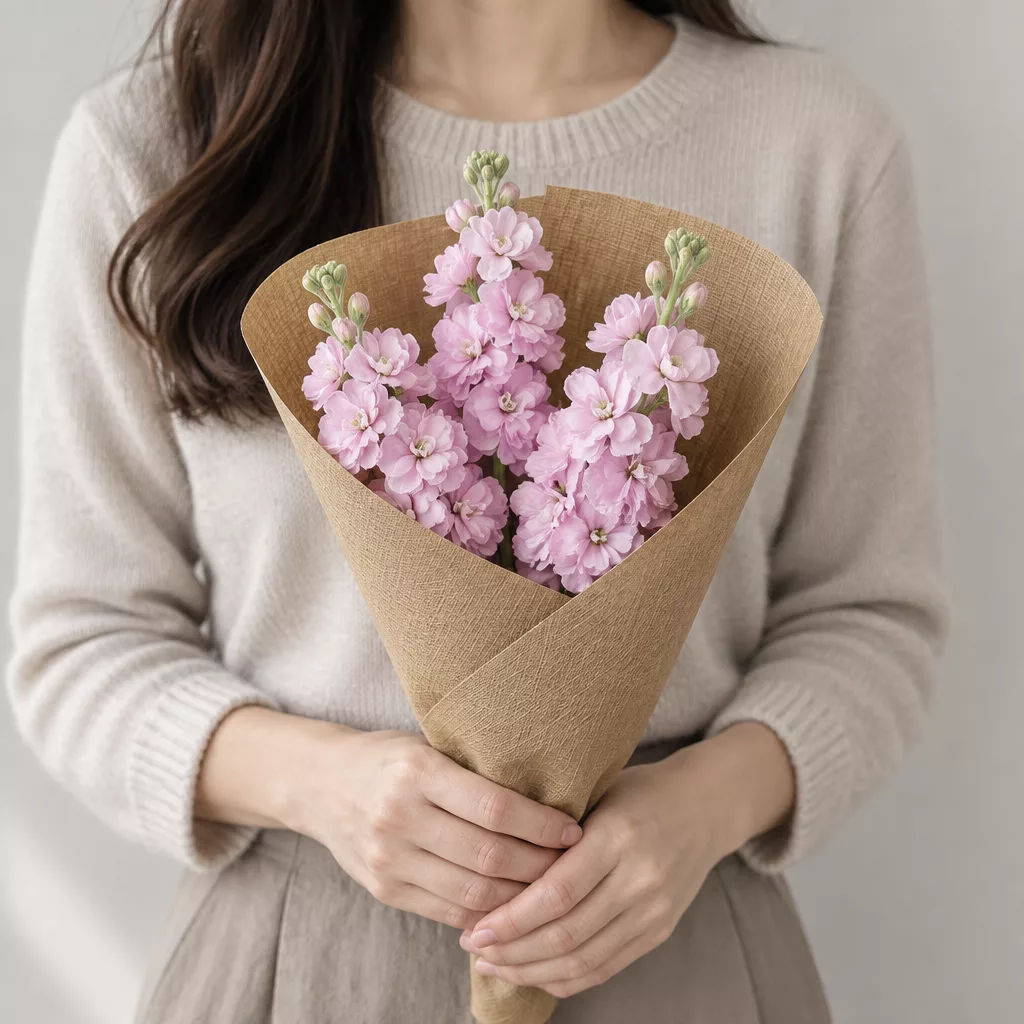
The wrapping colour is worth a thought. Kraft paper with a neutral ribbon reads as contemporary and works for almost any recipient. White wrapping with a white ribbon reads as elegant and slightly formal — appropriate for a senior colleague or a significant anniversary. Bright coloured wrapping suits children's birthdays and casual celebrations. In Russia, presentation is taken seriously; a well-wrapped bouquet signals that the sender did not simply click a button.
If the recipient is celebrating a birthday, Russian custom is to give an odd number of flowers — even numbers are traditionally reserved for funerals. This is worth knowing if you are selecting a specific stem count. Bouquets described simply as small, medium or large will already follow this convention, but if you are requesting a custom number, make it odd.
Finally, consider the timing relative to the recipient's day. A bouquet arriving at nine in the morning on a birthday sets the tone for the whole day. An evening delivery is still welcome but does not carry the same impact. If the person works regular hours, a late-morning arrival — when they are settled and can enjoy the moment — is often the most thoughtful choice.
Fryazino is a city where a well-chosen bouquet arrives quickly, travels a short distance and lands in the hands of someone who will genuinely appreciate the gesture. The logistics are straightforward when you plan around timing, temperature and the small details — a card message, the right colour palette, a vase of cool water waiting at home. The flower itself does the rest.
Frequently asked questions
Can I order flowers for delivery to Fryazino the same day?
Yes, same-day delivery to Fryazino is available for orders placed with enough lead time for assembly and transit. Morning orders are most reliably fulfilled within the one-to-two hour window. On major flower holidays such as March 8, we recommend ordering the evening before to guarantee your preferred time slot.
What if the recipient is not home when the courier arrives?
The courier will call ahead before arrival. If the recipient does not answer, we attempt contact twice and then reach out to the sender. Providing both numbers in your order avoids delays. Flowers cannot be left unattended safely, especially in winter temperatures, so a working contact number is important for every order.
Are there flowers that travel better in winter to Fryazino?
Roses, chrysanthemums and alstroemeria handle cold transit well when properly insulated. Tropical varieties like anthurium and bird-of-paradise are more cold-sensitive and need careful packaging below zero. We use insulated courier bags in winter months, but very delicate open blooms such as anemones are riskier to send in severe frost.
How many flowers should I order for a birthday in Russia?
Russian custom is to give an odd number of stems for celebratory occasions. This applies to counted bouquets — five, seven, eleven, fifteen and so on. Bouquets described by size rather than stem count already follow this convention. If you request a specific number, keep it odd to respect the local tradition.
How long will the flowers last after delivery to Fryazino?
With correct care — fresh water, re-cut stems, a cool spot away from radiators — most bouquets last five to seven days. Alstroemeria and chrysanthemums can reach ten to fourteen days. Roses typically last seven days. The biggest factors shortening vase life are warm rooms, direct sunlight and water that is not changed regularly.
Ready to send flowers?
Pick the city, choose the bouquet, and a local florist takes it from there.
Choose a city →