Sending Flowers to Lytkarino? Here Is What to Expect
Lytkarino sits close enough to Moscow to feel connected to the city, yet it has its own quieter rhythm — residential streets, family homes, the kind of place where a bouquet arriving at the door genuinely surprises someone. If you are ordering flowers for a person who lives or works there, you probably want to know how fast delivery reaches them, what holds up well on the road, and how to choose something that feels right for the moment rather than just filling a box.
Where in Lytkarino We Deliver and How the Route Works
Lytkarino is a compact city in the Moscow Oblast, southeast of the capital, and the entire urban area falls within our delivery zone. That includes the central districts around Ulitsa Lenina, the residential quarters near the Moskva River embankment, and the newer housing developments on the city's edges. We do not rely on drop-off points or third-party couriers — our own driver carries the bouquet directly from the preparation stage to the recipient's address.
The road from central Moscow to Lytkarino runs through the Novoryazanskoe or Egoryevskoe highway corridors depending on traffic. In clear conditions the drive takes roughly forty to fifty minutes. During peak hours — weekday mornings between eight and ten, and evenings between five and eight — we add a buffer to the estimated window so the time we give you is realistic, not optimistic.
When you place an order, you choose a delivery slot rather than a single minute. That slot is typically a two-hour window, and our courier will message the recipient before arriving so nobody is left waiting at the door. If the address is a gated complex or a building with a code entry, leaving that information in the order notes saves everyone time and keeps the flowers from sitting in the cold while someone searches for a contact number.
Bouquets we can deliver



Timing Your Order: Same-Day and Scheduled Delivery
Same-day delivery to Lytkarino is available when you place your order before the early afternoon cutoff — generally before one or two o'clock Moscow time, depending on the current schedule shown at checkout. Orders placed in the morning tend to arrive by midday or early afternoon. Orders placed around noon usually land in the late afternoon slot. This matters when you are planning around a birthday dinner, a work anniversary, or a moment when you know the person will actually be home.
Scheduled delivery is often the smarter choice if you want precision. You can place an order the day before and select a morning slot, which means the flowers are prepared fresh that morning and travel to Lytkarino in the first courier run of the day. Roses and tulips handled this way arrive tighter and last longer than flowers that have been sitting in a refrigerator overnight waiting for a late slot.
One practical note about Russian gift culture: flowers are almost always given in odd numbers — one, three, five, seven stems and so on. Even numbers are traditionally associated with mourning, so a bouquet of ten roses would feel out of place to most Russian recipients even if it looks generous. If you are ordering from abroad or simply did not know this, it is worth keeping in mind. We compose our bouquets with this in mind by default, so you do not need to count stems manually — but it is useful context if you are customising your order.
Choosing Flowers for the Person, Not Just the Occasion
The occasion tells you the register — celebratory, romantic, grateful, affectionate. The person tells you the flowers. A colleague turning fifty will likely appreciate something more composed and long-lasting, like a structured arrangement of spray roses, lisianthus and eucalyptus. A younger friend who just moved into a new flat might love something looser and more colourful — ranunculus in mixed blush tones, or a mixed seasonal bouquet with anemones and freesia that fills the room with scent.
For romantic gestures, red roses remain the clearest signal in Russian culture, and they are understood without explanation. If you want something that feels more personal, garden roses in soft peach or cream read as equally romantic but more considered. Peonies, when in season from late spring through early summer, are almost universally loved and have a lushness that photographs beautifully — relevant if the recipient is likely to share the moment.
For a parent or grandparent, chrysanthemums and gerberas are genuinely popular in Russia and carry no negative associations — they are cheerful, sturdy and last well in a home environment without much fuss. Lilies are another strong choice for older recipients: they open slowly over several days, which means the gift keeps giving rather than peaking and fading overnight. Just note that Asiatic and Oriental lilies have strong pollen that can stain fabric, so a quick mention to the recipient to remove the stamens as the flowers open is a kind detail to include in your card message.
What Travels Well on the Road to Lytkarino
Not every flower handles a forty-minute drive equally. Temperature matters most. In winter, when outdoor temperatures in the Moscow region drop below minus ten or minus fifteen Celsius, delicate open blooms — fully open garden roses, thin-petaled anemones, or tropical varieties like strelitzia — are more vulnerable to cold shock between the car and the front door. We wrap and insulate bouquets for cold weather, but if you are ordering in January or February, choosing flowers that are slightly more closed at dispatch means they arrive in better condition and open beautifully indoors over the following day.
In summer, the risk reverses. Heat above twenty-five degrees accelerates wilting, particularly for tulips, which are sensitive to warmth and ethylene gas from ripening fruit. We keep the car cooled and avoid leaving bouquets in direct sunlight during transit, but it is worth asking the recipient to move tulips away from sunny windowsills and fruit bowls once they arrive.
Roses, alstroemeria, carnations and lisianthus are consistently the most travel-stable options across seasons. They hold their shape, resist bruising and do not drop petals from minor vibration. If you are sending to someone who will not be home immediately and the flowers may wait in a hallway for an hour, these varieties give you the most margin. Hydrangeas are beautiful but thirsty — they should go straight into water and benefit from a cool room rather than a warm kitchen.
Bouquet Sizes, Combinations and Presentation
A single-variety bouquet — twenty-five roses, or fifteen peonies — makes a strong visual statement and is easy to style in a vase at home. Mixed bouquets take more skill to compose well but feel warmer and more personal when done right. The key is working with a colour story rather than mixing every available shade. Warm tones together — apricot roses, yellow ranunculus, rust-coloured gerbera — feel cohesive. Cool tones together — white lisianthus, lavender freesia, pale blue hydrangea — feel elegant and calm.
Greenery and filler matter more than most people realise. Eucalyptus adds scent and longevity. Ruscus gives structure. Wax flower provides texture without competing with the main blooms. A bouquet without any greenery can look heavy and crowded; too much greenery makes it look sparse. The balance is usually around twenty to twenty-five percent foliage by volume.
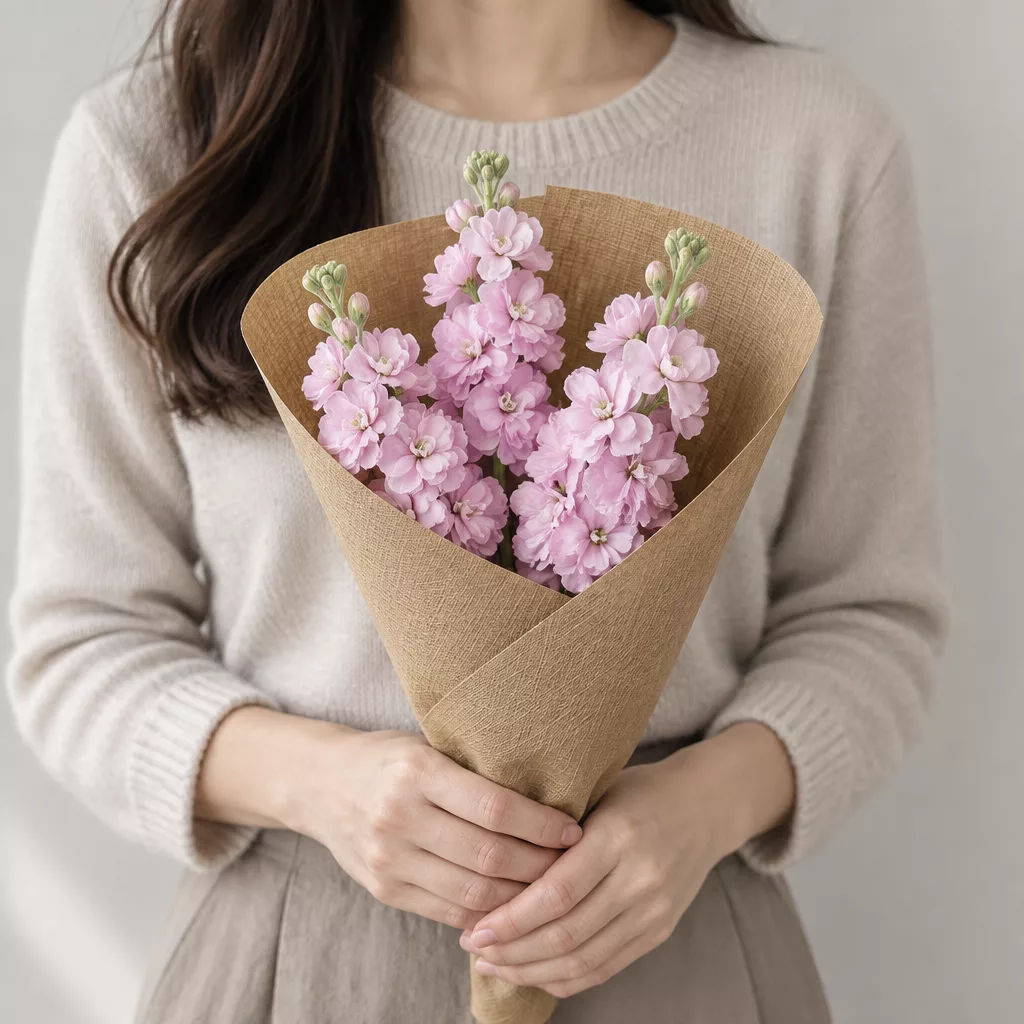
Presentation in Russia often involves wrapping — kraft paper, organza, or a combination — and a ribbon tied at the stems. This is the expected format for a gift bouquet; unwrapped flowers handed over feel more like a market purchase than a gesture. We wrap every bouquet as standard. If you want to add a handwritten card with a message in Russian or English, that option is available at checkout and our team writes it by hand rather than printing it, which makes a difference when someone opens the envelope.
For a particularly generous gift, a hatbox arrangement or a flower box lying flat is a popular format in Russia right now — it photographs well and feels luxurious to receive, especially for milestone birthdays.
Keeping Flowers Fresh After Delivery
The first thirty minutes after a bouquet arrives at home determine a lot of its vase life. The recipient should trim the stems at an angle under running water or while the ends are submerged — cutting at an angle increases the surface area for water uptake, and cutting underwater prevents air bubbles from blocking the stem. A sharp knife is better than scissors, which can crush the tissue. About two centimetres off the bottom is enough.
The vase should be clean and filled with cool, not cold, water. Flower food sachets — the small powder packets we include with every order — contain a mild biocide, a sugar for energy and a pH adjuster. They genuinely extend vase life by several days when used correctly. The sachet goes into the water before the flowers, not after. Change the water every two days and retrim the stems each time.
Placement in the room makes a significant difference. Flowers last longest away from direct sunlight, heating radiators and draughts from open windows. In a Lytkarino apartment in winter, radiators run warm and the air indoors can be quite dry — a position on a cool windowsill away from the heat source, or on a kitchen table away from the stove, works well. Roses typically last seven to ten days with good care. Alstroemeria can reach twelve to fourteen days. Tulips are shorter — five to seven days — but they continue to grow and move in the vase, which makes them interesting to watch. Lisianthus is one of the longest-lasting cut flowers and often goes two weeks without looking tired.
Making the Delivery Feel Personal Across the Distance
Ordering flowers for someone in another city — or from another country — carries a small anxiety: will it feel as thoughtful as handing something over in person? The answer depends on the details you put into the order rather than the gesture itself. A specific flower the person mentioned once, a colour you know they love, a card message that references something private between you — these details travel with the bouquet and arrive alongside it.
If you are ordering from outside Russia and writing a card message, English is fine — our team can write it exactly as you type it. If you would like the message in Russian but are not confident with the language, a simple phrase like 'S dnem rozhdeniya' (Happy Birthday) or 'S lyubovyu' (With love) is easy to include and will feel natural to the recipient. We are happy to help with phrasing if you leave a note in the order comments.
For milestone occasions — a significant birthday, a new baby, a promotion — consider adding something to the bouquet that anchors the memory. A small potted plant alongside the cut flowers means something living remains after the bouquet fades. Succulents and small orchids in pots are popular additions that travel safely and last indefinitely with minimal care.
Lytkarino is not a city that gets a lot of flower deliveries from afar. When one arrives at the door, it tends to stand out. The effort of sending something specific and well-chosen to a quieter city outside Moscow reads as more deliberate than sending to the capital, and that deliberateness is part of the gift.
Lytkarino is easy to reach and the people there receive flowers exactly as warmly as anywhere else — perhaps more so, because it happens less often. The practical side of delivery is straightforward once you know the timing, the seasonal considerations and the small cultural details that make a bouquet feel right rather than just present. Choose for the person first, let the occasion guide the register, and trust that a well-made bouquet handled carefully on the road will arrive looking exactly as it should.
Frequently asked questions
Can I order flowers to Lytkarino for same-day delivery?
Yes, same-day delivery to Lytkarino is available for orders placed before the early afternoon cutoff, usually around one or two o'clock Moscow time. The exact cutoff is shown at checkout. Morning orders typically arrive by midday or early afternoon, while orders placed around noon are usually delivered in the late afternoon slot.
How should the recipient care for the flowers when they arrive?
Trim the stems at an angle under water, place them in a clean vase with cool water and the included flower food sachet, and keep the bouquet away from direct sunlight, radiators and fruit bowls. Change the water every two days and retrim the stems each time. Most roses last seven to ten days with this routine.
What happens if no one is home when the courier arrives in Lytkarino?
Our courier messages the recipient before arriving. If nobody answers, the driver will contact the number provided in the order. We recommend including a backup contact or noting a safe neighbour in the order comments. We do not leave bouquets unattended in cold or warm weather as it damages the flowers.
Is there anything I should know about flower customs in Russia before ordering?
The most important one is the odd-number rule: bouquets are given in odd numbers of stems — one, three, five, seven and so on. Even numbers are associated with mourning and would feel inappropriate to most Russian recipients. Our bouquets follow this convention by default, so you do not need to adjust anything manually.
Which flowers hold up best during winter delivery to Lytkarino?
Roses, alstroemeria, carnations and lisianthus are the most resilient in cold weather. We insulate all bouquets for winter transit, but choosing flowers that are slightly closed at dispatch gives the best results. Fully open blooms and tropical varieties are more sensitive to cold shock between the car and the front door in temperatures below minus ten Celsius.
Ready to send flowers?
Pick the city, choose the bouquet, and a local florist takes it from there.
Choose a city →