Flower Delivery in Urus-Martan: Timing, Choices and What Arrives
You want flowers to reach someone in Urus-Martan and you want them to arrive fresh, on time and looking exactly as you imagined. That is a reasonable thing to want, and it is entirely possible. Distance is the first thing people worry about, but the real question is not how far the city is — it is how the bouquet is handled between the moment you order and the moment your recipient opens the door. This article walks you through every part of that journey so you can order with confidence rather than guesswork.
Where Urus-Martan Sits and Why It Matters for Delivery
Urus-Martan is a city in the Chechen Republic, located roughly 30 kilometres southwest of Grozny in the foothills of the Caucasus. Its position matters for flower delivery because the climate there is noticeably different from central Russia. Summers are hot and dry, winters are mild but can bring sharp frosts, and the transition seasons — spring and autumn — are short and changeable. A bouquet travelling to Urus-Martan in July faces heat stress that the same arrangement would never encounter in Saint Petersburg in the same month. That means packaging, transit time and variety selection all shift depending on when you are ordering.
The city itself is well connected by road to Grozny and to the wider Chechen road network, which makes last-mile delivery reliable once the arrangement has reached the region. The urban layout is straightforward — a central area surrounded by residential neighbourhoods — so address accuracy matters more than navigating a complicated city grid. When you place your order, include the full street name, building number and, if the recipient lives in a multi-storey block, the flat number and entrance code. That single detail prevents the most common delivery delay we see for this destination.
Knowing the geography also helps you choose the right flowers. Sturdy varieties that hold up in warmth — think chrysanthemums, alstroemeria, sturdy spray roses — travel better in summer months. Delicate garden roses or ranunculus need extra care and are better ordered for cooler seasons when temperatures along the route stay below 20 degrees Celsius.
Bouquets we can deliver


Realistic Timing: What One to Two Hours Actually Means Here
The one-to-two-hour delivery window that Turboflora offers across Russia applies to Urus-Martan, but it is worth understanding what that window means in practice. The clock starts from the moment the bouquet is assembled and dispatched — not from the moment you click confirm. Assembly itself takes 20 to 40 minutes depending on the complexity of the arrangement. A simple hand-tied bouquet of roses moves faster than a structured arrangement with foliage, fillers and a decorative wrap. If you are ordering for a specific moment, such as a birthday dinner or an anniversary lunch, build that assembly time into your calculation.
Seasonal demand also affects timing. On the 8th of March — International Women's Day — and on Valentine's Day, volumes across all Russian cities spike dramatically. Urus-Martan is no exception. Ordering 24 to 48 hours ahead on those dates is not overcaution; it is the practical choice that guarantees your preferred varieties are available and your time slot is secured.
For everyday occasions — a spontaneous thank-you, a housewarming, a get-well gesture — same-day ordering works well. Placing your order before noon local time gives the widest choice of flowers and the most comfortable delivery window. Late-evening orders for next-morning delivery are also reliable, and some recipients actually prefer a morning arrival: flowers on the doorstep before the working day begins carry a particular warmth that an afternoon bouquet cannot quite replicate. Plan around the recipient's schedule, not just your own convenience.
Choosing the Right Flowers for the Person and the Occasion
The starting point is never the flower — it is the person receiving it and the feeling you want them to have when they unwrap the bouquet. A young woman celebrating a promotion responds differently to a bold arrangement of deep-red garden roses and burgundy dahlias than she would to a pastel mix of pink carnations. An older relative being congratulated on a milestone anniversary might cherish something more classical: white and cream roses with soft greenery, arranged simply and generously. Think about their home, their personality and the moment before you think about varieties.
For Urus-Martan specifically, a few cultural notes help. Flowers are a widely appreciated gift in Chechen culture, given for birthdays, housewarmings, graduations and celebrations of all kinds. Bright, full arrangements tend to be received warmly — this is not a context where minimal Scandinavian-style single-stem arrangements are the obvious choice. Volume and colour read as generosity, and generosity is valued. Warm tones — coral, orange, red, bright yellow — work particularly well in summer and early autumn. In spring, soft pinks and whites feel fresh and seasonal.
Avoid arrangements that rely heavily on very soft petals in summer months. Garden roses with many petals, peonies and sweet peas are beautiful but fragile in heat above 25 degrees Celsius. Roses with tighter, firmer heads — varieties like Avalanche or Explorer — hold up significantly better. Alstroemeria, statice and waxflower are excellent fillers that add texture without adding fragility. Lisianthus is a reliable mid-range flower that looks luxurious and travels well across most seasons.
Bouquets by Budget: Thinking in Layers, Not Just Stems
Budget conversations about flowers often get stuck on stem counts, but that is the wrong frame. A bouquet of 25 single-variety stems in one strong colour can look more impressive and feel more intentional than a mixed arrangement of 40 stems with no clear direction. When you are working with a modest budget, simplicity and confidence in variety choice create more impact than trying to fill every price point with maximum quantity.
At the entry level, a clean hand-tied bouquet of spray roses or alstroemeria in a single colour family — all corals, or all whites, or a mix of creams and soft yellows — delivers well. Add a sprig of eucalyptus or ruscus and the arrangement looks complete without requiring expensive statement flowers. The presentation wrap matters enormously here: kraft paper with a wide satin ribbon elevates even a simple bunch.
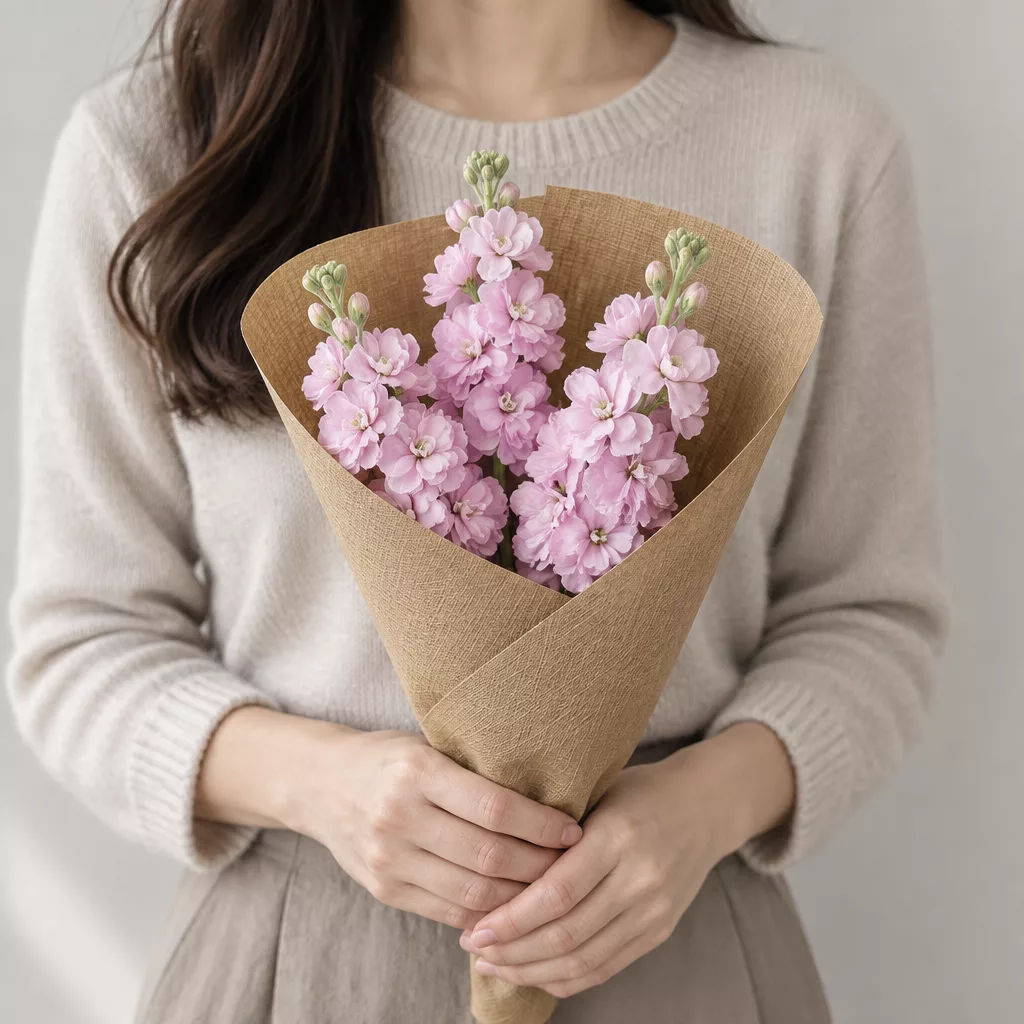
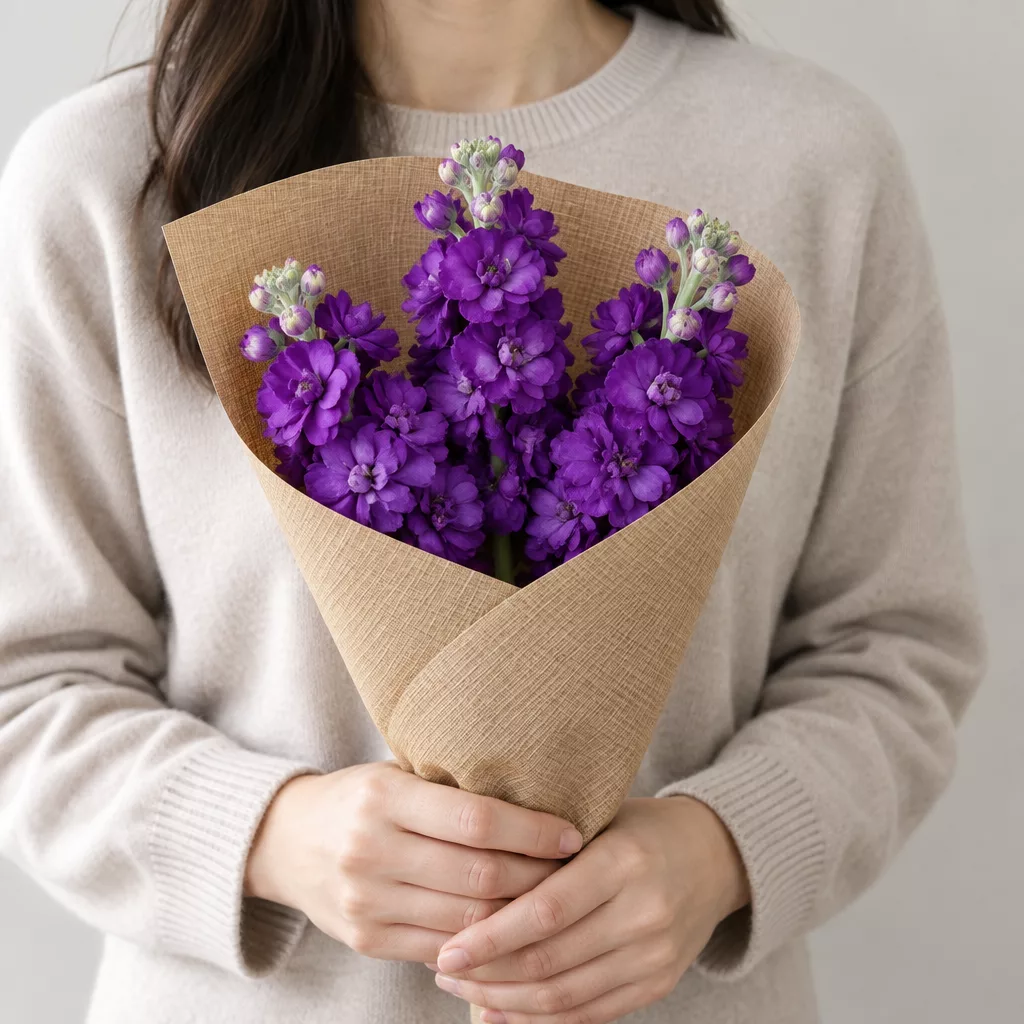
Moving up in budget, you introduce a statement flower. A central cluster of garden roses or large-headed standard roses surrounded by a supporting cast of lisianthus, matthiola and greenery creates a bouquet that photographs beautifully and fills a room with fragrance. Matthiola — stock flower — has a strong sweet scent and adds height and softness at the same time.
At the top of the range, think in terms of composition rather than just ingredients. Combine textures deliberately: the smooth roundness of roses against the ruffled edges of ranunculus, the fine spray of gypsophila against bold dahlia heads. A well-composed premium bouquet tells a story from every angle, and that is what makes it memorable long after the flowers have been unwrapped.
Packaging That Protects Flowers Across a Long Journey
Packaging for long-distance delivery is not decorative — it is functional first. Flowers arriving in Urus-Martan have typically travelled a significant distance, which means the packaging must maintain humidity around the stems, protect petals from mechanical damage and insulate the arrangement against temperature swings. A bouquet that looks beautiful in a florist's cold room can arrive limp and bruised if the packaging is not designed for transit.
The stems of cut flowers need moisture throughout the journey. Water tubes — small plastic vials that clip onto individual stems — are the most reliable solution for single stems or small clusters. For larger arrangements, a damp foam base wrapped in moisture-retaining material keeps stems hydrated for up to 12 hours without leaking. This matters particularly for roses, which are prone to wilting from the base of the stem upward if they lose access to water during transit.
Temperature management is the second challenge. In summer, arrangements are packed with cooling inserts that absorb ambient heat and keep the interior of the package several degrees cooler than the outside air. In winter, insulating wrap prevents frost damage to petals, which can turn translucent and collapse within minutes of exposure to temperatures below minus 5 degrees Celsius. Tulips and gerberas are particularly vulnerable to cold; roses and chrysanthemums tolerate brief cold exposure better.
The outer packaging also signals care to the recipient. A well-finished box or a neatly wrapped kraft paper bundle with a personalised card attached tells the person at the door that thought went into this — before they have even seen the flowers inside.
What to Tell the Recipient Before the Flowers Arrive
A small amount of preparation on the recipient's side makes a significant difference to how long the flowers last. You do not need to send a detailed instruction manual — a short message saying flowers are on their way and will need a vase with fresh water is enough. Most people know the basics, but a gentle prompt prevents the common situation where a beautiful bouquet sits in its packaging for three hours while the recipient is out, or sits on a warm surface without water because no vase was ready.
If the delivery is a surprise, consider whether the recipient will definitely be home. An unattended doorstep in summer heat can ruin even the best-packaged arrangement within an hour or two. For surprise deliveries, it often works better to coordinate with a family member or neighbour who can take the flowers in and place them in water. Alternatively, schedule the delivery for a time when you know the recipient is at home — early evening after work, or mid-morning on a weekend.
For recipients who are less familiar with caring for cut flowers, a brief verbal tip goes a long way: cut the stems at an angle under running water before placing them in the vase, use cool water rather than warm, keep the vase away from direct sunlight and from fruit bowls (ripening fruit releases ethylene gas, which accelerates petal drop). These four steps alone can add three to five days to the vase life of most common varieties. Roses and alstroemeria that might otherwise last five days can comfortably reach eight to ten days with this basic care.
Vase Life, Care and Making the Moment Last Longer
The flowers arrive, the recipient is delighted, and the bouquet goes into a vase. What happens next determines whether that moment lasts three days or ten. Vase life varies considerably by variety, and knowing which flowers in the arrangement are the longest and shortest lived helps the recipient get the most from the whole bunch.
Chrysanthemums are the endurance champions of cut flowers, routinely lasting 14 days or more with basic care. Alstroemeria follows closely, often reaching 10 to 14 days. Standard roses, when properly cared for, give a reliable 7 to 10 days. Gerberas are beautiful but shorter-lived, typically 5 to 7 days. Ranunculus and sweet peas are the most fleeting, often peaking at 4 to 5 days — which is why they are best used as accent flowers in a mixed arrangement rather than as the primary stem.
Water should be changed every two days, and the vase rinsed to prevent bacterial buildup. Each time the water is changed, trim another centimetre from the bottom of each stem at a 45-degree angle — this reopens the water-uptake channel that begins to seal after the first cut. Remove any leaves that fall below the waterline, as submerged foliage rots quickly and introduces bacteria that shorten the life of every other stem in the vase.
Keep the arrangement away from heating vents, radiators and windowsills with direct afternoon sun. A cool room — ideally between 16 and 20 degrees Celsius — is the single most effective thing a recipient can do to extend vase life. In Urus-Martan's warm summers, placing the vase in the coolest room of the home overnight makes a noticeable difference by morning.
Sending flowers to Urus-Martan is a straightforward and rewarding thing to do when you understand what the journey involves. Choose varieties suited to the season, give a complete address, build in time for assembly on busy dates and let the recipient know to have a vase ready. The distance between Saint Petersburg and the Chechen foothills is real, but it does not stand between a thoughtful person and the person they want to make smile. The flowers arrive fresh, the moment lands the way you imagined it, and the care that went into the choice shows — which is the whole point of sending flowers in the first place.
Frequently asked questions
Can I order flowers for same-day delivery to Urus-Martan?
Yes, same-day delivery is available for orders placed before noon. For specific time slots later in the day, placing your order a few hours ahead gives us time to assemble the arrangement and dispatch it within the delivery window. On major flower-giving dates like March 8th, ordering the day before is strongly recommended to secure your preferred varieties and timing.
Which flowers travel best to Urus-Martan in summer?
In summer heat, choose firm-headed roses such as Avalanche or Explorer, alstroemeria, chrysanthemums and lisianthus. These varieties tolerate warmth during transit without wilting. Avoid peonies, ranunculus and garden roses with many soft petals when temperatures exceed 25 degrees Celsius, as they are significantly more fragile and may arrive with bruised or drooping petals despite careful packaging.
What information do I need to provide for a successful delivery?
Provide the full street name, building number, flat number and any entrance code or intercom number. A working phone number for the recipient is also essential so the courier can confirm arrival. If the delivery is a surprise and you prefer the courier not to call ahead, note that in your order comments so we can handle the final approach discreetly.
Are large, colourful arrangements appropriate for Urus-Martan recipients?
Absolutely. Generous, vibrant arrangements are warmly received in Chechen culture, where flowers given as gifts tend to read as a gesture of respect and celebration. Bright warm tones — coral, orange, red, rich yellow — work especially well for birthdays and housewarmings. Full, voluminous bouquets are generally preferred over minimal single-stem styles for most celebratory occasions.
How do I help the recipient keep the flowers fresh for as long as possible?
Let them know to cut the stems at an angle under running water before placing them in a clean vase filled with cool water. Change the water every two days and trim the stems slightly each time. Keep the arrangement away from direct sunlight, heating vents and fruit bowls. A cool room between 16 and 20 degrees Celsius is the single most effective way to extend vase life noticeably.
Ready to send flowers?
Pick the city, choose the bouquet, and a local florist takes it from there.
Choose a city →