Sending Flowers to Usolie-Sibirskoye? Here Is What to Expect
Usolie-Sibirskoye sits on the Angara River in Irkutsk Oblast, far enough from Moscow that most people assume fresh flowers are simply out of reach. They are not. Whether you are marking a birthday from across the country or surprising someone who lives there full-time, a well-chosen bouquet can arrive fresh, fragrant and exactly on time — if you know what to plan for.
Where in Usolie-Sibirskoye We Deliver and Why the Geography Matters
Usolie-Sibirskoye is a compact city, which works in your favour. The central districts, residential mikrorayons along Ulitsa Lenina and the neighbourhoods closer to the Angara embankment are all reachable without the long cross-town drives that slow delivery in sprawling cities. Industrial zones on the outskirts take a little longer, so if you are sending to an address near the old chemical plant area or the far northern edge of town, it is worth adding a small buffer when you choose your delivery window.
The city's relatively tight street grid means a courier who knows the area can move efficiently. Unlike delivery in a rural settlement where the final kilometre is unpaved track, Usolie-Sibirskoye has solid road infrastructure through its main arteries. That matters in winter when side roads ice over — the main routes stay passable even in hard Siberian frost.
One thing to keep in mind: apartment buildings here often have intercom systems that require a code or a call-up. Always include the full address with the apartment number, floor and intercom code if there is one. A courier standing outside a locked entrance with a bouquet of spray roses is not the surprise anyone planned. A complete address saves the moment and keeps the flowers at their best.
Bouquets we can deliver

Timing Your Order: Delivery Windows and What Affects Them
Turboflora works on a one-to-two-hour delivery promise, and in Usolie-Sibirskoye that window holds for the majority of addresses during standard hours. The city operates on Irkutsk time, which is UTC plus eight — five hours ahead of Moscow. This is the single most important detail for anyone ordering from European Russia. When it is noon in Saint Petersburg, it is already five in the evening in Usolie-Sibirskoye. Place your order with that gap in mind or you will schedule a delivery for a time when your recipient is already asleep.
Peak demand days — the eighth of March, Valentine's Day, the first of September — compress courier availability everywhere in Russia. On those dates, ordering the evening before is genuinely the smarter move. A bouquet of Dutch tulips or garden roses assembled and dispatched early in the morning arrives in perfect condition; a last-minute order on a high-traffic day risks a later slot.
Weather in Usolie-Sibirskoye is serious. January temperatures regularly fall below minus twenty-five Celsius. Couriers use insulated packaging on cold days, but a bouquet left on an unheated stairwell landing for even fifteen minutes can suffer frost damage on the outer petals. Ask the recipient to be available to open the door, or leave a note in the order to call ahead. A small logistical detail like that protects the whole gesture.
Choosing the Right Bouquet for the Person and the Occasion
Start with the recipient, not the flower. A woman in her sixties who tends a dacha garden will likely appreciate something that feels grown rather than manufactured — garden roses, lisianthus, or a mixed seasonal arrangement with texture and scent. A younger colleague celebrating a promotion responds well to something graphic and contemporary: monobouquets of calla lilies, anthuriums or bold sunflowers make a statement without needing explanation.
For romantic occasions, red roses remain the clearest signal in Russian culture — there is no ambiguity in a dozen long-stemmed red roses, and that clarity is sometimes exactly what you want. But if the relationship is newer or you prefer something warmer and less formal, a peony-and-ranunculus combination in blush and cream reads as thoughtful rather than declarative. Peonies are seasonal from late spring through early summer; outside that window, garden roses give a similar lush, layered look.
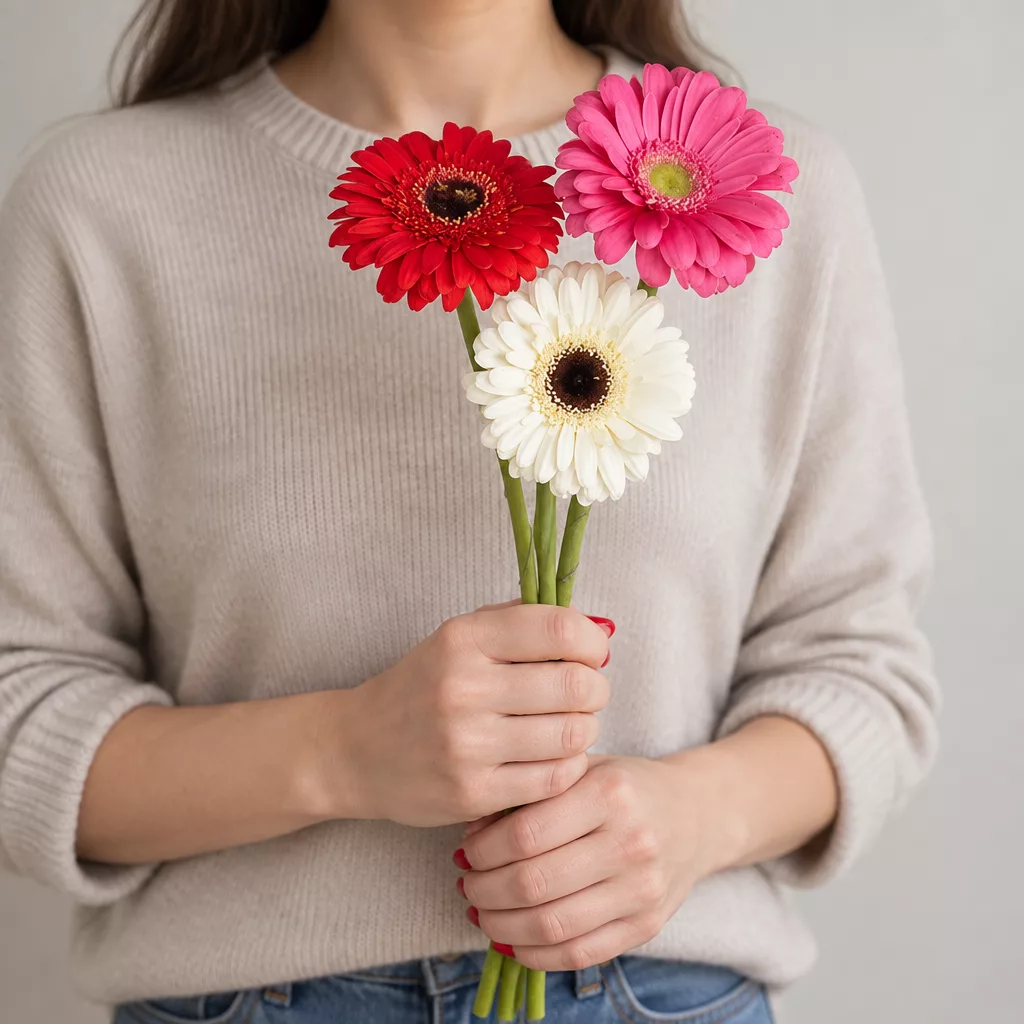
For children's birthdays or school celebrations, bright and cheerful wins over elegant. Gerbera daisies in mixed colours, solidago for yellow warmth, and a few stems of statice for texture create a bouquet that photographs well and makes a child genuinely excited rather than politely appreciative. In Russian custom, bouquets are traditionally given in odd numbers — three, five, seven, eleven — so a bunch of five gerberas already follows the local etiquette without you having to think about it. Explain this to anyone unfamiliar with Russian tradition and they will feel more confident in their choice.
Budget Ranges: What Different Price Points Actually Look Like
A modest budget does not mean a thin or apologetic bouquet. Three to five stems of quality spray roses with eucalyptus and a single focal flower — a garden rose or a protea bud — can look considered and generous. The key is proportion: a tight, well-wrapped hand-tied arrangement in a kraft sleeve reads as intentional, while the same budget spread across too many mediocre stems looks sparse. Florists call this the density principle, and it applies at every price point.
A mid-range order opens up combinations. You can mix textures — for example, velvet-petalled ranunculus alongside waxy tulips and feathery astilbe — and add a complementary greenery layer of ruscus or pittosporum. This is where bouquets start to feel genuinely curated rather than assembled. For a birthday or anniversary, this tier gives you enough material to make the bouquet feel like it was designed for that specific person.
At a higher budget, you gain access to premium focal flowers: David Austin garden roses with their quartered bloom and strong fragrance, large-headed peonies in season, or imported orchid stems. These are flowers that hold their visual weight even in a large arrangement. A bouquet built around two or three premium stems surrounded by complementary material — lisianthus, sweet peas, soft greenery — will photograph beautifully and last well if the recipient follows basic care steps. The presentation matters too: a quality ribbon, a handwritten card and thoughtful wrapping elevate any tier.
Siberian Climate and What It Means for Flower Freshness
Usolie-Sibirskoye has one of the more demanding climates in Russia for fresh flowers. Winters are long and genuinely cold; summers are short but can be surprisingly warm, with July temperatures reaching the mid-twenties Celsius. Both extremes create challenges that a florist needs to plan around, and that you as a sender should understand.
In winter, the risk is frost damage during transit. Outer petals of roses and tulips are the most vulnerable — they bruise at temperatures below minus five and blacken quickly if exposed. Proper insulated packaging and a short transit window are the main defences. Flowers should move from a climate-controlled vehicle to a warm interior as quickly as possible. This is another reason why having the recipient available to receive the bouquet matters so much in cold months.
In summer, the challenge reverses. Heat accelerates the opening of buds and shortens vase life. A bouquet of tulips that would last eight days in a cool apartment in April might open fully within two days in a warm room in July. Chrysanthemums, alstroemeria and carnations handle summer heat better than tulips or anemones. If you are ordering in warm months and want longevity, lean toward those hardier varieties. Advise the recipient to keep the vase away from direct sunlight and out of rooms that get very warm in the afternoon — a small piece of advice that doubles the life of the flowers.
Vase Life and Care: Advice Worth Passing On
The bouquet arrives and the moment is perfect. What happens next determines whether the flowers last three days or ten. Most recipients in Russia know to put flowers in water immediately, but the details beyond that are less widely understood — and sharing them makes you look thoughtful rather than pedantic.
The single most important step is a clean diagonal cut on each stem, made with a sharp knife rather than scissors. Scissors crush the vascular tissue and reduce water uptake. A diagonal cut increases the surface area. Do this under running water or immediately before placing stems in the vase to prevent air bubbles from blocking the stem. Remove any leaves that would sit below the waterline — they decompose quickly and cloud the water, creating bacteria that shorten the life of every stem in the arrangement.
Change the water every two days and re-cut the stems each time. Keep the vase away from radiators, which are running hard through the long Siberian winter, and away from fruit bowls — ripening fruit releases ethylene gas, which accelerates petal drop in roses and tulips. A cool room and indirect light are the best environment.
Different varieties have different natural lifespans. Chrysanthemums and alstroemeria regularly last two weeks with good care. Spray roses give you seven to ten days. Tulips are shorter — five to seven days — but they continue to grow and move in the vase in a way that many people find beautiful. Knowing these differences helps the recipient appreciate each stage rather than feeling disappointed when the first stems begin to fade.
Making the Delivery Feel Personal: Cards, Timing and Small Details
A bouquet without a card is a guessing game for the recipient. In Russian culture, flowers are often given in person with the emotion visible on the giver's face — a remote delivery has to carry that weight through the written word instead. A handwritten card, even a short one, transforms the gesture. Three sentences that are specific and honest land better than a long generic message: mention a shared memory, use the person's name, say plainly why you chose today to send flowers.
Timing the delivery to a specific moment adds another layer. Flowers arriving at the start of a birthday morning feel different from an afternoon delivery. If the recipient has a lunch break at a known time or finishes work at a predictable hour, scheduling around that moment turns a nice gesture into a genuinely memorable one. For a surprise to work, the element of unexpectedness has to be protected — do not hint too broadly in advance.
If you are sending from outside Russia and are unfamiliar with local customs, a few things are worth knowing. Flowers are a completely appropriate gift for men in Russia, particularly on professional occasions or significant birthdays — this surprises some Western senders but is entirely normal here. Yellow flowers carry no negative meaning in Usolie-Sibirskoye or anywhere in Siberia, despite a persistent myth that they signal bad luck — that association is regional and fading. A bright yellow mimosa or sunflower arrangement is a cheerful, well-received choice. The odd-number rule for stems is the one tradition that genuinely holds across all of Russia, so keep that in mind when you build or describe your order.
Sending flowers to Usolie-Sibirskoye from anywhere in Russia is entirely workable when you plan around the time zone, the season and the recipient's schedule. The city is well-served, the roads are solid, and a bouquet chosen with the person in mind — rather than just the occasion — will land with the warmth you intended. Get the address right, include a real card, and let the flowers do the rest.
Frequently asked questions
How far in advance should I place an order for delivery in Usolie-Sibirskoye?
For a standard day, two to three hours ahead is usually enough. On major flower-giving dates like the eighth of March or Valentine's Day, ordering the evening before gives you the best choice of varieties and a guaranteed morning delivery slot. Usolie-Sibirskoye is five hours ahead of Moscow, so always convert the time before you book.
Which flowers hold up best in Usolie-Sibirskoye's cold winters?
Chrysanthemums, alstroemeria and carnations are the most cold-tolerant in transit. Roses and tulips are more vulnerable to frost on outer petals. We use insulated packaging on cold days, but having the recipient ready to receive the bouquet at the door — rather than leaving it in an unheated stairwell — makes the biggest practical difference to freshness.
Is it true that yellow flowers are bad luck in Russia?
This belief is regional and much less common than it once was. In Siberia, including Usolie-Sibirskoye, yellow flowers — sunflowers, mimosa, yellow roses — are given and received without negative associations. If you love the colour or it suits the recipient's taste, order with confidence. The odd-number-of-stems tradition is the custom that genuinely holds everywhere.
Can I send flowers to a man in Usolie-Sibirskoye without it seeming unusual?
Absolutely. Flowers for men are a normal and respected gesture in Russian culture, especially for significant birthdays, professional achievements or expressions of gratitude. A structured bouquet of sunflowers, tropical foliage or a bold monobouquet of anthuriums tends to suit the occasion well. There is no social awkwardness in the gesture.
What should I do if the recipient is not home at the time of delivery?
Include a phone number for the recipient in your order so the courier can call ahead. If the person is temporarily unavailable, we can attempt redelivery or leave the bouquet with a trusted neighbour if the recipient agrees. Flowers should never sit in a cold stairwell in winter — coordinating a five-minute heads-up call prevents the most common delivery complications.
Ready to send flowers?
Pick the city, choose the bouquet, and a local florist takes it from there.
Choose a city →