What Flowers to Give a Female Colleague in Russia
You want her to feel genuinely appreciated, not handed something that looks like an afterthought from the corridor vending machine. Giving flowers to a female colleague in Russia carries its own quiet set of expectations — warm enough to mean something, composed enough not to raise eyebrows in a shared office. Get the combination right and a bouquet says exactly what you intended: respect, affection, and good taste all at once.
What the Workplace Setting Changes About Your Choice
In Russia, flowers are a deeply normal part of professional life. Women receive them from colleagues on birthdays, on International Women's Day in March, at farewells, and after a promotion. The gesture is expected and welcomed, which means the pressure is less about whether to give flowers and more about giving the right ones for the setting.
The office context calls for restraint in a specific way. This is not about choosing something bland — it is about avoiding flowers that read as intensely romantic. Deep red roses in a tight dozen, for example, carry a very clear romantic signal in Russian culture and can create awkward moments for the recipient at her desk. The same roses in a mixed arrangement with white spray roses, eucalyptus, and soft greenery shift the meaning entirely toward warmth and celebration.
Scale matters too. A bouquet that is enormous and theatrical works beautifully at a birthday party but can feel overwhelming in a small open-plan office where she still has four hours of meetings ahead. Aim for something she can stand in a vase on her desk without it blocking her monitor or becoming the main character of the room. A well-constructed medium bouquet of nine to fifteen stems, thoughtfully wrapped, lands with more elegance than an oversized arrangement that she cannot carry on the metro home. Think about her whole day, not just the moment you hand it over.
Bouquets we can deliver

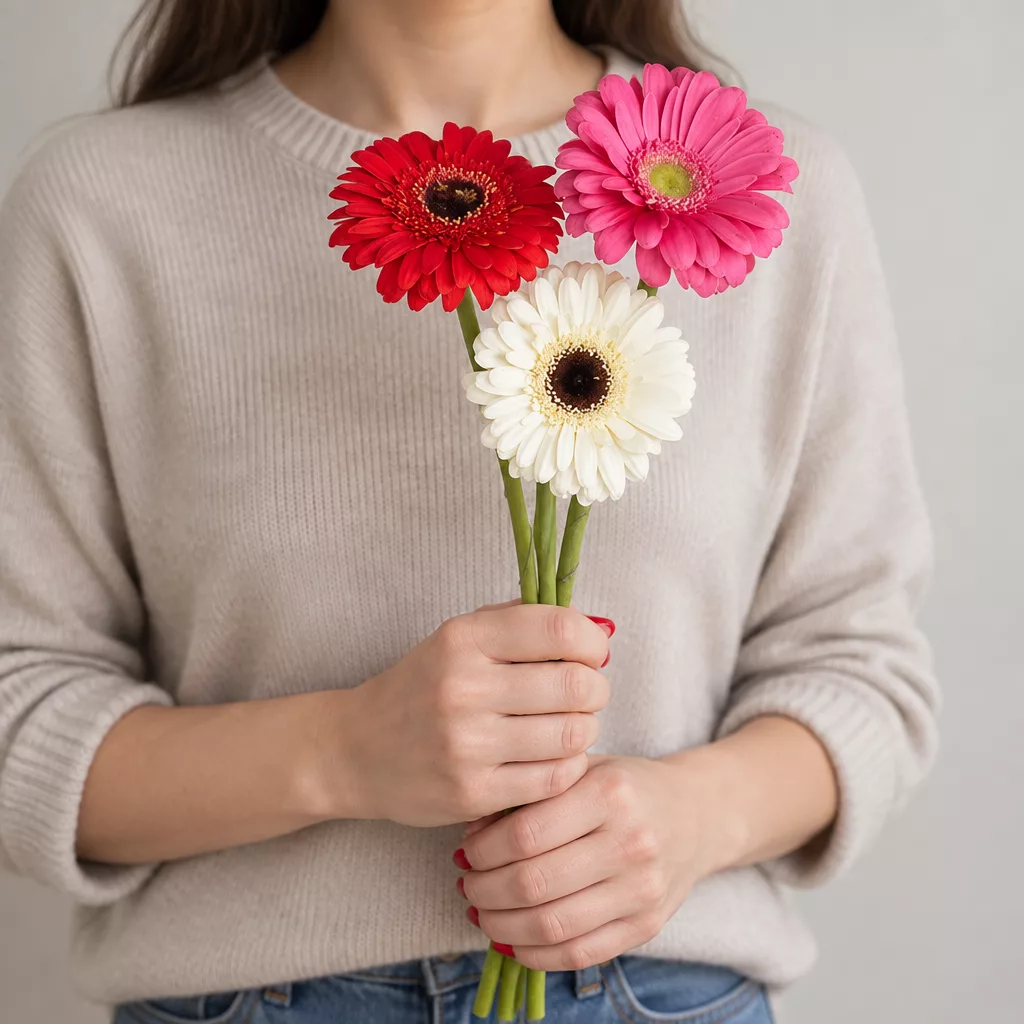


Birthdays: Cheerful, Personal, and Easy to Carry Home
A birthday bouquet for a colleague should feel festive without being loud. Alstroemeria is one of the best choices here: it comes in soft peach, lilac, cream, and warm pink, it lasts remarkably well even out of water for a few hours, and it signals celebration without any romantic weight. Pair it with white or blush lisianthus, which has the lush ruffled look of a peony but holds up beautifully at room temperature, and you have something that feels considered rather than grabbed off a shelf.
If you know she loves flowers and wants something more memorable, a small arrangement built around garden roses — varieties like Juliet or Keira in apricot and dusty rose tones — with ranunculus and eucalyptus gives a soft, romantic-but-not-directed feel that reads as genuinely luxurious. Garden roses have a layered, open bloom that photographs well and fills a room with a gentle fragrance, which colleagues tend to appreciate rather than find intrusive.
For a group gift where several colleagues contribute, a slightly larger mixed bouquet works well because it does not look like one person's romantic gesture — it looks like a team celebration. Ask for seasonal flowers in a palette rather than a single variety. In late winter and spring, tulips in cream or soft violet are a reliable, cheerful choice that most Russian women associate with warmth and the arrival of better weather. In summer, sunflowers mixed with white cosmos create a light, outdoor feeling that suits a birthday perfectly. Always choose an odd number of stems — even numbers are reserved for mourning in Russian tradition.
Promotions: Something That Says Achievement, Not Just Pretty
A promotion is a moment of professional pride, and the bouquet should echo that. This is the occasion where you can go slightly more architectural in the arrangement — something with structure and a sense of occasion rather than a soft, loose garden style. White or cream flowers carry particular weight here because they read as clean, elegant, and serious in the best sense. White calla lilies paired with ivory spray roses and dark green ruscus create a bouquet that looks genuinely impressive without veering into funeral territory, especially when wrapped in kraft paper or a warm ivory sleeve.
Anemonies with their dark centers and bold petals in white or deep burgundy are another strong choice for a promotion gift. They have a graphic quality that feels modern and intentional, and they stand out in a way that marks the occasion as significant. If you want to add color without losing the sense of occasion, dusty blue or deep violet tones — thistles, scabiosa, or veronica — add depth while keeping the palette sophisticated.
Avoid anything that looks too sweet or girlish for this moment. Pastel pink carnations or a bouquet that reads as a standard birthday arrangement can accidentally undersell what she has achieved. The bouquet is a small mirror of how you see her professionally. A clean, well-structured arrangement with a few high-quality stems and good foliage says you took her success seriously. If you are ordering for delivery to the office, specify that the bouquet should be wrapped to travel well and arrive looking composed — presentation on arrival matters as much as the flowers themselves.
Farewells: Flowers That Carry a Memory
A farewell bouquet is the one that she will photograph, post, and remember. It is the last impression the team leaves, and it deserves a little more thought than a birthday arrangement. The emotional register here is bittersweet — warm, celebratory of what has been, and genuinely affectionate. This is where you can be a little more generous with scent and texture.
Freesia is an underused choice for farewell bouquets and it is worth knowing about. It has a clean, sweet fragrance that is not heavy, it comes in white, yellow, soft pink, and lilac, and it gives a bouquet a lightness that suits the mood of a send-off. Combined with garden roses and a trailing element like ivy or eucalyptus, it creates something that feels personal and a little poetic without being theatrical.
If the colleague is someone the team has known for many years, a larger mixed bouquet with several flower types — roses, lisianthus, freesia, and perhaps a few stems of ornamental grass for texture — reads as a collective memory rather than a single note. Colors can be warmer here: peach, soft coral, cream, and warm yellow all work together and feel generous rather than sentimental.
One practical note: if she is traveling far or moving cities, consider asking for a bouquet built around flowers that travel well. Alstroemeria, spray roses, and chrysanthemums all last longer out of water than more delicate blooms like ranunculus or anemones. She should be able to get them home and into a vase without finding half the petals on her suitcase.
Budget Tiers: What You Get at Each Level
Flowers for a colleague do not need to be expensive to feel meaningful, but it helps to know what is realistic at each level so you can set expectations before you order.
At a modest budget, the strongest strategy is to choose one or two varieties in abundance rather than many varieties in small numbers. A bouquet of fifteen alstroemeria stems in two complementary colors — say, peach and cream — with simple greenery looks intentional and full. Spray roses work the same way: they have multiple blooms per stem, so a relatively small number of stems creates visual richness. Avoid mixing too many different flowers at this budget level because the arrangement can start to look scattered.
At a mid-range budget, you can introduce a focal flower. A few stems of garden roses or lisianthus surrounded by supporting flowers and foliage creates a bouquet that has a clear center of gravity and feels genuinely luxurious. This is the level at which most office birthday bouquets land when a small group contributes together, and it is a comfortable, reliable choice.
At a higher budget, the difference is usually in the focal flowers themselves — peonies in season, garden roses in named varieties, or orchid stems — and in the finishing. A bouquet with a clean, elegant wrap, a ribbon, and a card holder looks like a complete gift rather than just flowers. For a farewell or a significant promotion, this level of presentation adds to the sense of occasion. The recipient notices the care in how it was put together, not just what is inside.
Colors and Numbers: The Russian Customs Worth Knowing
If you are unfamiliar with Russian gifting customs around flowers, two rules will save you from an awkward moment. First, always give an odd number of stems. Even numbers — two, four, six, eight — are associated with mourning and funerals in Russian tradition. This is widely observed and genuinely matters to many recipients. Odd numbers signal celebration and goodwill. Nine, eleven, and fifteen are all comfortable, natural-looking counts for a workplace bouquet.
Second, be thoughtful with pure yellow flowers given alone. Yellow has some association with separation and bad luck in Russian folk tradition, though this is softening among younger generations in cities. Yellow flowers mixed with other colors — white, peach, or green — carry no such association and are perfectly appropriate. A bouquet of yellow and white freesia, for example, reads as cheerful and spring-like. A single-color yellow arrangement might catch an older colleague off guard.
Red deserves its own note. A single red rose or a few red roses mixed into a larger arrangement are fine and read as warm. A full bouquet of red roses — particularly twelve, which is the most iconic romantic number — sends a clear romantic signal. In an office context, that is almost always the wrong message. If you want to use red, use it as an accent within a mixed palette.
White flowers are not associated with mourning in the Russian context the way they sometimes are in other cultures. White roses, white lisianthus, and white calla lilies are all entirely appropriate for celebratory occasions and are often seen as elegant and sophisticated rather than somber.
Keeping the Bouquet Fresh Until It Gets Home
An office is not an ideal environment for cut flowers. The combination of central heating, air conditioning, and low humidity can shorten the life of a bouquet significantly, and in Russian winters, the journey from florist to office and then from office to home involves real cold exposure. Knowing this helps you choose and advise well.
When a bouquet arrives at the office, the best thing the recipient can do is unwrap it and put it straight into water if a vase is available. Even a large mug or a water bottle with the top cut off works. Flowers that have been out of water for more than two hours will benefit from having the stems cut at an angle before they go in — this reopens the uptake channel and helps them drink immediately.
In terms of vase life, alstroemeria typically lasts ten to fourteen days with fresh water every two days. Spray roses last seven to ten days. Lisianthus and chrysanthemums are similarly long-lasting. Ranunculus, anemones, and tulips are shorter-lived but no less beautiful — they simply need more attention and cooler conditions. If the recipient has a warm office, steer toward the hardier varieties.
One common mistake is placing the bouquet near a radiator or in direct sunlight from a window, both of which accelerate wilting. A spot on a desk away from the heat source, with indirect light, is ideal. In very cold weather, the bouquet should not be left near a window overnight. A little practical advice passed along with the flowers shows that the gift was given with genuine thought.
Giving flowers to a female colleague in Russia is one of the warmer gestures professional life offers, and it lands best when the choice reflects the occasion rather than just the habit of giving something. A birthday calls for cheerfulness and ease of transport. A promotion deserves structure and a sense of achievement. A farewell earns something personal and memorable. Get the number right, choose colors that suit the moment, and think about her whole day — the meeting after, the commute home, the vase she will find for it. When all of that comes together, a bouquet is not just a nice thing. It is a small, lasting impression of the people she worked alongside.
Frequently asked questions
Is it appropriate to give flowers to a female colleague in a Russian office?
Absolutely. Flowers are a normal and warmly received gesture in Russian professional culture. Colleagues give them for birthdays, International Women's Day, promotions, and farewells without any awkwardness. The key is choosing an arrangement that reads as celebratory and warm rather than romantic, which mostly comes down to flower choice and color palette.
Why do Russian people give an odd number of flowers?
In Russian tradition, even numbers of flowers are associated with funerals and mourning. Giving an odd number — seven, nine, eleven, fifteen — signals celebration and goodwill. This convention is widely observed across generations and regions, so it is worth following even if the recipient seems very modern. It is a small detail that many people genuinely notice.
Can I give yellow flowers to a Russian colleague?
Yellow flowers mixed with other colors are perfectly fine and carry no negative meaning. A single-color yellow bouquet has some association with separation in older Russian folk tradition, which is worth knowing if your colleague is from an older generation or a more traditional background. When in doubt, combine yellow with white or peach tones.
What flowers last longest in a warm office environment?
Alstroemeria, spray roses, chrysanthemums, and lisianthus are the most reliable choices for an office setting. They tolerate central heating and low humidity better than more delicate flowers like ranunculus, anemones, or garden roses. If the bouquet needs to travel home afterward, these varieties also handle time out of water more gracefully than most.
How far in advance should I order a bouquet for office delivery?
For a specific delivery time — say, before a morning meeting or a lunchtime celebration — ordering the evening before or first thing in the morning gives the best result. Turboflora delivers across Russia within one to two hours, so same-day orders are handled regularly. For large group orders or unusual arrangements, a day's notice helps ensure everything is prepared exactly as requested.
Ready to send flowers?
Pick the city, choose the bouquet, and a local florist takes it from there.
Choose a city →