Gerbera Daisies in Russia: Bright, Affordable and Year-Round
Walk into almost any Russian flower shop in January or July and you will find gerberas waiting for you — bold, cheerful and priced so that a generous bunch does not require a second thought. They are one of the few flowers that genuinely deliver colour in every season, which makes them a reliable choice whether you are sending a birthday surprise to a colleague in Saint Petersburg or brightening a friend's kitchen table on an ordinary Tuesday.
Why Gerberas Are Everywhere in Russian Flower Shops
Russia's flower market runs heavily on Dutch imports, and gerberas are one of the crops that Dutch growers have perfected over decades. They travel well when handled correctly — stems sealed in water tubes, heads cushioned in sleeves — which means they arrive in good condition even after the long journey from Aalsmeer to Saint Petersburg or Moscow. That reliable supply chain is the main reason you will find them in shops twelve months of the year without the seasonal gaps you see with peonies or lilacs.
Russian florists also love gerberas because they are honest flowers. What you see in the bucket is what the recipient gets. There is no waiting for a bud to open over three days the way you wait for a rose, and there is no dramatic wilt after forty-eight hours the way ranunculus can disappoint in a warm apartment. A fresh gerbera stem bought today will look essentially the same tomorrow morning.
For the customer who does not know Russian flower customs well, it helps to know that gerberas carry no complicated symbolism here. Roses signal romance, lilies can feel formal, but gerberas read as warm, friendly and celebratory across almost every context — a birthday, a thank-you, a new job, a housewarming. That neutrality is a genuine advantage when you are choosing for someone you do not know extremely well.
Bouquets we can deliver

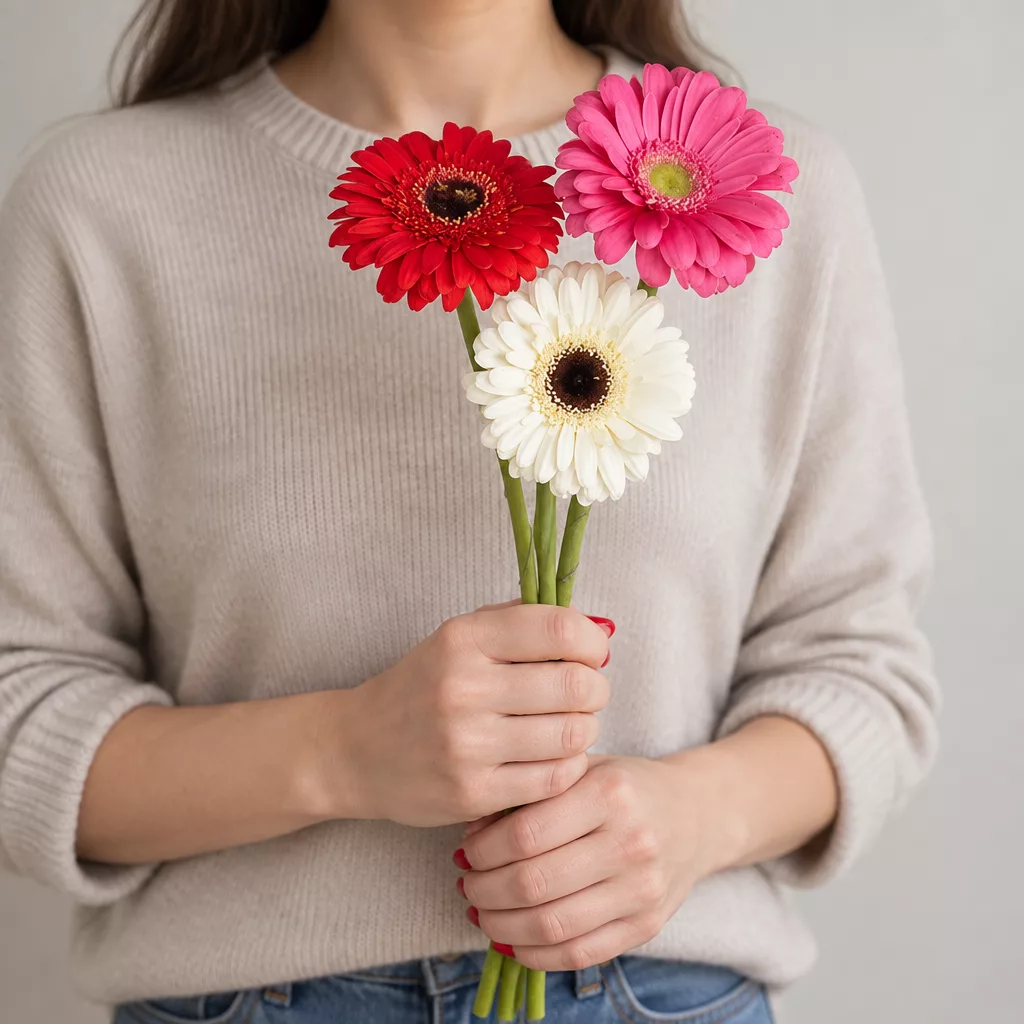


The Colour Palette: Choosing the Right Shade for the Person
Gerberas come in a wider range of colours than almost any other cut flower available year-round in Russia. You will find clean whites, pale creams, soft peaches, warm corals, every shade of pink from blush to hot, true reds, deep burgundies, bright oranges, sunny yellows, and even near-purples in varieties with dark centres. The centre disc itself varies too — black, dark brown, green or white — and that detail changes the mood of the whole stem considerably.
For a recipient who decorates in neutral tones, white or cream gerberas with a dark centre look sophisticated rather than plain. For a child or a teenager, the saturated oranges and hot pinks feel genuinely joyful without being sentimental. For a colleague you want to congratulate without overstepping, a mix of yellows and soft corals reads as warm and professional at the same time.
One mistake people make is choosing a colour they personally love rather than one that suits the recipient's home or personality. A vivid scarlet gerbera is beautiful in the shop but can look aggressive in a pale, minimalist apartment. When in doubt, the combination of two or three tones — say, peach, white and soft yellow — works in almost any interior and feels considered rather than random. Russian florists often use this three-tone approach as a default for mixed gerbera bouquets, and it is a good instinct to follow.
Choosing Gerberas for the Occasion: From Birthdays to Just Because
In Russia, flowers are given far more spontaneously than in many Western countries. It is completely normal to show up at a friend's home with a bouquet on a regular evening, and gerberas are one of the flowers most associated with that easy, no-occasion generosity. Their price point makes the gesture feel light rather than loaded, which is exactly right when you want to say 'I was thinking of you' without creating an obligation.
For birthdays, gerberas work best when they are abundant. A tight cluster of fifteen to twenty stems in two or three complementary colours makes a much stronger impression than a sparse mixed bouquet where gerberas play a supporting role. The flower is bold enough to carry a whole arrangement on its own, and when you give it that space, the result is genuinely striking.
For a teacher, a doctor or anyone in a service role — a common gifting occasion in Russia, particularly around professional holidays — a clean, well-wrapped bunch of gerberas in one colour reads as respectful and thoughtful. Russian professional holidays like Teacher's Day in October or Doctor's Day in June see enormous demand for exactly this kind of gift. Gerberas handle the volume of those days well because the supply is consistent and the flower does not require the careful staging that, say, a garden rose arrangement demands. The simplicity is part of the appeal.
Combining Gerberas with Other Flowers: What Works and What Does Not
Gerberas have a strong graphic quality — that flat, open face and the long straight stem — which means they pair best with flowers that offer texture or softness rather than competing structure. Spray chrysanthemums work beautifully alongside gerberas because they add a cloud of smaller blooms without fighting for dominance. Eucalyptus or ruscus as greenery grounds the arrangement and stops it looking like stems simply placed in a vase.
Freesias are another excellent companion. They add fragrance, which gerberas completely lack, and their delicate tubular blooms contrast well with the bold gerbera face. If you want to give a bouquet that both looks and smells like a gift, pairing gerberas with white or yellow freesias is one of the most effective combinations available year-round in Russian shops.
What tends not to work is combining gerberas with other large-headed flowers of similar scale — sunflowers, large dahlias or standard roses in a simple hand-tied bunch. The flowers end up competing rather than complementing, and the result looks crowded. Roses can work with gerberas, but the arrangement needs a florist's hand to balance the two. If you are ordering online and want something reliable, a pure gerbera bouquet with greenery is a safer choice than a complex mixed design. It photographs well, it travels well, and it lands with clarity rather than confusion.
Budget Options: How Many Stems and What Presentation
Gerberas are among the most affordable stems in the Russian flower market, which means your budget goes further here than with almost any other flower. A modest gift can still be a full, generous-looking bouquet if you choose gerberas, and that matters when the visual impact of the gift is part of what you are paying for.
At the entry level, a single-colour bunch of seven to nine stems wrapped simply in kraft paper is clean and unpretentious — a good choice for a casual thank-you or a spontaneous gesture. Step up to fifteen stems in two colours with a ribbon and the arrangement starts to feel celebratory. At twenty stems or more, particularly when arranged in a round dome shape, gerberas become a proper centrepiece gift that holds its own against a box of chocolates or a bottle of wine as the main event.
Presentation matters more than most people realise. Gerberas in a round, compact arrangement look more expensive than the same number of stems loosely wrapped. A florist who takes the time to face each bloom outward and layer the stems so every head is visible is giving you real value. When ordering for delivery, it is worth specifying whether you want a wrapped bouquet or an arranged bunch, because the same stems can look very different depending on how they are put together. In Russia, both formats are common and neither is considered more formal than the other.
Vase Life: Getting Five to Seven Days from Your Gerberas
A fresh gerbera stem, properly conditioned, will last five to seven days in a vase. That is a realistic figure rather than an optimistic one, but it depends on a few things the recipient needs to do — or avoid doing — in the first hours after the bouquet arrives.
The most important step is cutting the stems. Gerberas are particularly sensitive to air bubbles entering the stem, which block water uptake and cause the head to droop within a day even when the stem looks healthy. Cut at least two centimetres off each stem at a forty-five degree angle, do it under running water or while the stem is submerged, and place them immediately into a clean vase. This single step makes a larger difference to vase life than any other.
Water temperature matters too. Gerberas prefer cool water — room temperature at most, and ideally slightly cool. Avoid placing them near a radiator, which is a real hazard in Russian apartments during the heating season running from October through April. Central heating in Russia runs hot and dry, and a vase sitting on a windowsill above a radiator will lose its gerberas in two days rather than seven.
Change the water every two days and recut the stems each time. Remove any leaves that sit below the waterline, because decaying foliage introduces bacteria that shorten vase life for the whole bunch. With these steps followed, gerberas are genuinely one of the longer-lasting affordable cut flowers available.
Ordering Gerberas for Delivery Across Russia: What to Expect
Because gerberas are available from Dutch imports year-round, ordering them for delivery in any Russian city is straightforward without the seasonal uncertainty you face with locally grown flowers. Supply does not dry up in winter, and the quality does not peak sharply in one month the way it does with domestic field flowers. That consistency makes gerberas a dependable choice when you are ordering remotely for someone in another city and cannot check the quality yourself.
For a one-to-two hour delivery window, gerberas are well suited because they do not require the careful temperature management that more delicate flowers need. They handle the transition from a climate-controlled shop to a delivery vehicle to a recipient's hallway better than, for example, open garden roses or sweet peas. The stems are sturdy, the heads do not bruise easily, and a well-wrapped bouquet arrives looking close to how it left the shop.
When ordering, it helps to specify the colour direction rather than leaving it entirely open. Saying 'warm tones — orange, peach, yellow' or 'cool tones — pink, white, lilac' gives the florist enough direction to make a coherent choice without locking them into a specific stem count of each colour. Russian florists respond well to this kind of brief because it respects their eye while giving the arrangement a clear intention. If the delivery is for a specific occasion, mention it — a florist who knows it is a birthday will make different choices about density and ribbon than one assembling a generic mixed bunch.
Gerberas earn their place in Russian flower shops not through novelty or prestige but through sheer reliability — reliable colour, reliable availability, reliable vase life and a price that lets you be generous without deliberating. Whether you are sending fifteen stems to a friend in Saint Petersburg or arranging a birthday delivery to a colleague in another city, gerberas give you a flower that arrives looking like a real gift and stays looking that way for the better part of a week. Choose the colours for the person, not for yourself, give the stems a clean cut the moment they arrive, keep them away from the radiator, and gerberas will do the rest.
Frequently asked questions
Are gerbera daisies available in Russia in winter?
Yes. Because Russian flower shops rely on Dutch greenhouse imports rather than domestic seasonal growing, gerberas are available in consistent quality and colour range throughout the year, including the depths of January and February. You will not face the supply gaps that affect locally grown or seasonal flowers.
How long will gerberas last in a Russian apartment during heating season?
Russian central heating runs hot and dry from October through April, which is the main threat to vase life indoors. Keep gerberas away from radiators and direct heat sources, use cool water, and change it every two days. With these precautions, five to six days is a realistic expectation even in a warm apartment.
Is it appropriate to give gerberas as a gift in Russia, or are they considered too casual?
Gerberas are widely accepted across almost every gifting occasion in Russia — birthdays, professional holidays, thank-you gestures and casual visits. They carry no negative associations and are not considered too informal. A well-presented bunch of fifteen or more stems reads as a genuine and thoughtful gift.
What colours of gerbera are typically available for delivery?
Most Russian flower shops carrying Dutch imports stock white, cream, peach, coral, pink, hot pink, red, burgundy, orange, yellow and near-purple gerberas, with variation in centre colour from black to green to white. Availability of specific shades can vary slightly by week, so specifying a colour direction rather than an exact shade gives the best results.
Why do gerbera stems droop even when the water looks clean?
Drooping in gerberas is almost always caused by an air bubble blocking the stem, which prevents water from reaching the head. The fix is to recut two centimetres off the stem at a forty-five degree angle while the stem is submerged in water, then place it immediately into a fresh vase. The head usually recovers within a few hours.
Ready to send flowers?
Pick the city, choose the bouquet, and a local florist takes it from there.
Choose a city →