Major Flowers Grown in the Netherlands and How to Choose Them
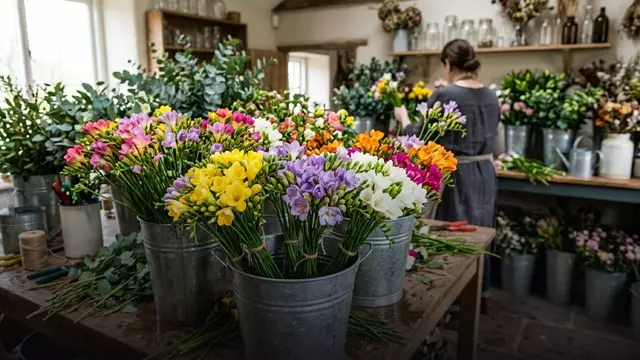
The major flowers grown in the Netherlands include tulips, chrysanthemums, roses, lilies, gerberas, carnations and alstroemeria. Daffodils, hyacinths and irises are also important Dutch-grown bulb flowers. Tulips are the best-known symbol, but Dutch flower growing extends well beyond the colourful spring fields.
For you as a buyer, the useful differences are season, scent, shape and how the stems behave in a vase. A bunch of tulips changes shape as it opens, while chrysanthemums give a bouquet a fuller, more structured outline. Understanding those differences helps you choose flowers for the recipient and occasion, whether you are giving them in the Netherlands or sending a bouquet to someone in Russia.
Which flowers are grown in fields, and which under glass?
Dutch flower production includes outdoor bulb fields and protected cultivation in greenhouses. Tulips, daffodils and hyacinths are closely associated with the outdoor spring landscape. Roses, gerberas, chrysanthemums and other cut flowers are also cultivated under glass, where growers can manage light and growing conditions. The familiar field photograph therefore shows only one part of Dutch flower growing.
There is another useful distinction: growing bulbs and growing flowers for cutting are different aims. A field grown for bulb production is managed to develop the underground bulb; its blooms are not necessarily destined for bouquets. Cut-flower cultivation focuses on stems suitable for harvesting and arranging. A photograph of flowering fields cannot tell you what is available to order.
Finally, a flower sold or traded in the Netherlands is not automatically Dutch-grown. The country is also a centre for international flower trade. If origin matters to you, check the information attached to the particular bouquet or ask before ordering. A variety name, a Dutch association or a photograph alone does not establish where the stems were cultivated.
Tulips, daffodils and hyacinths: the spring bulb flowers
Tulips suit someone who enjoys a bouquet that moves and changes. Their stems continue to elongate after cutting and often curve towards light, so an initially upright arrangement may become looser. Choose a clean vase with room for this movement, remove leaves that would sit below the water and refresh the water regularly. Keep the flowers away from direct sun, heaters and ripening fruit.
Daffodils bring a clear spring character, with trumpet-shaped centres and colours ranging from white to yellow. Freshly cut daffodil stems release sap that can affect other flowers in the same water. For an uncomplicated arrangement at home, give them their own vase. If you want a mixed bouquet, ask about appropriate conditioning instead of combining freshly cut stems without preparation.
Hyacinths offer dense clusters of small flowers and a noticeable fragrance. They can make a small arrangement feel substantial, but scent deserves as much attention as colour: check the recipient's preference before choosing them for a desk or bedroom. Outdoor spring flowering and the availability of cut stems are different calendars, so ask about the intended delivery date rather than assuming year-round availability.
Bouquets we can deliver




Roses and lilies: choosing shape, scent and symbolism
Roses are a major Dutch-grown cut flower, with varieties that differ in head size, petal count and opening pattern. Red commonly suggests romantic affection, while pink, cream or yellow can support a different message depending on the relationship. Treat these associations as a starting point, not a universal code. A clear card message tells the recipient more reliably why you chose the bouquet.
Lilies create height and a strong outline, and their buds can open successively in the vase. Fragrance varies: some types have a pronounced scent, while others have little. If the bouquet will stand close to someone for hours, ask about scent before choosing it. Once flowers open, carefully removing the pollen-bearing anthers can help prevent stains on clothing and furniture.
True lilies are highly toxic to cats, including their pollen and vase water. For a home with cats, choose a bouquet without lilies and tell the person helping you select it about the pet. For either roses or lilies, start with a clean vase, trim the stems with a clean tool and remove submerged foliage. Check the water daily rather than waiting for it to look cloudy.
Chrysanthemums, gerberas, carnations and alstroemeria
Chrysanthemums offer a wide range of forms, from small daisy-like spray flowers to large rounded heads. They are useful when you want visible fullness or repeated colour throughout a bouquet. Their meaning varies between countries: white chrysanthemums can have memorial associations in parts of Europe. For an international gift, consider the recipient's customs and the occasion before choosing an all-white arrangement.
Gerberas have an open, daisy-like face that makes individual flowers easy to see, even in a modest bunch. Their stems need careful handling because bending or crushing can weaken them. Use a thoroughly cleaned vase, follow any supplied flower-food directions and keep leaves out of the water. When arranging them yourself, avoid forcing the stems into a tight position that creates a sharp bend.
Carnations provide ruffled texture, while alstroemeria carries several smaller flowers on branching stems. Both can work as the main flower in an arrangement rather than merely filling gaps. Remove fading blooms and any foliage below the waterline, and give the stems enough space in the vase. Their useful vase life still depends on freshness, handling and room conditions; a fixed number of days would be misleading.
How to choose a bouquet for the person and the date
Start with three practical details: the occasion, the recipient's preferred colours and where the flowers will stand. A tall lily arrangement needs different space from a compact bunch of tulips. For a shared office, fragrance may matter more than symbolism; for a home with pets, plant safety comes first. These details give you a more useful shortlist than choosing only the flower most associated with Holland.
Then check availability for the actual date. A flower's natural outdoor season does not guarantee that it will be offered in a particular delivery city, and greenhouse cultivation does not make every variety continuously available. Use the bouquets catalogue to explore arrangements, then confirm any essential flower or colour before ordering. If a particular stem matters, say so explicitly.
For someone in Russia, an odd number of stems is customary in a celebratory bouquet where the individual stems are clearly counted; even numbers are traditionally associated with mourning. This is especially relevant to a simple bunch of roses or tulips. Add a short, personal card message explaining the occasion. You do not need elaborate floral symbolism when a few direct words express what you mean.
Sending flowers to Russia or to the Netherlands
Turboflora delivers flowers across Russia. City delivery costs 500 RUB; for remote districts and suburbs, the operator confirms the price when confirming the order. In large cities, express delivery takes 1–2 hours after confirmation. Other options include an exact time within ±30 minutes, windows of 09–12, 12–15, 15–18 or 18–21, and pre-ordering 1–30 days ahead. Agree timing for the recipient's city.
To arrange a Russian delivery, choose a bouquet and prepare the address, recipient details and card text. Contact a manager on WhatsApp for help choosing, agreeing the address and time, or arranging a photo before delivery. The card is free, and delivery is anonymous by default: the courier does not name the sender. The courier calls the recipient about 15 minutes before arrival.
We also deliver abroad to 49 countries and more than 1,550 cities, listed on Flower delivery abroad, a page in Russian. Our Netherlands delivery page covers six cities: Alphen aan den Rijn, Bergen op Zoom, Hoofddorp, Leiden, Roosendaal and Zoetermeer. Choose a bouquet on the country or city page, enter the address and card text, and pay in rubles; the displayed price includes delivery. Checkout uses CloudPayments: check the payment options shown, as acceptance of every foreign card is not guaranteed. Russian delivery fees and timing conditions do not apply to orders abroad. Availability and timing of delivery across Russia are confirmed for the chosen city, address, date and bouquet.
Frequently asked questions
What are the major flowers grown in the Netherlands?
They include tulips, chrysanthemums, roses, lilies, gerberas, carnations and alstroemeria. Daffodils, hyacinths and irises are also important bulb flowers cultivated there.
Are all flowers sold in the Netherlands grown there?
No. The Netherlands also trades flowers grown in other countries, so you need information about the particular stems to establish their origin.
Which Dutch-associated flowers should I choose for someone sensitive to scent?
Tulips or gerberas may be easier choices than strongly scented hyacinths or some lilies. Ask about the particular flowers being offered, because fragrance varies.
Can I order flowers to Russia while living abroad?
You can choose a bouquet for delivery in Russia and pay through CloudPayments at checkout. Check the payment options displayed for your card; acceptance of every foreign card is not guaranteed.
What happens if the recipient is absent when the courier arrives?
For delivery in Russia, we agree a second delivery the same day or handing the flowers to a neighbour or concierge with the sender's consent. The courier calls the recipient about 15 minutes before arrival.
Ready to send flowers?
Pick the city, choose the bouquet, and a local florist takes it from there.
Choose a city →