What Flower Is This? How to Answer “Qué flor es”
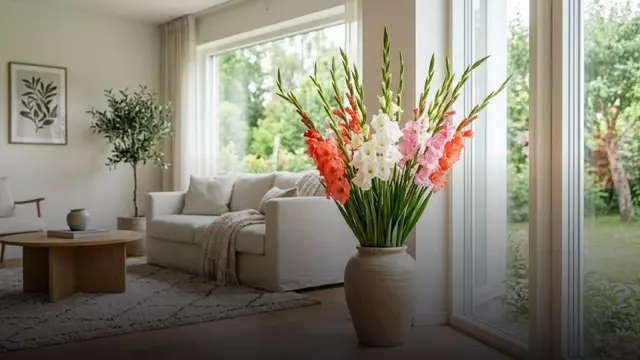
“Que flor es”, usually written “¿Qué flor es?” in Spanish, means “What flower is it?” or “What flower is this?” To identify an unfamiliar flower, examine its petals, centre, leaves and the way its blooms grow along the stem. Colour alone is rarely enough, because many different flowers share the same shades.
You might be trying to name a flower in a photograph, understand a bouquet you received, or choose something similar for someone in Russia. Start with the flower’s structure, then consider how it will be used: a striking stem for a tall vase needs a different approach from a compact bouquet for a bedside table. This guide helps you make those distinctions and turn an uncertain description into a useful choice.
Look at the whole stem before naming the flower
Begin with the outline of one open bloom. Is it a cup, a trumpet, a flat disc or a rounded cluster of smaller flowers? Then look at the centre: a daisy-like flower has a visible central disc, while a densely petalled rose may conceal its centre completely. These structural details are usually more informative than whether the flower is pink, cream or red.
Next, follow the stem down to the leaves. Note whether they are broad or narrow, smooth-edged or toothed, and attached individually or in groups. Check whether one stem carries a single flower or branches into several blooms. Do not assume that nearby foliage belongs to the flower: bouquets often combine cut stems with separate decorative greenery.
If you are taking photographs for identification, capture the flower from above, from the side and with its leaves visible. Use daylight and avoid colour filters; include a ruler if size is difficult to judge. A tightly closed bud or a heavily edited photograph may leave the identification uncertain. In that case, describe the visible features rather than assigning a confident name.
Recognise the flowers you are most likely to encounter
Roses commonly have layered petals arranged around a central bud, with compound leaves made up of several leaflets. Tulips have a simpler cup-shaped bloom and broad, smooth leaves that rise along the stem. A very full, rounded flower could be a peony, a double tulip or a garden-style rose, so petal count and silhouette alone will not reliably distinguish them.
Carnations have conspicuously frilled petal edges and narrow leaves; their stems have visible joints. Chrysanthemums vary considerably, from small daisy-like flowers to dense rounded heads. Gerberas have a prominent central disc surrounded by rays of petals, usually on a leafless flower stem. For these flowers, a clear view of the centre helps narrow the possibilities.
Lilies typically have six prominent petal-like segments, often opening into a trumpet or star, with noticeable stamens. Alstroemeria also has six petal-like segments, often with streaks or markings, but usually carries smaller flowers in a branching cluster. If you are choosing for a home with cats, avoid lilies: they are highly toxic to cats, including exposure to their pollen and vase water.
Bouquets we can deliver




Use flower meanings as a guide to the recipient
Flower symbolism can help you express an intention, but it is not a universal code. Red roses often suggest romantic love; a mixed bouquet can feel less explicitly romantic. White flowers may suit an elegant celebration or a gesture of sympathy, depending on the setting. The occasion, your relationship and the recipient’s preferences should guide the choice together.
For a birthday, think about the colours the person actually enjoys and where the bouquet will stand. For a colleague, a balanced mixed arrangement may be easier to interpret than a strongly romantic design. For an apology or a difficult conversation, let the card carry the message clearly. A flower cannot explain what happened or replace a direct, considerate sentence.
In Russia, an odd number of flowers is customary for celebratory gifts when the stems are counted individually; even numbers are associated with mourning. This distinction is particularly relevant to a simple bouquet of roses or tulips. If you are unsure how a specific design will be understood, ask before ordering rather than relying on a tradition from your own country.
Choose for the room, the vase and the person
A bouquet should fit the recipient’s space as well as the occasion. Long stems need a stable vase with enough height to support them; a compact arrangement is easier to place on a small table. If you do not know what vase is available, ask the recipient discreetly or agree the bouquet’s proportions with a manager. A photograph alone can make scale difficult to judge.
Consider fragrance before choosing a bouquet for a shared office, bedroom or someone sensitive to strong scents. Scent varies between flower types and cultivars, so a name or colour does not establish how fragrant a particular bouquet will be. Ask about the flowers being considered instead of assuming that all roses smell strongly or all pale flowers have little scent.
You can explore the bouquets catalogue with these practical points in mind. Notice whether you are drawn to a particular flower, an overall shape or a colour combination: these are different preferences. If you cannot identify a flower in a reference picture, describe what you like about it, such as its ruffled edges, open centre or airy branching stems.
Care for cut flowers from the moment they arrive
Start with a clean vase and fresh water. Remove leaves that would sit below the waterline, then trim the stem ends with a clean, sharp tool before placing the flowers in water. Submerged foliage decays and makes the water dirty more quickly. If cut-flower food is provided, follow its instructions rather than guessing the concentration or adding household ingredients.
Check the water every day and top it up as needed; replace it when it becomes cloudy, cleaning the vase at the same time. Keep the bouquet away from radiators, direct sunlight and ripening fruit. Remove fading flowers and any leaves that drop into the water. These small, regular actions are more useful than waiting until the whole bouquet looks tired.
Different flowers change shape as they open. Tulip stems can continue to lengthen and bend after cutting, while a lily bud may open well after another bloom on the same stem. Allow space around the flowers instead of forcing every stem into a rigid outline. There is no single reliable vase-life promise for all bouquets: flower type, maturity and conditions in the room all matter.
Arrange flower delivery to Russia with clear details
Turboflora delivers flowers across Russia. City delivery costs 500 RUB; for remote districts and suburbs, the operator confirms the delivery price when confirming your order. When arranging a gift from abroad, prepare the recipient’s address, phone number, preferred date and card text. Give the intended delivery time in the recipient’s local time so the detail is unambiguous.
In large cities, express delivery is available within 1–2 hours after order confirmation. You can also arrange an exact time with a tolerance of ±30 minutes, choose a window of 09–12, 12–15, 15–18 or 18–21, or pre-order 1–30 days ahead. Use WhatsApp to agree the bouquet, address, timing and card text, and arrange a photo of the bouquet before delivery.
Delivery is anonymous by default: the courier does not name the sender, and a card with your text is free. The courier calls the recipient about 15 minutes before arrival. If they are absent, we agree a second delivery that day or, with your consent, hand the flowers to a neighbour or concierge. Checkout uses CloudPayments; check the displayed options for your card, since acceptance of every foreign card is not guaranteed. See delivery and payment for these practical arrangements.
Frequently asked questions
Does “que flor es” mean “What flower is this?”
Yes: the standard Spanish question is “¿Qué flor es?”, meaning “What flower is it?” or, in context, “What flower is this?” The accent on “qué” marks it as a question word.
Can I identify a flower by its colour alone?
Usually, colour alone is insufficient because unrelated flowers can share the same shade. Compare the bloom’s shape, centre, leaves and branching pattern, ideally using photographs of the whole stem.
What should I check when sending flowers to someone with pets?
Check the safety of every flower and foliage type for the animal living in the home. Avoid lilies in homes with cats, and keep unidentified bouquets and their vase water out of pets’ reach.
Can I send flowers to Russia without revealing my name?
Yes, delivery is anonymous by default and the courier does not name the sender. A card with your text is free, so include your name in the message if you want the recipient to know who sent it.
Can I pay for a Russian flower delivery with a foreign card?
Online checkout uses CloudPayments; check the payment options displayed there for your card. Acceptance of every foreign card is not guaranteed.
Ready to send flowers?
Pick the city, choose the bouquet, and a local florist takes it from there.
Choose a city →