Sending Flowers to a Russian Office on the Same Day
You have decided to send flowers to a colleague, a business partner, or a team member at their workplace — and you need them there today. That is entirely possible across Russia, but office deliveries follow a rhythm that is slightly different from home deliveries. Buildings have security desks, receptionists screen visitors, and the recipient may be in a meeting all afternoon. Knowing these details before you order turns a stressful errand into something that simply works.
Why Office Deliveries Need a Little More Planning Than Home Ones
When flowers arrive at a residential address, the person who opens the door is almost always the recipient. At an office, the journey from the street to the right desk can involve a security guard, a reception team, a locked floor, and a colleague who may not know where the recipient is sitting that day. None of this is a problem — it just means the details you provide at checkout matter more than usual.
Russian corporate buildings, especially in Saint Petersburg and Moscow, frequently require couriers to present identification and register at the front desk before entering. The courier carries the bouquet through that process smoothly, but only if the address information is complete. A building name alone is rarely enough.
The good news is that a beautifully assembled arrangement of garden roses, lisianthus, and eucalyptus travels perfectly well through this process. Sturdy stems, a well-conditioned water source inside the packaging, and a secure wrap mean the flowers arrive in the same condition they left the studio. What determines success is the information you give at the ordering stage, not the fragility of the blooms themselves.
Think of it this way: you are not just ordering flowers, you are choreographing a small event inside someone else's workday. A few extra minutes spent on the address and timing details is what makes that event feel effortless for everyone involved.
Bouquets we can deliver


Cutoff Times: When You Need to Order to Make It Happen Today
Same-day delivery to an office works on a tighter schedule than an evening home delivery, because most offices close between 18:00 and 19:00 and you need to account for travel time, registration at the front desk, and the recipient actually being present to receive the arrangement.
As a general rule, placing your order before 14:00 local time gives the studio time to compose the bouquet, condition the stems, and dispatch the courier with enough buffer to handle any delays at the building entrance. Orders placed between 14:00 and 16:00 can still reach most Saint Petersburg offices before closing, but the window is tighter and it is worth confirming the recipient's schedule before committing.
If the office is in another Russian city and you are ordering from abroad or from a different time zone, remember to convert correctly. Russia spans eleven time zones. Saint Petersburg runs on Moscow Time, which is UTC plus three, with no daylight saving adjustment. An order placed at noon in London is already 15:00 in Saint Petersburg, so the math matters.
For Friday deliveries, close the window by an hour. Many Russian offices shift to a shorter working day on Fridays, with staff leaving by 17:00 or even 16:30. Sending a bouquet of spray roses and white freesia on a Friday morning, rather than Friday afternoon, means it will be seen and enjoyed rather than left on an empty desk over the weekend.
Getting the Address Right: What Russian Office Addresses Actually Need
A Russian office address has more layers than a typical European one, and each layer matters for the courier. The full street address includes the street name, the building number, and often a corpus or stroenie — these are additional building identifiers used when a single plot contains more than one structure. Writing only the street and number when there are two buildings on the same plot sends the courier to the wrong entrance.
Beyond the physical address, include the floor number, the office or room number, and the name of the company. In large business centres, a single floor may hold four or five separate tenants, and the reception desk will ask the courier which company they are visiting. Without that information, the delivery stalls.
If the office is inside a business centre with a branded name — and many Saint Petersburg offices are — include that name too. Couriers and security staff navigate by the building's common name as much as by the street address. Mentioning both removes any ambiguity.
One detail that often gets overlooked: the intercom or access code for the building entrance. Some offices in converted residential buildings or smaller premises require a code to open the street-level door. If the recipient has given you their work address, it is worth asking them casually whether there is anything the delivery person should know about getting in. That single question prevents the most common cause of a delayed office delivery.
Confirming the Recipient Is Actually There That Day
Sending flowers to an office without knowing whether the recipient is in the building that day is the single most avoidable mistake in corporate gifting. Remote work, business travel, client meetings off-site, and sick leave are all normal parts of working life in Russia as everywhere else. A bouquet of peonies or garden roses that arrives at an empty desk does not make the impression you intended.
The simplest approach is to confirm casually before ordering. A brief message — asking what time the person is in the office, without revealing the surprise — is usually all it takes. If you want to keep the gift completely unexpected, you can ask a colleague or assistant at the recipient's company to confirm attendance discreetly.
When you place the order, you can include a mobile number for the recipient so the courier can send a brief message or call on arrival. In Russia, it is standard practice for couriers to contact the recipient directly when they reach the building, especially in larger offices where the reception desk cannot always locate individuals. This call or message also gives the recipient a moment to come down to the lobby if the building does not allow external visitors past the front desk.
If the recipient is unexpectedly absent on the day, a good alternative is to leave the arrangement with a named colleague or the reception desk, with a note attached. Fresh flowers in a well-conditioned wrap will hold their shape and scent for several hours at room temperature, so a two-hour wait on a reception desk does not ruin the gesture.
Choosing Flowers That Travel Well and Look Right in a Professional Setting
An office environment calls for arrangements that are composed rather than wild, and that can sit on a desk or a meeting table without dominating the space. Tall, dramatic installations work beautifully in a home, but a bouquet that blocks a monitor or tips over in a narrow corridor is a practical problem rather than a pleasure.
For professional settings, consider structured bouquets built around roses, lisianthus, or alstroemeria — all of which hold their form well during transit and last reliably in an office environment. Lisianthus in particular is an excellent choice: its ruffled petals resemble peonies but the stems are sturdy, and the flowers do not shed petals onto a desk. Alstroemeria opens gradually over several days, which means the recipient watches the arrangement evolve through the working week.
Avoid heavily perfumed varieties for office deliveries. Tuberose, oriental lilies, and some hyacinths have a scent that fills a room quickly, which can be overwhelming in a shared workspace or uncomfortable for colleagues with sensitivities. Roses, lisianthus, and spray chrysanthemums give visual warmth without strong fragrance.
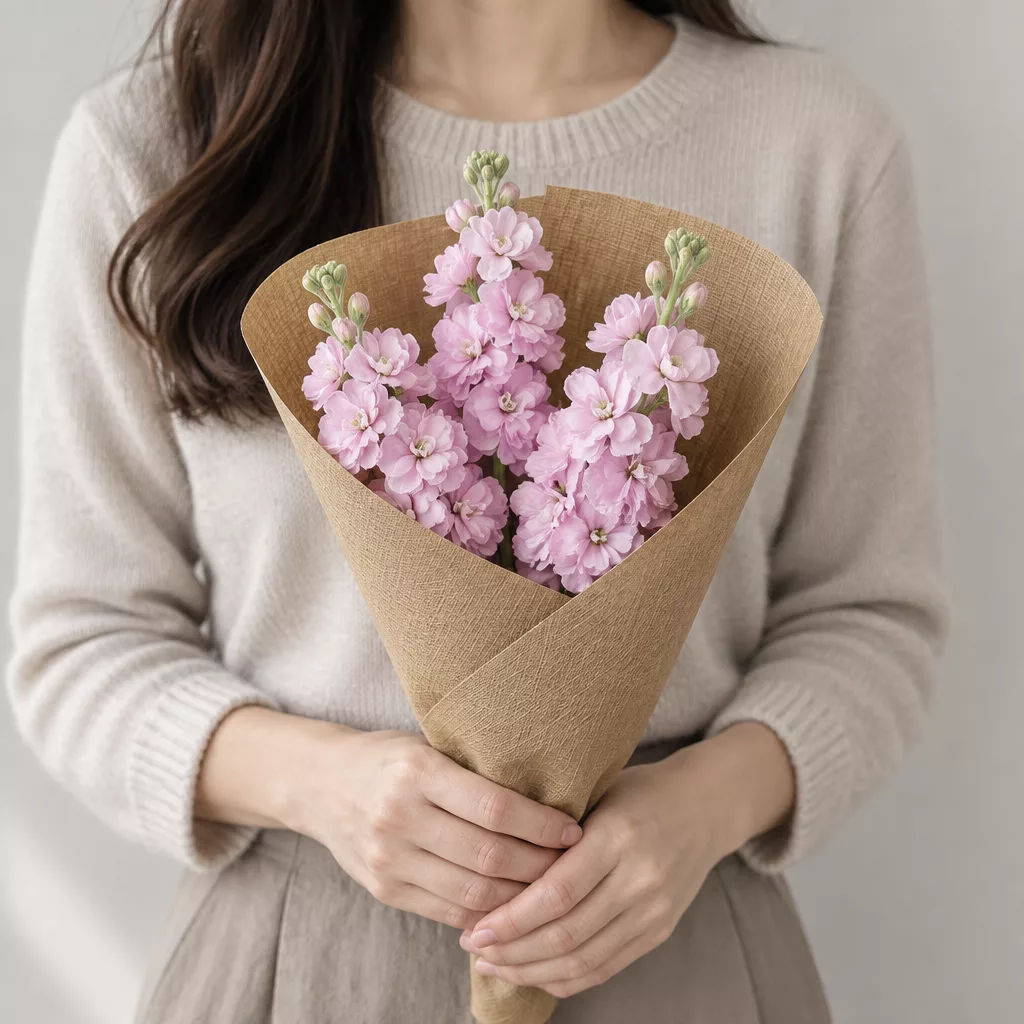
In terms of presentation, a neat kraft paper or linen wrap with a ribbon looks polished in a corporate context. It signals intention and care without being theatrical. The packaging should allow the recipient to carry the bouquet from the reception desk to their desk without feeling conspicuous. A compact, well-balanced shape achieves that.
What to Write on the Card When It Is a Professional Occasion
The card that accompanies an office delivery carries more weight than people expect. In a professional setting, the message is sometimes read aloud, passed around, or photographed — it becomes part of the memory of the occasion. A generic note can flatten an otherwise generous gesture, while a specific, warm sentence or two makes the whole thing feel considered.
For a colleague's work anniversary or a promotion, acknowledge the specific achievement rather than writing a general congratulation. Something that references the person's actual contribution — their patience, their persistence through a particular project, their leadership — lands differently than a phrase that could apply to anyone. You do not need many words to do this.
For a business thank-you, keep the tone warm but measured. Russian professional culture values sincerity and directness. A simple, genuine sentence expressing appreciation for a specific collaboration or outcome reads as more respectful than effusive praise. Avoid anything that sounds like marketing language.
If you are sending flowers to mark a personal milestone — a birthday, the birth of a child, a recovery from illness — a slightly warmer tone is entirely appropriate even in a professional context. Russians appreciate the human element in business relationships, and a heartfelt note attached to a bouquet of blush roses or white lisianthus signals that you see the person, not just the professional title. Keep the card legible and, if possible, handwritten or printed clearly — a smudged or cramped note diminishes the effect of even the most beautiful arrangement.
After the Delivery: Helping the Flowers Last Through the Working Week
Most office recipients have never been told how to care for cut flowers, and the default behaviour — placing them in a vase of tap water and forgetting them — shortens the arrangement's life considerably. A short care note tucked inside the packaging is a practical kindness that extends the enjoyment of your gift by several days.
The most important step is a fresh diagonal cut on each stem before the flowers go into water. This increases the surface area for water uptake and removes the sealed end that forms during transit. A sharp knife or scissors are both fine; what matters is that the cut is clean rather than crushed. Office scissors often crush rather than cut, so encouraging the recipient to use something sharp is worth mentioning.
Water temperature matters more than most people realise. Lukewarm water, roughly at room temperature, is absorbed more efficiently than cold water by most cut flowers. Roses, lisianthus, and alstroemeria all respond well to this. The water should be changed every two days, and the vase rinsed each time to prevent bacterial build-up, which is the primary cause of early wilting.
Office environments are often drier than homes because of air conditioning and heating systems running continuously. Placing the vase away from direct airflow — not directly under a vent or beside a radiator — and away from direct sunlight through a window will significantly extend vase life. Under these conditions, a well-conditioned bouquet of roses or lisianthus should last seven to ten days, giving the recipient a full working week of colour on their desk.
Sending flowers to a Russian office on the same day is genuinely straightforward once you understand the rhythm of it. Accurate address details, a realistic cutoff time, a quick check that the recipient is actually in the building, and a choice of flowers that suit a shared professional space — these four things together make the difference between a delivery that delights and one that gets complicated. The flowers themselves do the rest. A composed bouquet of lisianthus and roses arriving at a desk in the middle of an ordinary Tuesday has a way of making the whole day feel less ordinary, which is exactly what you were hoping for when you placed the order. We deliver bouquets across Russia in 1–2 hours.
Frequently asked questions
What is the latest I can order same-day flowers for a Saint Petersburg office?
Placing your order by 14:00 Saint Petersburg time gives the most comfortable window for a same-day office delivery. Orders up to 16:00 are often still possible, but the buffer for any delays at the building entrance becomes smaller. For Friday deliveries, order an hour earlier than usual, as many offices close by 16:30 or 17:00.
What address details do I need to provide for a Russian office delivery?
You need the full street address including any corpus or stroenie number, the floor, the office or room number, the company name, and the name of the business centre if there is one. If the building has a door code or specific entry instructions, include those too. Missing any one of these details is the most common reason a delivery is delayed at the front desk.
What happens if the recipient is not at their desk when the flowers arrive?
The courier will call or message the recipient on arrival, which is standard practice in Russian office deliveries. If the recipient is temporarily unavailable, the arrangement can be left with a named colleague or at the reception desk. A well-conditioned bouquet holds its appearance for several hours at room temperature, so a short wait does not affect the quality.
Are there flowers I should avoid sending to a shared office environment?
Yes — strongly scented varieties like oriental lilies, tuberose, and hyacinth can be overwhelming in a shared workspace and may cause discomfort for colleagues with fragrance sensitivities. Roses, lisianthus, alstroemeria, and spray chrysanthemums all provide visual warmth without a heavy scent, making them better suited to professional settings.
Can I send flowers to an office in another Russian city on the same day?
Yes, same-day delivery is available across Russia, but time zone differences matter. Russia spans eleven time zones, and Saint Petersburg runs on UTC plus three with no daylight saving. If you are ordering from outside Russia, convert your local time carefully before placing the order to ensure you are within the same-day cutoff window for the destination city.
Ready to send flowers?
Pick the city, choose the bouquet, and a local florist takes it from there.
Choose a city →