Will the Card Message Be Kept Private From the Recipient?
You have chosen the flowers, picked the perfect combination of blush ranunculus and white freesia, and then you sit down to write the card. Suddenly a small but very real worry surfaces: will the person opening that bouquet see your words before they are meant to, or will a courier accidentally reveal who sent it? These are fair questions, and they deserve a straight answer rather than vague reassurance. Here is exactly what happens to your message from the moment you type it to the moment it reaches someone's hands.
How Your Message Travels From Screen to Bouquet
When you place an order and type your greeting, that text moves through an internal system before it ever touches paper. The message is printed in the fulfilment stage, which happens alongside the wrapping of the flowers themselves. It does not travel on the outside of any package, it is not written on a dispatch label, and it is not visible to anyone handling the order in transit. The courier who picks up the bouquet sees a delivery address and an order reference, nothing more.
At Turboflora the card is printed on a small kraft or white card stock, folded once, and placed inside a sealed envelope before it is attached to the bouquet. The envelope is not transparent. It carries no printed text on the outside apart from a small decorative element or the word for greeting in Russian, which tells the recipient there is a personal note inside without revealing a single word of what you wrote.
This matters more than it might seem. In Russian gifting culture, the moment of reading a card is considered personal, almost ceremonial. Recipients often wait until they are alone to open it. Knowing the envelope is sealed means that moment belongs entirely to them, and to you, rather than to whoever happened to open the door.
Bouquets we can deliver



Does the Sender's Name Appear Anywhere on the Packaging?
This is the question most people are actually asking when they wonder about privacy. The short answer is no, your name does not appear on the outer packaging unless you deliberately put it inside the card yourself. The exterior of the bouquet wrapping, whether kraft paper, a fabric ribbon tie, or a gift box for more structured arrangements like garden roses with eucalyptus, carries only what the presentation requires aesthetically.
The delivery label used by the courier contains the recipient's address and phone number, because the driver needs those details to complete the drop. It does not contain your name, your phone number, or your address. If the courier needs to call ahead, which sometimes happens for large apartment buildings or gated communities in cities like Moscow or Kazan, they use the recipient's contact details, not yours.
There is one practical exception worth knowing. If the recipient calls Turboflora directly after receiving the bouquet and asks who sent it, the team will not disclose that information without your permission. The sender's identity is treated as part of the order, not as public information attached to a transaction. So if you are planning a surprise for an anniversary or a quiet gesture of appreciation for a colleague, the process is designed to protect the moment rather than accidentally unravel it.
What the Envelope Actually Looks Like Up Close
Presentation details matter because they shape the recipient's first impression before a single petal is smelled. The envelope used for greeting cards is a standard small format, roughly the size of a business card folded in half, made from paper with enough weight that it holds its shape during transport. It is sealed with a moisture-activated adhesive strip, the same method used for quality stationery envelopes, so it cannot be casually lifted and resealed without showing signs of tampering.
The card inside is printed with your exact wording. Turboflora does not edit, correct, or alter what you write unless you ask for help composing the message. If you write in English, it prints in English. If you mix languages, it prints as you wrote it. This is relevant for international senders, people based outside Russia who are ordering flowers for someone in Saint Petersburg or another Russian city, because the message does not get translated or paraphrased by anyone in the process.
The envelope is tucked into the bouquet rather than taped to the outside in a way that could catch on a door frame or get wet in transit. For wrapped bouquets the card sits within the inner layer of paper near the stems, protected from the elements. For boxed arrangements of, say, garden peonies or spray roses, it rests flat against the inner lid so the recipient finds it immediately upon opening. The placement is deliberate and part of the overall unboxing experience.
Anonymous Deliveries and When You Want No Name at All
Some of the most meaningful bouquets arrive without any obvious sender, and that is a completely valid choice. If you want the card to contain only a message with no name signed at the bottom, simply write it that way. The system does not auto-append your account name, your email address, or any identifier to the printed card. What you type is what gets printed, nothing added.
This is particularly popular for gestures that are meant to feel like a discovery rather than a direct gift. Imagine a single stem of garden roses or a small hand-tied bunch of sweet peas left with a note that reads only a line of poetry or an inside joke. The recipient knows someone thought of them without necessarily knowing who, at least until you choose to reveal it yourself. In Russian romantic tradition, this kind of anonymous gesture carries a specific warmth, it suggests the feeling was too strong to wait for the right moment to announce itself.
If you do want your name on the card, simply sign it within the message field. Many senders write naturally, the way they would in a text message, opening with the recipient's name and closing with their own. That is entirely fine. The point is that the choice is yours alone. No part of the Turboflora process assumes you want your identity disclosed, and no part of the packaging will disclose it without your explicit inclusion of it in the card text itself.
What Happens if the Recipient Is Not Home
Delivery logistics are where privacy concerns most often become real. If the recipient is not home when the courier arrives, the handling of the bouquet and its card needs to be considered carefully. Leaving a bouquet of, say, hydrangeas and lisianthus outside a door in warm weather is not ideal for the flowers, and leaving a sealed card in a hallway raises its own concerns.
In most cases the courier will call the recipient to arrange a handoff time or confirm an alternative recipient such as a neighbour or building concierge. The card remains sealed and attached to the bouquet throughout this process. The courier does not open the envelope to check contents or read the message aloud. If the bouquet is left with a concierge, it is handed over as a complete unit, flowers and sealed card together.
For temperature-sensitive flowers like tulips in early spring or anemones in late autumn, the courier will make multiple contact attempts before leaving the bouquet in a sheltered spot. In Saint Petersburg specifically, where hallway temperatures in older apartment buildings can drop significantly in winter, the timing of the handoff matters for vase life. Tulips, for instance, keep best between four and eight degrees Celsius and will suffer if left for hours in an unheated entryway. The goal is always a fresh, intact delivery with the card undisturbed, because the experience you designed should arrive exactly as you intended it.
Writing a Card That Lands Well Across the Distance
For people ordering from abroad, the card often carries more weight than the flowers themselves. When you cannot be in the room, the words on that small folded card become your presence. This is worth thinking about before you type the first line.
Keep the tone consistent with how you actually speak to this person. A message that sounds formal when your relationship is warm, or breezy when the occasion is significant, can feel slightly off even if the flowers are stunning. A bouquet of blush David Austin roses paired with eucalyptus and white waxflower already speaks of care and thoughtfulness. The card should echo that, not undercut it with something that reads like a company memo.
For Russian recipients who may not read English fluently, consider writing in whichever language you share most naturally. If that is Russian, write in Russian. If your relationship has always been in English, that card in English will feel more like you than a translated version would. The card prints exactly as entered, so there is no risk of a machine translation flattening your meaning.
One small cultural note: in Russia it is common to address the recipient by their first name and patronymic in formal or semi-formal contexts, but close friends and family almost always use the short form of the first name. Matching that register in your card shows attentiveness that goes beyond the flowers themselves. It is one of those details that recipients notice without necessarily being able to say why the whole gift felt so right.
The Moment the Bouquet Is Opened: What the Recipient Experiences
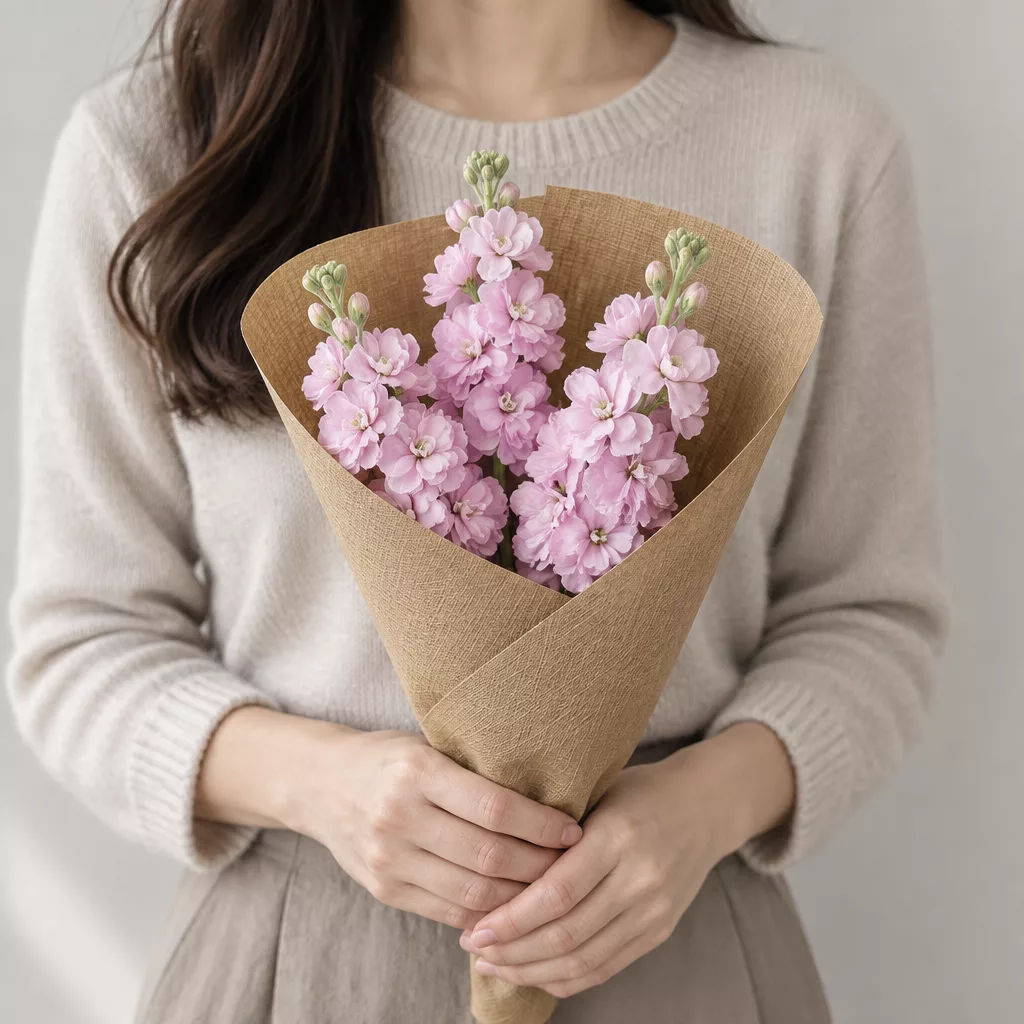
Thinking through the recipient's experience from their side helps clarify why privacy in the card process matters so much. The bouquet arrives, likely wrapped in kraft paper with a ribbon or in a structured box depending on what you ordered. The outer presentation gives nothing away about the sender. The recipient sees flowers, colour, fragrance, perhaps the soft spice of freesia or the clean green scent of stems freshly cut, before they see anything else.
Then they find the envelope. Because it is sealed, there is a small moment of anticipation before they open it. That pause is part of the gift. It is the difference between someone handing you a card already read and someone handing you a sealed letter. The seal signals that these words were meant only for you.
After reading, the card becomes a keepsake for many people. Recipients in Russia frequently keep cards from significant bouquets, tucking them into books or journals. Knowing that the message was private from the start, that no courier or packing team read it, makes it feel more genuinely personal. It belonged to the sender and recipient alone from the moment it was printed.
For the flowers themselves, the care instructions often come as a separate small printed sheet tucked alongside the card or attached to the stems. Cutting stems at an angle, changing water every two days, keeping ranunculus away from direct sunlight, these practical notes are separate from your personal message, so the card remains purely about connection rather than maintenance.
Sending flowers across Russia from another city or another country already takes a certain amount of trust. You are handing over something personal, a feeling you want someone to experience, and hoping the details hold together at the other end. The card is the most personal part of that, and it deserves the same care as the flowers themselves. At Turboflora the message you write is sealed, private, and delivered exactly as you intended, with your name appearing only if you choose to sign it yourself. The rest of the experience, the fragrance, the colour, the moment of opening, is theirs to discover.
Frequently asked questions
Can the courier read my card message during delivery?
No. The card is sealed inside an opaque envelope before it leaves the fulfilment stage. The courier handles the bouquet as a complete unit and has no reason or access to open the envelope. The message travels sealed from printing to the recipient's hands, exactly as you wrote it.
Will my phone number or email appear anywhere on the bouquet packaging?
Your contact details do not appear on any outer packaging or delivery label. The label the courier uses contains only the recipient's address and phone number. Your account information remains internal and is never printed on anything the recipient or anyone else can see upon receiving the flowers.
What if I want to send flowers completely anonymously, with no name on the card?
Simply write your message without signing your name, and that is exactly how it will print. Nothing is added automatically. The card will contain only what you type, so an unsigned note, a line of poetry, or just a single sentence will arrive with no identifying information attached unless you choose to include it yourself.
If the recipient contacts Turboflora to ask who sent the flowers, will you tell them?
No. Sender identity is treated as private order information. If a recipient calls to ask who sent the bouquet, the team will not disclose your name or contact details. The surprise or privacy you intended is protected regardless of whether the recipient is curious enough to ask directly.
Can I write my card message in English if the recipient speaks Russian?
Yes, and the card will print in exactly the language you use. There is no automatic translation. If your relationship with the recipient has always been in English, writing in English will feel more genuine. If you share Russian, write in Russian. The choice of language is yours and the message prints precisely as entered.
Ready to send flowers?
Pick the city, choose the bouquet, and a local florist takes it from there.
Choose a city →