Writing a Card for a Russian Recipient: What to Say and How to Say It
A bouquet arrives at the door, the wrapping is beautiful, the flowers are fresh — and then the recipient reads the card. That small rectangle of paper is where the real message lives. If you are sending flowers to someone in Russia and English is your first language, the card can feel like the hardest part. Do you write in English or attempt Russian? Do you keep it formal or warm? This guide gives you real phrases, honest advice on tone, and a clear sense of what lands well with a Russian reader — so the card feels as considered as the flowers themselves.
Why the Card Matters More Than You Might Expect
In Russian culture, the written word carries genuine weight. Russians grow up with a strong tradition of poetry, letters, and handwritten notes, and that tradition shapes how a greeting card is received. A card is not just a label on a gift — it is read carefully, sometimes kept for years, and occasionally shared with family. This means a generic printed phrase can feel slightly cold, while even a short personal line feels like a real gesture.
The good news is that you do not need to write a paragraph. Three or four sincere sentences are almost always better than a long, formal block of text. Russians tend to value directness that is also warm — a combination that sounds contradictory but is actually very natural once you see it in practice. Think of how a close friend speaks rather than how a corporate email reads.
If you are sending flowers for a birthday, a professional milestone, or a celebration like a new home, the card is the place to name the occasion clearly. Russians appreciate when the sender acknowledges exactly what is being celebrated rather than keeping the message vague. Specificity signals that you were paying attention, and that matters enormously in Russian social culture. Even something as simple as mentioning the city or a shared memory makes the card feel personal rather than copied from a template.
Bouquets we can deliver



Choosing the Right Tone for the Occasion
Russian greetings exist on a clear spectrum from very formal to affectionate and familiar, and the right tone depends almost entirely on your relationship with the recipient. For a colleague, a business partner, or someone you have met only a few times, a respectful and warm tone works best — sincere but not overly intimate. For a close friend, a partner, or a family member, Russians expect and appreciate genuine warmth, sometimes even a little tenderness that might feel unusual in English-language cards.
For professional occasions — a promotion, a company anniversary, or a work achievement — phrases that acknowledge effort and wish continued success feel natural. Avoid anything that sounds too casual or uses nicknames unless you know the person very well. Russians in professional settings still use first name and patronymic (the middle name derived from the father's first name) as a sign of respect, so if you know someone as Irina Mikhailovna, addressing her that way on a formal card is a small but meaningful detail.
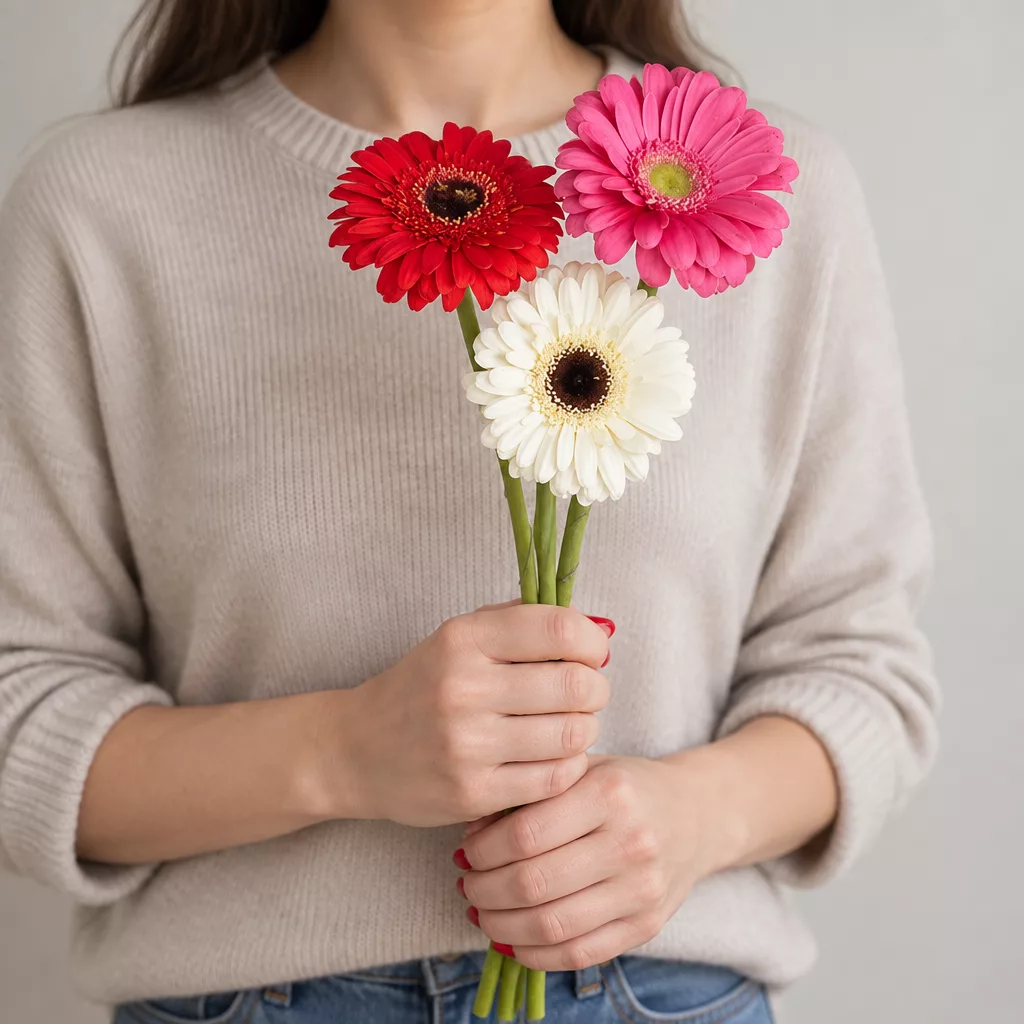
For personal celebrations like birthdays or anniversaries, warmth and sincerity are the priorities. Russians are not embarrassed by affectionate language between friends or family — phrases that express genuine love or deep friendship are entirely appropriate and will not read as excessive. The mistake most senders make is erring too far toward the neutral. A slightly warmer card than you would normally write in English is usually exactly right for a Russian recipient. Match the flowers to the tone: soft garden roses and peonies suit tender messages, while bold sunflowers or bright gerberas carry cheerful, celebratory energy.
Writing in English Versus Writing in Russian
You do not have to write in Russian for your card to be well received. Many Russians, particularly in cities like Saint Petersburg and Moscow, read English comfortably, and a card written in sincere, clear English from a foreign sender carries its own charm — it shows the effort of reaching across a language. If your recipient speaks English, writing in your native language is completely appropriate and often more personal than a stilted translation.
That said, including even one line in Russian — a greeting, a closing phrase, or a single wish — can make a significant impression. It signals that you made an effort to step into the recipient's world, and Russians notice that kind of gesture. You do not need to be fluent. A simple phrase written carefully is far better than a complex sentence riddled with errors.
If you want to include Russian text, use transliteration carefully. The sounds that trip up English speakers most often are the soft sign (which softens the preceding consonant), the letters Ы and Э, and the difference between Ш and Щ. For a card, you are likely working with standard phrases rather than composing original sentences, which makes transliteration manageable. Tools like Google Translate can give you Cyrillic text to copy directly, which is safer than attempting to transliterate by ear. If you are ordering through Turboflora, you can write your message in English and our team will ensure it is presented clearly — you do not need to worry about Cyrillic input yourself.
Phrases That Work: Birthdays and Personal Celebrations
For a birthday card, the most common Russian opening is С днём рождения — transliterated as S dnyom rozhdeniya — which simply means Happy Birthday. Following that with a personal wish is where your card becomes memorable. Rather than generic phrases about happiness and health, try to name something specific: a dream the person has mentioned, a quality you admire in them, or a shared experience you are grateful for.
In English, a card that works well for a Russian birthday recipient might read: 'Wishing you a day as bright as you make every room you walk into. May this year bring everything you have been working toward.' That kind of specificity and warmth translates across languages without feeling foreign. If you want to close in Russian, Всего самого лучшего — Vsego samogo luchshego — means 'All the very best' and is universally appropriate.
For anniversaries and romantic occasions, the phrase Люблю тебя — Lyublyu tebya — means 'I love you' and is used between partners without any awkwardness. С годовщиной — S godovshchinoy — marks an anniversary. Russians tend to appreciate cards that name what the relationship means rather than simply marking the date. A line like 'Every year with you feels like a gift I did not expect' reads beautifully in both English and Russian sensibility. Pair this kind of card with red roses, white ranunculus, or blush peonies — flowers that carry romantic weight without needing explanation.
Phrases That Work: Professional and Formal Occasions
When the occasion is professional — a promotion, a successful project, a company jubilee, or a colleague's significant birthday — the card should feel respectful and genuinely congratulatory without crossing into overfamiliarity. Russians in formal contexts appreciate acknowledgment of specific achievement rather than blanket praise. Saying 'Your dedication to this project was clear to everyone who worked alongside you' lands better than 'You did a great job.'
A useful Russian phrase for professional congratulations is Поздравляю с успехом — Pozdravlyayu s uspekhom — which means 'Congratulations on your success.' For a promotion specifically, Поздравляю с повышением — Pozdravlyayu s povysheniem — is precise and appropriate. Closing a formal card with Желаю дальнейших успехов — Zhelayu dalneishikh uspekhov — which translates as 'Wishing you continued success' — is a phrase Russians recognize as genuinely respectful rather than formulaic.
For a formal bouquet accompanying a professional card, classic arrangements work best: white or cream chrysanthemums, burgundy roses, or a structured arrangement of alstroemeria and eucalyptus. These flowers read as considered and appropriate rather than overly romantic or casual. The card and the flowers should feel like they belong together — a bold, colorful wildflower arrangement paired with a stiff corporate message creates a strange dissonance that the recipient will notice. Let the tone of the card guide the flower choice, or let the flower choice guide the tone of the card.
Common Mistakes and How to Avoid Them
The most common mistake non-Russian senders make is writing a card that is too short and too vague. 'Thinking of you' or 'With best wishes' on their own feel incomplete to a Russian reader who expects the card to carry a real message. Even if you keep the card brief, make sure it contains one specific, personal thought — something that could only have been written by you, for this person, on this occasion.
The second common mistake is mistranslating through a machine tool and not checking the result. Automated translation tools have improved significantly, but they still stumble on tone. A phrase that sounds warm in English can come out oddly formal or even slightly cold in Russian, and vice versa. If you are writing in Russian and are not confident in the translation, it is safer to write in English and add just one authentic Russian phrase rather than risk a full card that reads strangely.
A third mistake is misusing the formal and informal 'you' in Russian. Russian has two forms: Вы (Vy) for formal or plural use, and ты (ty) for informal and close relationships. Using ты with someone you address formally in real life can feel presumptuous; using Вы with a close friend can feel bizarrely distant. If in doubt, Вы is the safer choice for anyone who is not a very close friend or family member. Finally, avoid generic superlatives — phrases like 'the best person in the world' or 'the most wonderful human' are so common in Russian greeting card culture that they have lost meaning. A specific, observed compliment will always feel more genuine.
Presentation Details That Make the Card Feel Complete
The physical presentation of the card matters more in Russian gifting culture than many senders expect. A card that is handwritten — even in imperfect handwriting — feels more personal than a printed insert. If you are ordering flowers for delivery and providing your message digitally, our team at Turboflora prints your message clearly and attaches it to the bouquet, but if you have the opportunity to write by hand, that extra step is always noticed.
The signature is worth thinking about carefully. Russians often close cards with a phrase before their name — something like С любовью — S lyubovyu — meaning 'With love,' or С уважением — S uvazheniem — meaning 'With respect,' for more formal cards. These closing phrases are not just pleasantries; they set the final emotional tone of the card. Choosing the right one is as important as the opening line.
If your bouquet includes a specific flower that has meaning to the recipient — perhaps a flower that grows in the region they are from, or a variety they have mentioned loving — name it in the card. Something like 'I chose peonies because you once said they were your favorite' turns a beautiful arrangement into a story. Russians respond deeply to this kind of attentiveness. It shows that the flowers were not simply ordered but genuinely chosen, and that distinction is exactly what makes a gift feel like an act of care rather than a transaction. That feeling is what a great card, paired with a great bouquet, is designed to create.
A card is never just words — it is the part of the gift that the recipient returns to after the flowers have been arranged in water and the wrapping has been set aside. For a Russian recipient, a card that is warm, specific, and sincere will be remembered long after the last petal has fallen. You do not need to be fluent in Russian to write something genuinely touching. You need to know the person, name the occasion, and let a little honesty onto the paper. The flowers carry the visual message; the card carries the one that stays. We deliver bouquets across Russia in 1–2 hours.
Frequently asked questions
Is it acceptable to write the card entirely in English for a Russian recipient?
Yes, especially if your recipient speaks English or if English is your only language. A sincere card in clear English is far better than an awkward machine translation. You can add one simple Russian phrase — a greeting or closing — to show thoughtfulness without risking a mistranslation that changes the tone of the whole message.
Should I use the recipient's first name and patronymic on the card?
For formal or professional occasions, using the first name and patronymic — for example, Irina Mikhailovna — is a respectful touch that Russians appreciate. For close friends or family, the first name alone or even a nickname is more natural. If you are unsure of the patronymic, using just the first name is always appropriate and will not cause offence.
What is the safest Russian phrase to include if I only know one?
С днём рождения — S dnyom rozhdeniya — works for birthdays, but for a universal phrase that suits almost any celebration, Поздравляю — Pozdravlyayu — meaning simply 'Congratulations' or 'I congratulate you' — is warm, clear, and appropriate across a wide range of occasions from birthdays to professional achievements to new beginnings.
How long should the card message be for a Russian recipient?
Three to five sentences is ideal for most occasions. Russians value sincerity over length, so a short message with one specific, personal observation will land better than a long generic paragraph. If the occasion is very significant — a major birthday milestone or a meaningful professional achievement — you can write a little more, but clarity and warmth always matter more than word count.
Can I mention the specific flowers I chose in the card message?
Absolutely, and it is a detail that Russians find genuinely touching. Naming the flowers and briefly explaining why you chose them — because they are the recipient's favourite, because their colour felt right for the occasion, or because they carry a particular meaning — turns the bouquet into a considered personal gesture rather than a standard gift. It shows the flowers were chosen, not simply ordered.
Ready to send flowers?
Pick the city, choose the bouquet, and a local florist takes it from there.
Choose a city →