Where Does the Florist's Chrysanthemum Come From?
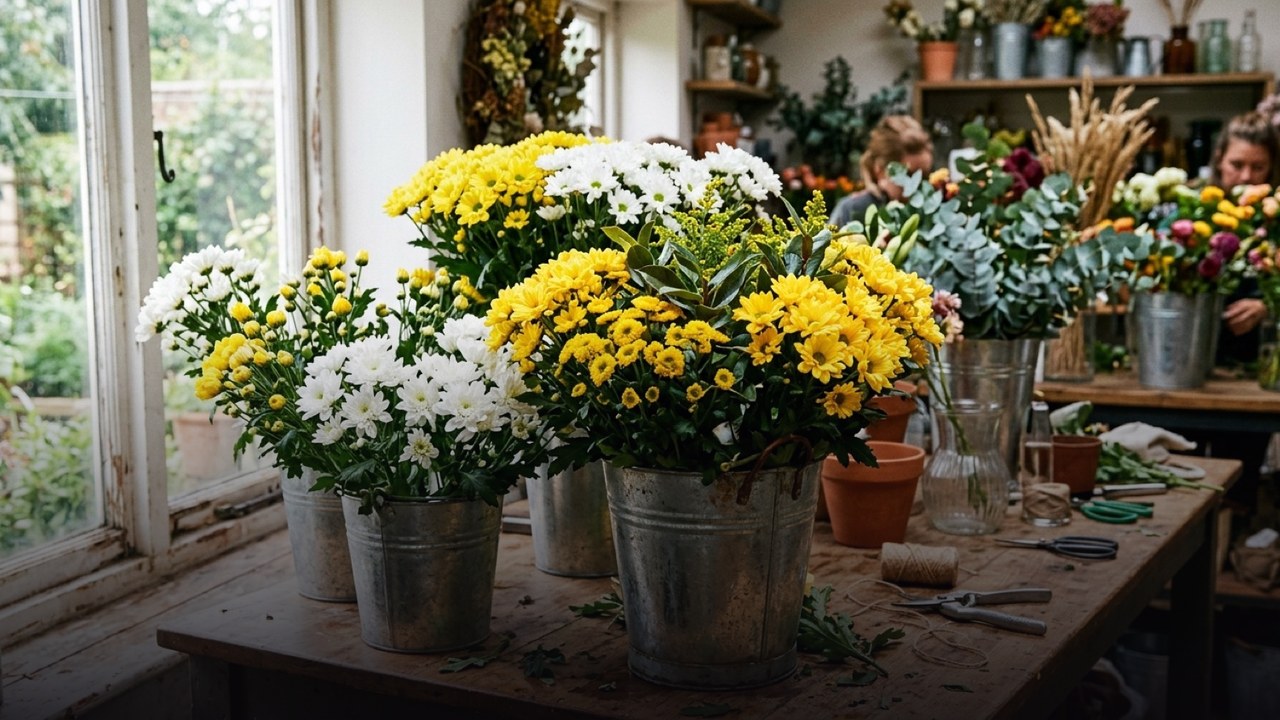
The florist's chrysanthemum originated through centuries of cultivation and hybridisation in China, drawing on East Asian wild chrysanthemums. Often called Chrysanthemum × morifolium, it is a cultivated hybrid group rather than a single wild species; its later development in Japan also helped shape the flowers you see in bouquets today.
That history explains why one flower name covers such different-looking blooms: small open daisies, neat pompons and large heads with long, curling petals. If you are choosing chrysanthemums for someone in Russia, their shape, colour and presentation are more useful guides than the name alone. Here is how their origins connect with the practical decisions you make when sending a bouquet.
Chinese origins and the Japanese chapter
Chrysanthemums have a long history of cultivation in China, where growers selected plants for desirable flowers over many generations. The modern florist's chrysanthemum has a complex ancestry, so assigning it one wild parent would be misleading. Chrysanthemum indicum is among the species associated with that ancestry, but a florist's cultivated variety should not be treated as identical to the wild plant.
Chrysanthemums later reached Japan, where cultivation and selection developed further. The flower became closely associated with the Japanese imperial household, whose emblem is a stylised chrysanthemum. That cultural connection is strong enough to make Japan a common answer to the origin question, but it describes an important chapter in the flower's history rather than the beginning of its cultivation.
Cultivated chrysanthemums subsequently spread to European gardens and underwent further breeding. The name itself comes from Greek words meaning gold and flower, reflecting the yellow flowers associated with the name. A Greek-derived name, Chinese cultivation history and Japanese symbolism can therefore all be correct at once: they describe different parts of the same story.
What 'florist's chrysanthemum' tells you about a bouquet
The term usually refers to cultivated chrysanthemums grown for ornamental use, especially the familiar cut flowers sold in bouquets. You may encounter Chrysanthemum morifolium without the multiplication sign, or the older name Dendranthema grandiflorum. Botanical naming varies between references; for choosing a gift, a clear photograph and a description of the flower form are usually more useful than the Latin label.
Two practical terms are spray and disbud. A spray chrysanthemum carries several flower heads on a branching stem. A disbud is grown with side buds removed so that one main bloom develops. This affects the bouquet's outline: sprays create a branching, textured appearance, while large single heads provide more distinct focal points. Neither term identifies a separate country of origin.
Ask about both stem count and flower-head size when comparing arrangements. Five branching stems and five large single-headed stems can create very different results, even though the stem count matches. Petal shape matters too: an open daisy centre looks quite different from a tightly packed pompon or a spider form with long, narrow petals. Describe the appearance you want rather than relying on 'chrysanthemums' alone.
Bouquets we can deliver




Meanings depend on where you send them
Chrysanthemums carry several cultural meanings, and there is no universal code that every recipient follows. In Chinese cultural traditions they are associated with autumn and longevity; in Japan they also have imperial associations. These connections can add interest to a gift, but they do not mean that a person receiving a modern bouquet will interpret each flower through its historical symbolism.
In some European countries, chrysanthemums have strong associations with remembrance and cemetery visits. That can make an overseas sender hesitate. In Russia, they are also familiar flowers for everyday gifts and celebrations, so the flower itself does not automatically make a bouquet a memorial arrangement. The recipient's background, the occasion and the overall presentation still deserve attention.
For Russian gift etiquette, an odd number of flowers is the usual choice when the count is clear; even numbers are traditionally associated with mourning. With branching sprays or mixed arrangements, counting individual flower heads can be confusing, so explain the occasion when choosing. Our article on chrysanthemums in Russia explores their place in gift bouquets in more detail.
Choose the colour and shape around the recipient
Start with what the recipient enjoys looking at. If you know they prefer soft colours, a restrained palette is a more dependable choice than an elaborate claim about what each shade means. Yellow chrysanthemums do not universally mean separation, and white chrysanthemums do not have one fixed meaning across all countries. Personal taste and cultural context give those colours their significance.
Then choose the flower form for the impression you want. Small daisy-like sprays can suit an informal thank-you, while large rounded heads can give an arrangement a more structured appearance. These are visual choices rather than rules of etiquette. If you are working from a photograph, identify the features that matter most: visible centres, rounded blooms, long petals or a particular balance of colours.
Make the occasion clear in the card, especially if you are sending from abroad and cannot explain the gift in person. A sentence such as 'Thinking of you on your birthday and wishing we could celebrate together' removes ambiguity more effectively than a supposed flower-language formula. You can browse the bouquets catalogue for a visual starting point, then discuss your preferences before confirming an order.
How to care for cut chrysanthemums at home
Begin with a clean vase and fresh water. Remove any leaves that would sit below the waterline, then recut the stem ends with clean, sharp scissors or secateurs before putting them in water. Submerged foliage decays and makes the vase harder to keep clean. If flower food is supplied, follow its dilution instructions rather than estimating how much powder the vase needs.
Place the bouquet away from radiators, strong direct sunlight and ripening fruit. Check the water level every day, particularly with a full arrangement whose stems may hide it. Replace water when it becomes cloudy, clean the vase and remove damaged foliage or fading flowers. A cool position helps, but a chrysanthemum's association with autumn is not evidence that a cut bouquet can safely be left in freezing conditions.
Avoid promising yourself a fixed vase life based on the flower name. Freshness at arrival, room conditions and care all affect how long the bouquet looks good. Support large flower heads while arranging the stems so their weight does not pull against a narrow vase opening. For a fuller routine, see our guide to keeping cut flowers fresh.
Sending chrysanthemums to someone in Russia
We deliver flowers across Russia. City delivery costs 500 RUB; for remote districts and suburbs, the operator confirms the price when confirming your order. Before ordering, gather the recipient's address and contact details, your preferred delivery date and the card text. If you are abroad, make clear that the delivery time you are discussing is the time at the recipient's destination.
In large cities, express delivery is available within 1–2 hours after the order is confirmed. You can also choose an exact time with a tolerance of plus or minus 30 minutes, or a window of 09–12, 12–15, 15–18 or 18–21. Orders can be placed 1–30 days ahead. Use WhatsApp to agree the time, address and card text, get help choosing a bouquet, or arrange a photo before delivery.
Delivery is anonymous by default: the courier does not name the sender, so sign the free card if you want the recipient to know who sent it. The courier calls about 15 minutes before arrival. If the recipient is absent, we agree a second delivery that day or handover to a neighbour or concierge with your consent. Online checkout uses CloudPayments; check the payment options displayed there, as acceptance of every foreign card is not guaranteed. We deliver bouquets across Russia in 1–2 hours.
Frequently asked questions
Is the florist's chrysanthemum originally Chinese or Japanese?
Its cultivation history begins in China, with Japan playing an important role in its later development and cultural significance. Modern florist's chrysanthemums are cultivated hybrids with complex ancestry, rather than one unchanged wild species.
What is the botanical name of the florist's chrysanthemum?
It is commonly called Chrysanthemum × morifolium, although naming differs between botanical and horticultural references. You may also see Chrysanthemum morifolium or the older name Dendranthema grandiflorum.
Are chrysanthemums appropriate birthday flowers in Russia?
Yes, chrysanthemums are used in birthday and other gift bouquets in Russia. Consider the recipient's preferences and choose an odd number when the flowers form a clearly countable gift.
Does the flower's origin tell me where my bouquet was grown?
No, botanical origin describes the history of the cultivated plant group. It does not establish the growing location of the stems in an individual bouquet.
Can I pay for delivery to Russia with a foreign card?
Online checkout uses CloudPayments, and you should check the payment options displayed at checkout. Acceptance of every foreign card cannot be guaranteed.
Ready to send flowers?
Pick the city, choose the bouquet, and a local florist takes it from there.
Choose a city →