Flowers for a Russian Colleague: Office-Friendly Choices That Land Well
Sending flowers to a colleague in Russia is a genuinely warm gesture, but the office setting adds a few quiet rules that are worth knowing before you order. Get the variety, size, and timing right and your bouquet will sit on their desk all week. Get it wrong and it either overwhelms a shared workspace or carries an unintended message. This guide walks you through exactly what works, from the flower itself to the moment it arrives at the reception desk.
Why the Workplace Changes Everything About Your Flower Choice
A bouquet that would delight someone at home can create real awkwardness in an open-plan office. Strong fragrance is the first concern. Lilies, tuberose, and hyacinth smell wonderful in a living room but can trigger headaches and allergic reactions when colleagues are sitting nearby for eight hours. Russian offices tend to be warm and dry, which intensifies scent further, so even a mildly fragrant flower becomes more pronounced by midday.
Size matters just as much. A grand cascading arrangement that works beautifully on a hallway table simply has nowhere to go on a standard desk beside a monitor, a keyboard, and a coffee cup. Your colleague will either have to move it to a windowsill or leave it at reception, which rather defeats the personal touch.
There is also a social dimension specific to Russian workplace culture. Flowers given to one person in a shared office draw attention, and colleagues will notice. That is not a problem in itself, but it means the bouquet becomes a small public statement. A tasteful, medium-sized arrangement reads as respectful and considered. An extravagant one can feel showy in a way that makes the recipient uncomfortable rather than celebrated. Choosing well is an act of care for how they will feel in front of their team, not just how they feel when they first unwrap the paper.
Bouquets we can deliver



The Safest Varieties for a Russian Office Setting
Roses remain the most universally accepted flower in Russia, and for the office they work best in a single colour rather than a mixed palette. White, cream, or soft pink roses read as elegant and neutral. Red roses carry romantic weight in Russian culture and are best reserved for personal relationships, so avoid them for a professional context unless you know the person very well.
Spray chrysanthemums are an excellent office flower and underused in international gift-giving. They have almost no fragrance, they last ten to fourteen days in water, and their compact, multi-headed stems make them easy to arrange in a small vase. In Russia they are an everyday flower with no negative connotations in a workplace context.
Eustoma, sometimes called lisianthus, is another strong choice. The ruffled petals look expensive and the stems hold well in a warm room. Alstroemeria is similarly practical: long-lasting, nearly scentless, and available in clean colours that suit a professional setting. Gerbera daisies bring a friendly, cheerful energy that works well for a birthday or a send-off without feeling overly formal.
What to avoid: stargazer lilies and oriental lily varieties for fragrance reasons already mentioned, and anything with a very short vase life like sweet peas or anemones, which will wilt before the working week is out. Carnations are perfectly acceptable in Russia despite their dated reputation elsewhere, but choose spray carnations in modern colours rather than the large single-headed variety, which can look old-fashioned.
Reading the Occasion Before You Pick Up the Phone
The occasion shapes the bouquet more than any other single factor. A birthday calls for something with energy and colour: think warm peach eustoma with white spray chrysanthemums, or coral alstroemeria with eucalyptus. The goal is a bouquet that feels celebratory but not theatrical.
A farewell or retirement gift has a different emotional register. Here you want something that feels considered and lasting, a combination that photographs well and that the recipient will remember. Cream roses with dusty miller and a few dried elements like cotton stems or pampas grass create a contemporary arrangement that travels well and suits any home once it leaves the office.
Promotions and professional milestones are common occasions for flowers in Russian workplaces. A colleague receiving a new title or completing a major project is very likely to receive flowers from their team, and individual gifts on top of that are warmly received. For this occasion, white or champagne-toned flowers with greenery feel appropriately sophisticated without veering into the romantic.
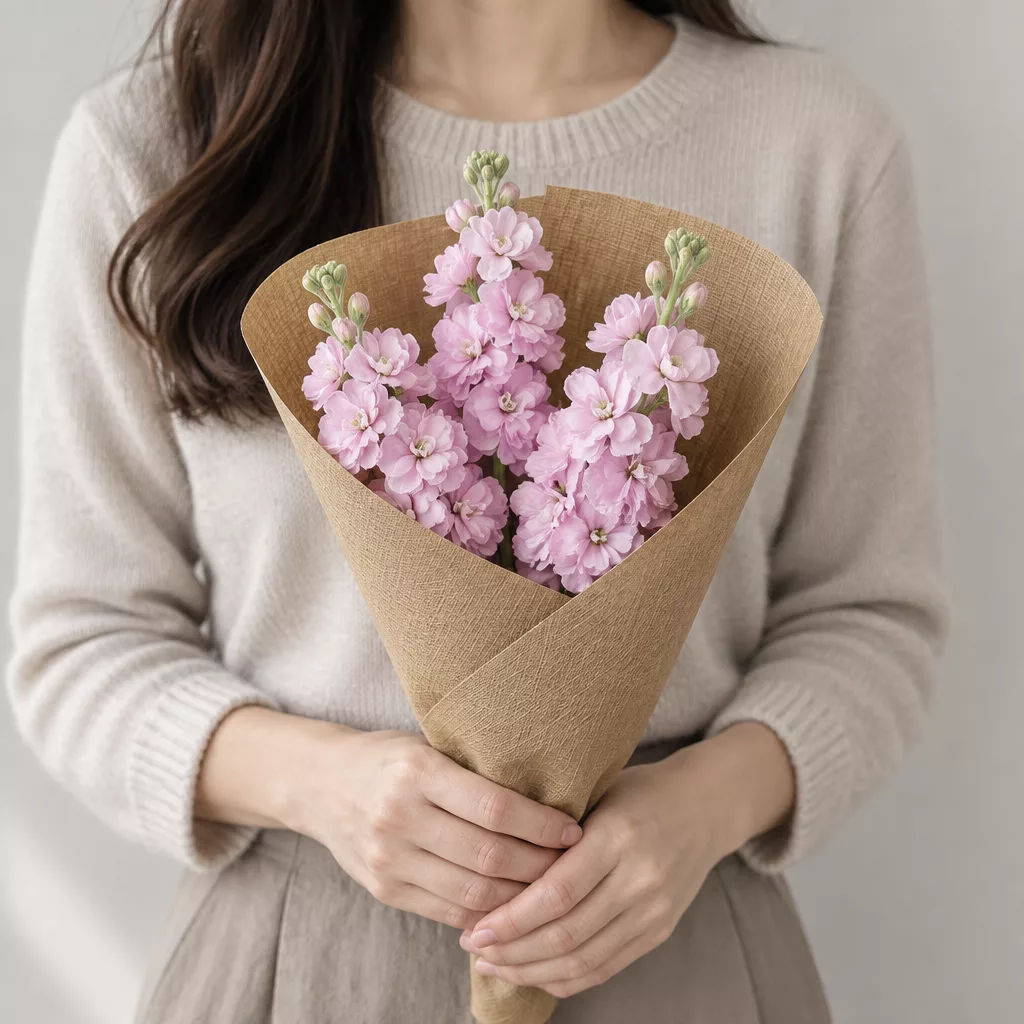
If you are sending flowers simply to say thank you or to mark a colleague returning from a long absence, keep the arrangement modest and bright. Three to five stems of a single variety wrapped in kraft paper with a handwritten note is entirely appropriate and avoids any misreading of the gesture. In Russian professional culture, simplicity reads as sincerity, and a small, well-chosen bouquet often makes a stronger impression than a large one assembled without a clear intention.
Choosing by Budget Without Losing the Effect
The most important thing to understand about budget and flowers is that fewer stems of one quality variety always outperforms many stems of mixed lower-quality ones. A bouquet of seven long-stemmed white roses in a clean wrap looks deliberate and generous. A bouquet of twenty mixed stems from five different flowers at the same total cost can look chaotic and rushed.
At a modest budget, spray chrysanthemums or alstroemeria are your best allies. Both are genuinely long-lasting, both look clean and intentional when wrapped well, and both are available in enough colour variation to suit the occasion. A monochromatic arrangement of a single variety in one or two tones is a florist's trick for making a modest spend look considered.
At a mid-range budget, eustoma combined with a complementary greenery like ruscus or pittosporum creates a full, lush look that reads as a proper gift. Add three or four spray roses to give the arrangement some height variation and the result looks like something from a boutique florist window.
At a higher budget, garden roses with their layered petals and soft fragrance are the premium office choice, provided you select low-fragrance varieties. David Austin-style garden roses have become widely available in Russia and are immediately recognisable as something special. Pair them with eucalyptus and white eustoma for a combination that photographs beautifully and lasts well in a warm room.
In every budget tier, the wrapping matters. Kraft paper with a satin ribbon or a simple linen wrap signals care and professionalism in a way that cellophane alone does not.
Delivery to a Russian Office: Timing and Logistics
Russian office hours typically run from nine in the morning to six in the evening, with lunch between one and two. The best delivery window for an office bouquet is between ten in the morning and noon: your colleague is settled at their desk, the day has not yet become hectic, and they have time to find a vase and enjoy the moment before meetings take over.
Late afternoon delivery works too, but there is a risk the recipient has already left or is in back-to-back meetings. Avoid requesting delivery right at nine when offices are still filling up and reception staff are managing arrivals.
Always provide the full address including the floor and office number, the recipient's full name, and a working phone number. Russian office buildings often have security desks or coded entry systems, and a courier without a specific contact name may be turned away or kept waiting. A brief note in the order specifying the recipient's department helps enormously.
If the occasion is a surprise, it is worth noting that in most Russian offices the reception or security staff will call ahead to the recipient before allowing the delivery through. This is standard procedure, not a spoiler. Your colleague will still be delighted when the bouquet arrives at their desk.
Turboflora delivers across Russia within one to two hours, which means you can order the morning of the occasion without anxiety. For a birthday that you remembered the night before, same-day delivery is entirely realistic. The key is ordering before the midday rush when possible, giving the courier the clearest possible window.
Helping Your Colleague Keep the Flowers Fresh at Work
Russian offices are often centrally heated to high temperatures in winter and air-conditioned quite aggressively in summer. Both conditions shorten vase life. Including a small care card with the bouquet is a genuinely useful gesture, not a fussy one, and most colleagues appreciate a few simple instructions.
The most important tip is a diagonal cut on the stems before placing them in water. This increases the surface area for water uptake and makes a noticeable difference to how long the flowers last. A sharp knife is better than scissors, which can crush the stem. If your colleague does not have either at their desk, even a clean break by hand is better than no cut at all.
Water temperature matters more than most people realise. Cool or lukewarm water is ideal. Very cold water slows water uptake and very hot water can shock the stems. The vase should be clean, and any leaves that would sit below the waterline should be removed to prevent bacterial growth.
For an office setting, a medium-height vase is practical. Too tall and the arrangement becomes unstable on a desk; too short and the stems crowd each other. If your colleague does not have a vase at work, a clean glass or even a water bottle with the top cut off will keep the flowers going until they can bring something from home.
Changing the water every two days and trimming the stems slightly each time can extend the life of roses and eustoma by three to four extra days. Spray chrysanthemums are more forgiving and will last even with minimal care, which is one more reason they are such a reliable office flower.
Small Details That Make the Gesture Feel Genuinely Russian
Flowers in Russia are given in odd numbers. This is one of the most consistent customs in Russian gift-giving culture and it applies across all occasions except mourning, where even numbers are traditional. If you are ordering a bouquet, ask for an odd number of stems: five, seven, nine, eleven. An even number will be noticed by your Russian colleague and may create a moment of confusion or discomfort that you did not intend.
The note matters. Russians tend to write longer, warmer dedications than is common in some other cultures. A card that simply says Happy Birthday feels thin. Something that acknowledges the person specifically, their work, their character, or the occasion in a slightly fuller way, lands much better. You do not need to write in Russian; an English note from an international sender is perfectly understood and often treasured. But put some thought into the words.
Wrapping style has shifted in Russian floristry over the last decade toward the kind of natural, textural presentation common in European boutique shops: kraft paper, linen ribbon, dried elements mixed with fresh ones. This style reads as contemporary and tasteful in a Russian office context. The older style of tight cellophane cones with a large bow is still seen but feels dated to many recipients under fifty.
Finally, do not overthink the colour symbolism. Yellow flowers, sometimes said to bring bad luck in older Russian folk belief, are perfectly acceptable as a gift today, particularly among urban professionals. White is universally positive. Pink is warm and friendly. The occasion and the quality of the flowers matter far more than colour superstitions that have largely faded from everyday life.
Sending flowers to a colleague in Russia is one of those gestures that, done thoughtfully, is remembered for a long time. The office context simply asks you to think a little more carefully than you might for a home delivery: lighter fragrance, a manageable size, an odd number of stems, and a note that says something real. The varieties that work best in this setting, spray chrysanthemums, eustoma, alstroemeria, roses in neutral tones, are not second choices. They are the flowers that look beautiful on a desk on Monday and still look beautiful on Friday. Choose for the person and the place, and the bouquet will do everything you are hoping it will.
Frequently asked questions
Is it appropriate to send flowers to a male colleague in Russia?
Yes, and it is more common than in many Western countries. Men in Russia regularly receive flowers for birthdays, professional milestones, and farewells. Choose something structured and not overly romantic in colour: white or cream roses, spray chrysanthemums in cool tones, or a simple green and white combination work well without any awkwardness.
Can I send flowers to a Russian office if I do not know the exact desk location?
Providing the company name, floor, and the recipient's full name is usually enough. Russian office buildings typically have a reception or security point where couriers check in. Include a working phone number for the recipient in your order notes so the courier can reach them directly if the building has restricted access.
What is the significance of giving an odd number of flowers in Russia?
Odd numbers are associated with celebration and living occasions in Russian tradition, while even numbers are reserved for mourning. This custom is widely observed across generations, so a bouquet of six or eight stems may create unintended discomfort. Ordering five, seven, or nine stems is a simple way to show cultural awareness.
How long will office flowers last in a typical Russian workplace environment?
In a centrally heated or air-conditioned Russian office, expect roses and eustoma to last five to seven days with basic care. Spray chrysanthemums and alstroemeria can reach ten days or more. Keeping the vase away from direct heat sources, changing the water every two days, and trimming stems slightly each time will extend vase life noticeably.
Are there any flowers I should definitely avoid sending to a Russian office?
Avoid strongly fragrant varieties like oriental lilies, tuberose, and hyacinth, which can cause discomfort in enclosed spaces. Skip red roses for professional recipients unless the relationship is close, as they carry romantic meaning in Russian culture. Very short-lived flowers like sweet peas are also a poor choice for an office where the recipient cannot give them constant attention.
Ready to send flowers?
Pick the city, choose the bouquet, and a local florist takes it from there.
Choose a city →