Flowers for a New Baby in Russia: Hospital Discharge Traditions and What to Send
The moment a new mother steps through the maternity hospital doors holding her baby for the first time is one of the most photographed, most emotional scenes in Russian family life. If you have never witnessed a Russian discharge ceremony, you might be surprised by the scale of it — a crowd of relatives, balloons, gifts, and armfuls of flowers waiting outside. Getting the flowers right matters enormously, and if you are sending from abroad or simply unfamiliar with local customs, a few insider details will help you choose something genuinely beautiful rather than accidentally awkward.
The Russian Hospital Discharge Ceremony: What Actually Happens
In Russia, giving birth is treated as a major family milestone that deserves a proper public celebration. The mother and newborn typically leave the maternity hospital, called a roddom, on day three or four after a straightforward birth. Unlike in many Western countries where discharge is a quiet, practical handover, the Russian tradition turns it into a small ceremony.
Family members — fathers, grandparents, siblings, close friends — gather outside the main entrance well before the scheduled time. The father often receives the swaddled baby from a nurse at the door, wrapped tightly in a flannel blanket tied with a ribbon: pink for a girl, blue for a boy. This ribbon colour is the single most important detail for florists to know, because it traditionally guides the colour palette of the flower arrangement.
Photographers are frequently hired, speeches are made, and the whole group may move on to the family home for a celebratory meal. Flowers presented at this moment are highly visible — they appear in every photograph and video. A limp, travel-worn bouquet will stand out for the wrong reasons. This is why timing the delivery precisely and choosing varieties that hold their structure outdoors, even briefly in cold weather, matters as much as the aesthetic itself. The ceremony is joyful, generous, and unapologetically sentimental, and the flowers should match that energy completely.
Bouquets we can deliver

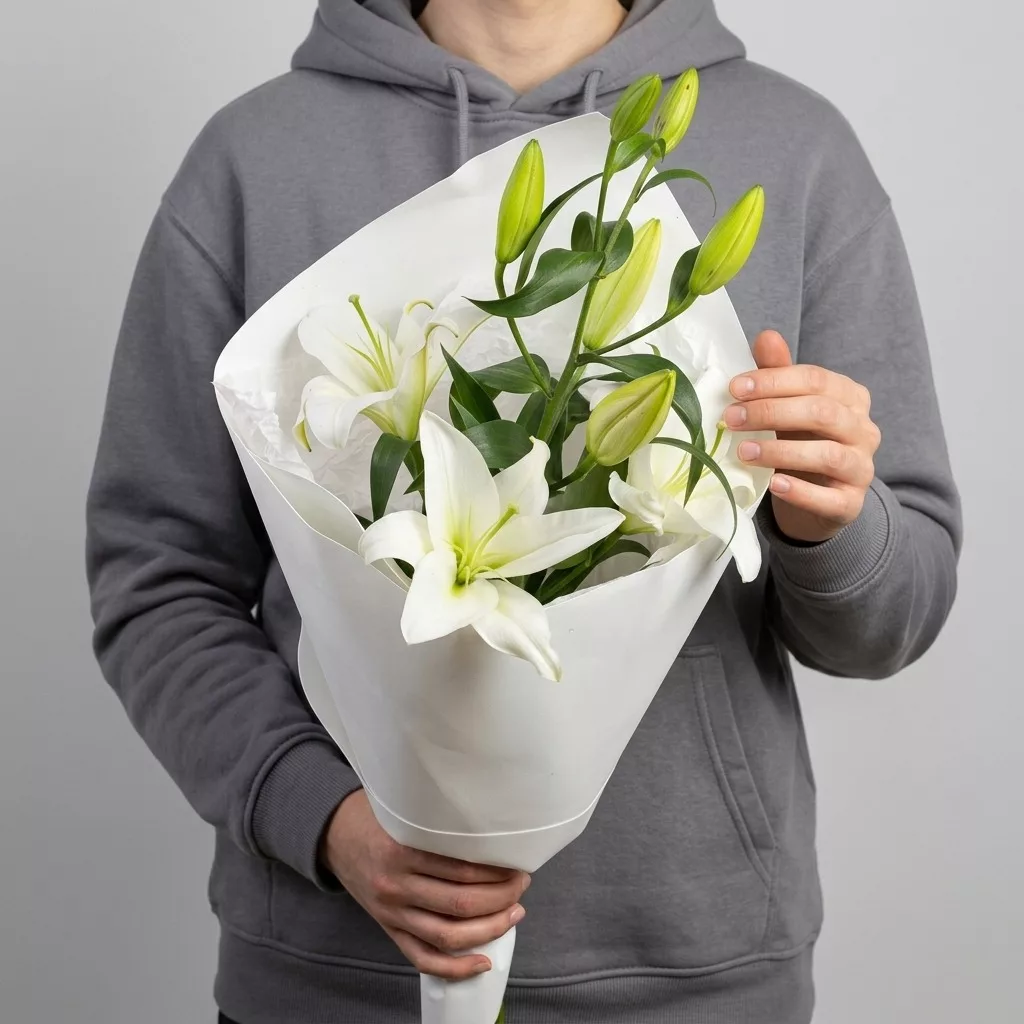
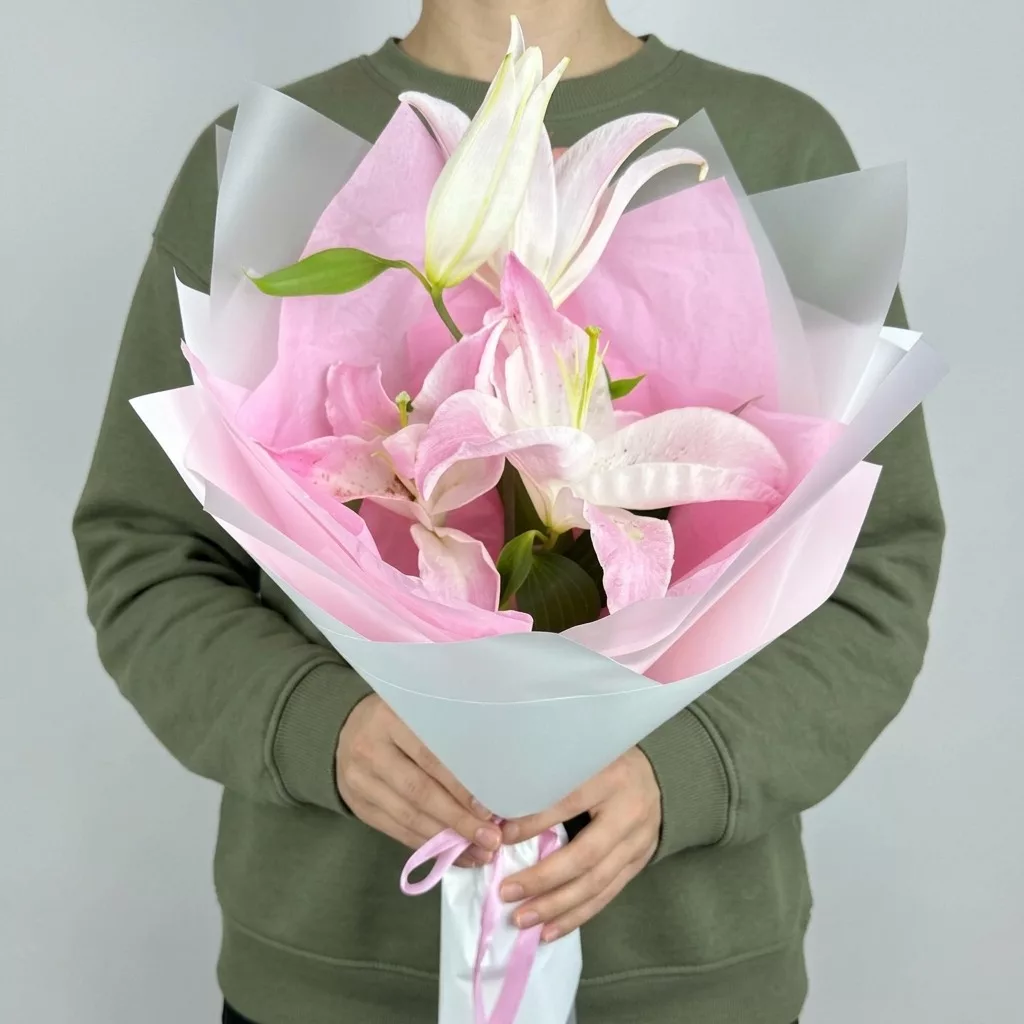

Colour Traditions: Pink, Blue, White, and When to Break the Rules
The pink-for-girl, blue-for-boy convention is followed widely in Russia, but it is softer and more flexible than it might sound. For a girl, soft pink roses, blush peonies when in season, pale pink ranunculus, and white eustoma with dusty miller accents are all considered ideal. The palette can extend into lilac, lavender, and cream without breaking any rule — the key word is soft. Harsh magenta or deep crimson reads as a romantic gift rather than a birth celebration and can feel slightly off-key to Russian guests at the ceremony.
For a boy, the tradition is trickier. Pure blue flowers are genuinely rare in nature — delphiniums and hydrangeas in steel blue are the most reliable options. Most experienced florists working with birth bouquets for boys lean into white and cream arrangements accented with blue ribbon, blue wrapping paper, or a single stem of blue hydrangea as a focal point. This approach photographs beautifully and avoids forcing an unnatural colour.
When the baby's sex was not announced in advance or the sender simply wants something universally appropriate, white is always correct. White roses, white spray chrysanthemums, white tulips in season, and white orchid stems all work well. Some families now request gender-neutral arrangements in soft yellow or peach, which has become more accepted over the past decade. If you are unsure, choosing white with quality greenery such as eucalyptus or ruscus is the safest and most elegant decision you can make.
The Best Flower Varieties for a Discharge Bouquet
Not every beautiful flower is a sensible choice for this occasion. The bouquet will be held outdoors, possibly for thirty minutes or longer, photographed repeatedly, and then transported home in a car. You need varieties with genuine structural resilience.
Roses are the default choice for good reason. Garden-style roses with dense, layered petals — varieties like David Austin-style blooms — hold their shape well and look generous in photographs. Standard hybrid tea roses with tightly closed buds travel better in cold weather than fully open heads. In autumn and winter, which covers a long stretch of the Russian calendar, a bud that is three-quarters open will survive a cold outdoor ceremony far better than a fully blown flower.
Eustoma, also sold as lisianthus, is an outstanding supporting flower: it looks delicate but is surprisingly robust, holds water well in floral foam, and comes in white, soft pink, lavender, and purple. Ranunculus is beautiful but more fragile — it suits warmer months and should be used when same-day delivery is guaranteed.
Hydrangeas add volume and work well as a base flower for large statement arrangements. Spray roses fill gaps elegantly and last well. Tulips are appropriate in spring but wilt quickly in warmth, so they are a seasonal choice rather than a year-round one.
Avoid tropical varieties like anthuriums or birds of paradise — they read as office or corporate gifts in Russian culture rather than tender, celebratory ones. Avoid highly fragrant flowers like lilies near a newborn, as strong scent can be overwhelming for a baby in an enclosed space.
Timing Your Delivery: The Details That Make or Break It
Discharge times in Russian maternity hospitals are rarely announced more than a day in advance, and they can shift by several hours depending on the doctor's schedule and the mother's paperwork. This unpredictability is the single biggest logistical challenge for anyone ordering flowers for the occasion.
The practical approach is to confirm the approximate discharge window with the family as late as possible — ideally the evening before or on the morning of the day itself — and then place the order for delivery to the home address timed to arrive one to two hours before the family is expected back. Delivering to the hospital entrance directly is possible but requires precise coordination, because flowers left waiting outside in Russian winter temperatures below minus ten degrees Celsius will suffer visibly within twenty minutes.
If the ceremony is happening outdoors in cold weather, request that the arrangement be wrapped in insulating kraft paper rather than cellophane, which conducts cold and can cause petal burn on delicate varieties. In summer, the concern reverses: direct sunlight and heat above twenty-five degrees Celsius will cause roses and ranunculus to open and soften rapidly, so a shaded delivery location matters.
Ordering the night before and specifying a two-hour delivery window for the morning of discharge is the method most experienced Russian families use. Turboflora's one-to-two-hour delivery window across Saint Petersburg makes it straightforward to time this precisely even when the hospital announces a last-minute schedule change.
What Size and Format Works Best: Bouquet, Basket, or Box
Russian discharge bouquets tend to be generous. A small hand-tied bouquet of ten stems can look underwhelming in photographs and, more importantly, may read as a token gesture rather than a genuine celebration. The standard expectation from close family — parents, siblings, grandparents — is a substantial arrangement of twenty-five stems or more, often with a mix of focal flowers, filler flowers, and quality foliage.
Hand-tied bouquets are the most traditional format and the easiest for the mother to hold while being photographed. They should be spiral-tied firmly so the stems do not splay when held at different angles. A loose, badly tied bouquet photographs poorly and can drop flowers during the outdoor ceremony.
Floral boxes, known in Russia as floral hatboxes or kompozitsii v korobke, have become extremely popular over the past several years. They are self-contained, require no vase, and look spectacular in photographs. They are particularly practical for close friends or colleagues sending a gift to the home rather than to the ceremony itself, since they sit beautifully on a table and last well in water-retaining foam.
Wicker or woven baskets with handle arrangements are another option favoured by grandparents. They have a warm, domestic quality that suits the home arrival rather than the outdoor ceremony. Avoid cellophane-wrapped supermarket-style bouquets — the wrapping style signals a last-minute purchase and does not photograph well. Whatever format you choose, ask for the stems to be cut fresh and the water tubes or foam to be properly hydrated before delivery.
Common Mistakes to Avoid When Ordering Baby Flowers in Russia
The most frequent mistake made by people unfamiliar with Russian customs is choosing the wrong occasion register. Sunflowers, for example, are cheerful and beloved in Russia, but they are associated with summer countryside warmth and are not conventionally a birth flower. Similarly, red roses carry a strong romantic connotation — sending them to a new mother from anyone other than her partner would be considered a social misstep.
Ordering without confirming the ribbon colour is another common error. If you send a pink arrangement for a boy, it will be noticed and remembered. When in doubt, ask the family directly or default to white.
Ignoring the temperature is a mistake that costs the arrangement its quality. Many people order beautiful flowers but specify delivery to an outdoor address without noting that the recipient will not be home for another three hours. A summer bouquet left in direct sunlight on a doorstep, or a winter arrangement left in a cold entrance hall below five degrees Celsius, will arrive at the ceremony looking stressed. Always specify a delivery window that matches when the family will actually be at home.
Choosing heavily scented varieties is a well-intentioned but problematic decision. Oriental lilies, for instance, have a powerful fragrance that is genuinely overwhelming in a small apartment with a newborn. Stick to lightly or un-scented varieties: roses, eustoma, ranunculus, and hydrangea all have minimal scent.
Finally, do not underestimate the card. In Russian tradition, a handwritten message, even a short one, carries significant sentimental weight. A generic printed label is noticed as impersonal.
Sending flowers for a Russian hospital discharge is one of those gestures that lands with real emotional weight when it is done thoughtfully. The ceremony is brief but vivid — those photographs will be shared widely and kept for years. Choosing the right colour palette, the right varieties for the season and temperature, the right format for the occasion, and timing the delivery precisely are not small details: they are the difference between a bouquet that becomes part of a treasured memory and one that simply wilts on a step. As florists who work with these orders every week in Saint Petersburg, we know how much the right arrangement matters to families on this particular day, and we are always glad to help you get it exactly right.
Frequently asked questions
Is it appropriate to send flowers directly to the maternity hospital in Russia?
Most Russian maternity hospitals do not allow visitors inside during the stay, so flowers are almost always presented at the discharge ceremony outside the building or delivered to the family home. Sending to the home address timed to arrive shortly before the family returns is the most reliable and practical approach, and it means the arrangement arrives in perfect condition rather than waiting outdoors in variable weather.
What if I do not know whether the baby is a boy or a girl?
White is universally appropriate and genuinely elegant for a Russian birth bouquet when the sex is unknown or the family kept it private. A well-composed arrangement of white roses, white eustoma, and eucalyptus with quality ribbon looks generous and intentional rather than neutral. Soft peach or warm cream are also widely accepted as gender-neutral alternatives that photograph beautifully at the discharge ceremony.
How far in advance should I order flowers for a Russian hospital discharge?
Because discharge times can shift at short notice, the safest approach is to confirm the approximate timing with the family the evening before and place your order that same evening for a morning delivery. Turboflora's one-to-two-hour delivery window means you can also order on the morning itself once you have a confirmed time, without sacrificing flower quality or arrangement complexity.
Are there flowers I should definitely avoid sending for a newborn occasion in Russia?
Avoid strongly scented flowers such as oriental lilies near a newborn, and avoid red roses, which carry romantic rather than celebratory connotations in Russian culture. Yellow flowers are sometimes associated with separation or ill feeling in older Russian tradition, though this is less observed among younger generations. When genuinely uncertain about a variety, white or soft pink roses are always a safe and warmly received choice.
Can I send a flower arrangement from abroad to be delivered in Saint Petersburg?
Yes. You can place an order with Turboflora online from anywhere in the world, specify the Saint Petersburg delivery address and your preferred two-hour delivery window, and include a personalised card message. Payment is handled online. The arrangement is assembled fresh on the day of delivery, so distance on your end does not affect the quality of what arrives at the ceremony.
Ready to send flowers?
Pick the city, choose the bouquet, and a local florist takes it from there.
Choose a city →