Guernsey Lilies: Identification, Growing Tips and Gift Advice
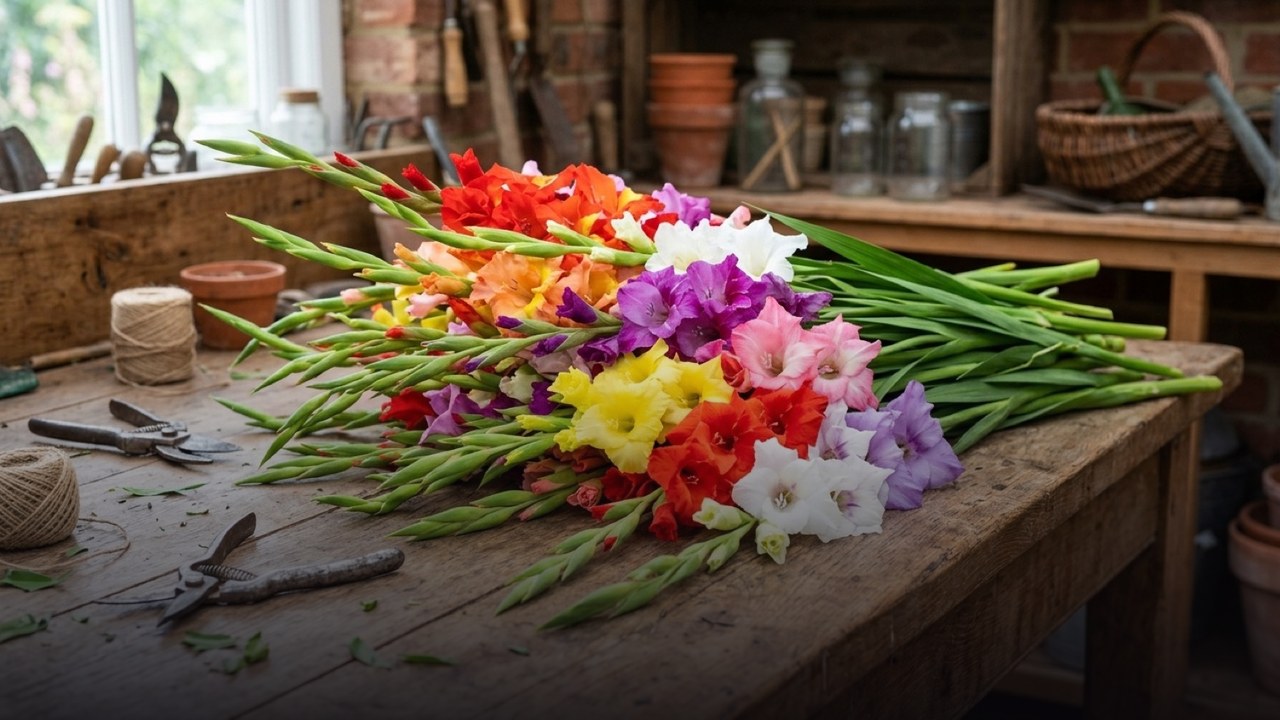
“Guernsey lillies” usually means Guernsey lilies: nerines, bulbous plants with clusters of narrow, curling petals carried on upright stems. The name is especially associated with Nerine sarniensis, although other nerines, including Nerine bowdenii, are also sold under it. They belong to the amaryllis family rather than the true lily genus, Lilium.
That distinction matters when you choose a plant, decide where to grow it or look for flowers for a gift. Different nerines follow different seasonal growth patterns, so a label saying only “Guernsey lily” is not enough to settle their care. Start with the botanical name, then consider whether you want a flowering bulb for yourself, cut stems for a vase or a bouquet delivered to someone else.
How to recognise a Guernsey lily
Look for several flowers opening together at the top of a long, leafless flowering stem. Each bloom has six slender segments, often with rippled edges and tips that curve backwards, plus prominent stamens. The result is an airy cluster with space between the flowers. Strap-shaped leaves grow from the bulb, but they may be present at a different stage from the blooms.
Pink is familiar in Nerine bowdenii, while Nerine sarniensis and its cultivated forms can offer scarlet, orange, pink or white flowers. Colour alone will not reliably identify the species because cultivated selections overlap. If you are buying a bulb, ask for its full botanical name and growing instructions; if you are identifying a photograph, include the leaves and the whole plant where possible.
Despite the common name, nerines originate in southern Africa. “Guernsey lily” reflects their association with cultivation on Guernsey rather than their native range. You can explore the species most closely linked with that name in our guide to Nerine sarniensis, particularly if you need to distinguish it from the commonly grown garden nerine.
Flowering season: understand the bulb before you water
Nerines are generally associated with autumn flowers, but a flowering date is a seasonal tendency, not an appointment. Species, growing conditions and the bulb's maturity all influence when a stem appears. A newly purchased or recently disturbed bulb may take time to establish, so the absence of flowers in its first season does not by itself mean that it is unhealthy.
The important care difference is the growth cycle. Nerine bowdenii typically grows leaves through spring and summer before flowering in autumn. Nerine sarniensis usually begins active growth around autumn and carries its leaves through winter, followed by a summer rest. Treating both to the same watering calendar can leave one wet during dormancy or short of water while its leaves are growing.
Use the plant's leaves and its supplied care instructions together. Water during active growth, allow excess water to drain and reduce watering as foliage naturally yellows and dies back. Do not cut healthy green leaves away to make a pot look tidier: they help replenish the bulb for future growth. If the label is missing, establish the species before making a major change to its routine.
Bouquets we can deliver




Growing nerines in pots or a garden
Choose a bright, sunny position and a growing medium that drains freely. A container needs drainage holes, and water should not remain standing in its saucer after watering. Plant with the bulb's neck exposed rather than burying the entire bulb deeply. Follow the supplier's guidance for spacing and planting depth, especially when a named cultivar comes with specific instructions.
Decide on winter protection using the species and your own climate, rather than assuming that every Guernsey lily suits the same garden. Nerine sarniensis is more tender than Nerine bowdenii and often needs protected cultivation where frost occurs. A pot gives you flexibility to move the plant, but an unheated container outdoors does not automatically protect a bulb from freezing conditions.
Once a nerine is settled, avoid lifting or dividing it simply as an annual routine. Divide an overcrowded clump when necessary, at a stage appropriate to its growth cycle, and expect that disturbance may interrupt flowering. For a leafy plant that repeatedly fails to bloom, review light, planting depth, recent division and feeding before adding more fertiliser; vigorous foliage alone does not identify the cause.
How to care for cut Guernsey lilies
For cut stems, begin with a clean vase and fresh water. Recut the stem bases with a clean, sharp tool before arranging them, and remove any foliage that would sit below the waterline if the stems arrive in a mixed bouquet. Use cut-flower food according to its packet directions. Do not add an improvised mixture of household cleaners, sugar or other ingredients to the vase.
Place the arrangement away from direct sun, radiators and other heat sources, and keep it clear of ripening fruit. Check the water regularly and replenish it as needed; replace it and clean the vase if it becomes cloudy. Remove spent individual flowers gently so the remaining cluster stays tidy, without pulling at unopened buds or bending the main stem.
Nerines work well where their open shape has room to show. In a mixed arrangement, avoid squeezing their flower heads tightly between heavier blooms, and use a vase that supports the stems without crushing them. Vase life varies with stem condition and the room environment, so judge freshness by the flowers themselves rather than relying on a fixed number of days.
Meaning, occasions and choosing a thoughtful gift
There is no single, universally accepted meaning for a Guernsey lily. Symbolic claims attached to flowers vary between sources and cultures, so it is better to make your intention clear in a personal message. You might choose nerines because the recipient enjoys unusual plants, likes their curling petals or has a connection with Guernsey; those are more specific reasons than an uncertain symbolic definition.
Consider the recipient's interest and space before choosing between bulbs and cut flowers. A bulb is a continuing gardening commitment with a seasonal rest, while cut stems offer flowers to enjoy immediately. For someone who does not grow plants, a bouquet may be the easier gift. For a keen gardener, an accurately labelled bulb with suitable care information is usually more useful than an unidentified pot.
If the gift is going to Russia, separate your preferred flower from the occasion and delivery date. This article does not establish that Guernsey lilies are available to order from Turboflora. Before making plans around nerines specifically, ask a manager whether they can be included, and explain which qualities matter to you: the colour, the delicate outline or the flower itself.
Sending flowers to Russia: agree the practical details
Turboflora delivers flowers across Russia. You can browse the bouquets catalogue and contact a manager on WhatsApp for help choosing a bouquet, agreeing the address, delivery time and card text, or requesting a photo of the bouquet before delivery. City delivery costs 500 RUB; for remote districts and suburbs, the operator confirms the delivery price when confirming the order.
In large cities, express delivery is available within 1–2 hours after the order is confirmed. You can also arrange an exact time with a tolerance of plus or minus 30 minutes, choose a window of 09–12, 12–15, 15–18 or 18–21, or pre-order 1–30 days ahead. When ordering from another country, state your intended date and the recipient's city clearly so that a time-zone difference does not create ambiguity.
Delivery is anonymous by default: the courier does not name the sender, and a card with your text is free. The courier calls the recipient about 15 minutes before arrival. If they are absent, we agree a second delivery that day or, with the sender's consent, hand the flowers to a neighbour or concierge. Online checkout uses CloudPayments; check the payment options displayed there, as acceptance of every foreign card is not guaranteed. We deliver bouquets across Russia in 1–2 hours.
Frequently asked questions
Is “Guernsey lillies” the correct spelling?
The usual spelling is “Guernsey lilies”, with one l in the ending “lilies”. Both searches generally refer to nerines, especially Nerine sarniensis and related cultivated plants.
Are Guernsey lilies true lilies?
No. Nerines belong to the amaryllis family, while true lilies belong to the genus Lilium, so you should use nerine-specific care instructions.
Why does my Guernsey lily have leaves but no flowers?
Possible reasons include insufficient light, a bulb planted too deeply, recent disturbance or a bulb that needs more time to establish. Check the species and its growth cycle before changing watering or feeding.
Can I order Guernsey lilies for delivery in Russia?
Ask a Turboflora manager whether nerines can be included before choosing your bouquet around them. Delivery across Russia is available, but this guide does not confirm stock of a particular flower.
Can I pay for flowers from abroad?
Online checkout uses CloudPayments. Check the options shown at checkout for your payment method; acceptance of every foreign card is not guaranteed.
Ready to send flowers?
Pick the city, choose the bouquet, and a local florist takes it from there.
Choose a city →