How to Give Flowers Without a Vase and Keep the Gift Practical
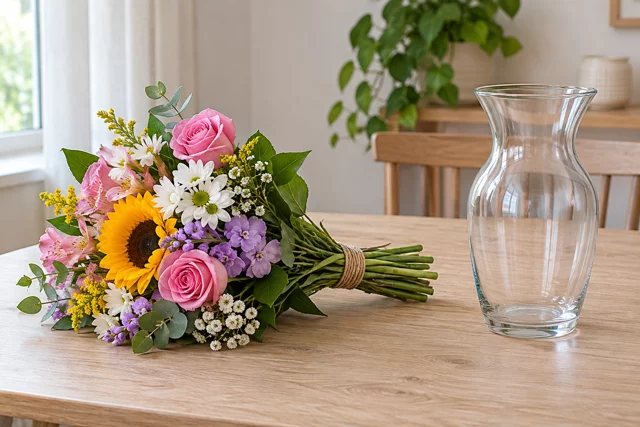
You can give flowers without a vase: hand over a wrapped bouquet when the recipient can put the stems in water soon, or pair it with a clean jar, jug or other watertight container. If they will be travelling or attending an event, arrange the handover closer to their arrival home. Presentation wrapping alone should never be assumed to keep flowers hydrated.
The thoughtful part is anticipating what happens after the gift changes hands. A bouquet that looks beautiful at the door still needs a stable container, water and somewhere suitable to stand. You do not need to turn the gesture into a care lesson, but a little planning saves your recipient from searching the kitchen while holding wet stems.
Choose a bouquet the recipient can manage
Start with the recipient’s circumstances rather than the size of the gesture. Someone receiving flowers at home can usually find a temporary container; someone leaving a restaurant for a long train journey has a more awkward task. Where a vase is unlikely, a manageable bouquet is easier to carry, unwrap and support than a large arrangement with long, spreading stems.
Consider the stems as well as the flower heads. A tall bouquet needs a container with enough height and weight to prevent it tipping, while shorter stems can fit a sturdy kitchen jug. Avoid relying on a shallow drinking glass for a top-heavy bunch. If you are choosing remotely, explain the available container and setting before settling on the bouquet.
You can use the bouquets catalogue to identify the style you like, then ask about suitability for the recipient’s situation. Do not assume a photographed container is included or that decorative wrapping contains a water supply. Establish what the selected bouquet comes with before you plan how it will be displayed.
Turn an everyday container into a temporary vase
A clean glass jar, ceramic jug or watertight bottle can hold flowers perfectly well for the initial display. Wash it thoroughly with detergent, rinse away residue and check for leaks. Choose a broad, stable base and an opening that supports the stems without squeezing them together. A beautiful container is less useful than one that stays upright.
Match the opening to the bunch. A narrow-necked bottle works for a few slim stems, but forcing a whole bouquet through it can damage foliage and make later cleaning difficult. If the only container is too small, divide the flowers between two or three clean vessels. Keep each group loose enough that the stems can sit in water without being crushed.
For a gift you are handing over yourself, bring a simple container and carry it empty to avoid spills. Fill it at the destination before arranging the flowers. Decorative baskets, paper bags and unlined wooden boxes are not water vessels; use a separate watertight container inside them and make sure it cannot slide or tip.
Bouquets we can deliver




Handle the journey without treating wrapping as a vase
Keep the interval between taking flowers out of water and putting them back as short as practical. Prepare your route and container first, then collect or lift the bouquet from water close to departure. Avoid leaving flowers waiting in a parked car, beside a heater or in direct sunlight while you finish other errands.
Carry the bouquet with the stems supported and the flower heads clear of bags, door frames and other passengers. Keep protective wrapping in place during the journey if it prevents rubbing or crushing. If the stem ends have a temporary water pack, keep it upright and check for leaks; its presence does not establish how long the flowers can safely wait.
If you know the recipient cannot get to water for a substantial part of the day, change the timing of the gift. A doorstep handover after their return may be kinder than presenting a bouquet at the start of an outing. There is no single reliable dry-travel allowance for every flower: condition, handling and the surrounding environment all affect the result.
Get the stems into water with a simple care routine
At the destination, place the bouquet somewhere safe while you prepare its container. Remove any transport material around the cut stem ends and loosen wrapping that blocks access to the stems. Take off leaves that would sit below the waterline, because submerged foliage encourages the water to deteriorate. Keep useful ties in place if they help the bouquet hold its shape.
With clean, sharp scissors or secateurs suitable for the stems, make a fresh cut at each stem end, removing any visibly damaged portion. Put the stems into clean water promptly. If flower food is supplied, follow the packet’s dilution instructions; adding an arbitrary amount or mixing in household ingredients is unnecessary. Make sure all cut ends actually reach the water.
Check the water daily and replenish it as needed. Replace it and wash the container if it becomes cloudy or develops an odour, and remove fading material as it appears. Stand the flowers away from direct sun, heating appliances and ripening fruit. A temporary jar can remain their container if it provides adequate support and is easy to keep clean.
Make the gesture comfortable for your recipient
Giving a bouquet without a vase is usually a perfectly workable gesture when the recipient has somewhere to put it. The potential inconvenience comes from timing and scale, rather than the absence of an expensive accessory. For a host preparing a meal, a modest bunch with a clean jug ready to use may be easier to enjoy than flowers requiring immediate rearrangement.
When visiting, offer practical help with a brief phrase such as, “Shall I put these in water for you?” Let the recipient choose where the flowers go, and accept an everyday container without comment. At a workplace or public event, think about desk space, the journey home and whether the person will feel comfortable carrying a conspicuous bouquet.
If you are unfamiliar with Russian flower-giving customs, bouquets for celebrations are traditionally given in odd numbers when individual stems are counted; even numbers are associated with mourning. Personal preferences still matter, especially with mixed bouquets. A short message explaining your intention can make the gift feel clear and personal without relying entirely on flower symbolism.
Arrange delivery in Russia around access to water
If you are sending flowers from abroad, choose an address and time when the recipient can attend to the bouquet. Turboflora delivers across Russia. City delivery costs 500 RUB; for remote districts and suburbs, the operator confirms the price when confirming the order. Tell the manager if the recipient has no vase so you can discuss a suitable bouquet and clarify its presentation.
In large cities, express delivery is available within 1–2 hours after order confirmation. You can also arrange an exact time with a tolerance of plus or minus 30 minutes, choose 09–12, 12–15, 15–18 or 18–21, or pre-order 1–30 days ahead. Use WhatsApp to agree the address, timing and card text, get help choosing, and arrange a photo of the bouquet before delivery.
The courier calls the recipient about 15 minutes before arrival. If they are absent, we agree a second delivery that day or a handover to a neighbour or concierge with the sender’s consent. Delivery is anonymous by default: the courier does not name the sender, so sign the free card if you want to be identified. See delivery and payment for ordering information; online checkout uses CloudPayments, and you should check the payment options displayed there rather than assume a foreign card will be accepted.
Frequently asked questions
Is it rude to give flowers without a vase?
Usually, no: a wrapped bouquet is a practical gift when the recipient can put it in water soon. If they are hosting, travelling or unlikely to have a container, bring a clean jug or jar, or choose a more convenient handover time.
Can flowers stay in their wrapping until the next day?
Do not assume the wrapping supplies water or protects the flowers from dehydration. Check what surrounds the stem ends and transfer the stems to a clean container of water promptly.
What can I use if I have no flower vase?
Use a clean, watertight jar, jug or bottle with a stable base and enough room for the stems. Divide a large bouquet between several containers if that gives better support and keeps every cut end in water.
Can I send flowers to Russia if the recipient has no vase?
Yes, but plan delivery for a time when they can place the stems in a suitable household container. Tell the manager about the lack of a vase and clarify the selected bouquet’s presentation before ordering; do not assume a container is included.
How do I make sure the recipient knows who sent the flowers?
Include your name in the free card text. Delivery is anonymous by default, and the courier does not name the sender.
Ready to send flowers?
Pick the city, choose the bouquet, and a local florist takes it from there.
Choose a city →