Matthiola in Russia: The Fragrant Spring Stem Explained
Walk into a flower market in Saint Petersburg in late April and something stops you before you even see the source — a warm, spicy-sweet cloud that sits somewhere between cloves and honey. That is matthiola, known in English as stock, and it is one of the most beloved spring stems in Russia precisely because of that scent. If you have never ordered it before, or if you have only seen it tucked quietly into the back of a bouquet, this article will tell you everything you need to choose it well, pair it right, and keep it alive as long as possible.
Why Matthiola Matters So Much in the Russian Spring
In Russia, spring arrives unevenly. Snow can linger into April in Saint Petersburg, and the emotional weight of finally having warmth and light is enormous. Matthiola arrives at exactly this moment, typically from late March through May, and its fragrance carries a kind of promise that almost no other flower can match. Russians have a deep cultural habit of giving flowers for any positive occasion — a school performance, a job promotion, a first visit to a new home — and matthiola fits all of these because it feels generous without being formal.
The stem itself is tall and densely flowered, with dozens of small blooms packed along a single spike. The flowers come in white, cream, pale pink, deep rose, lilac, and purple. The double-flowered types, which are the ones you almost always see in florist bouquets, have a full, ruffled look that photographs beautifully and holds its shape well even after cutting.
What makes matthiola especially valuable to a working florist is that it does something rare: it fills a room. A single stem on a bedside table will scent the whole room by morning. Three stems in a kitchen bouquet will be noticed the moment someone opens the front door. For recipients who live alone or who spend a lot of time at home, that ambient presence is a genuine gift, not just a visual one. It turns an ordinary bunch of flowers into something that changes the atmosphere of a space.
Bouquets we can deliver


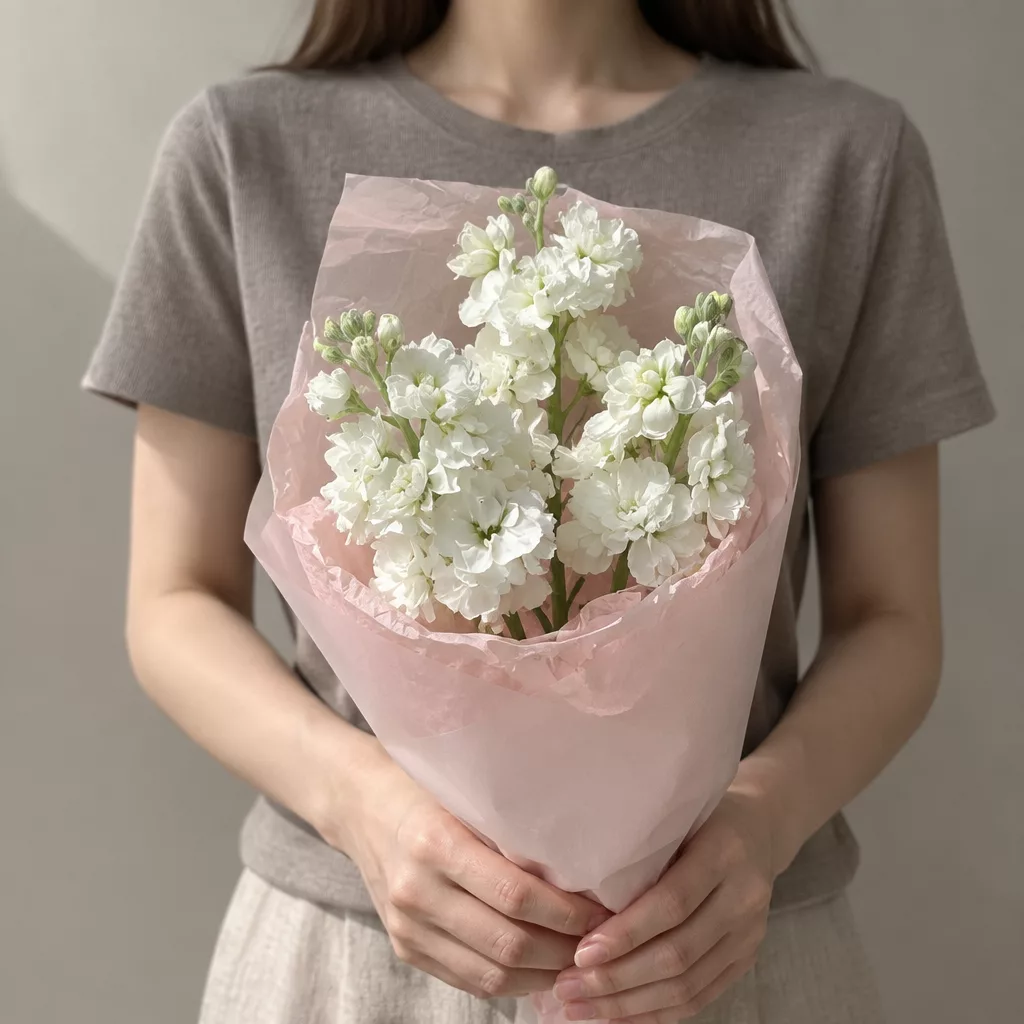
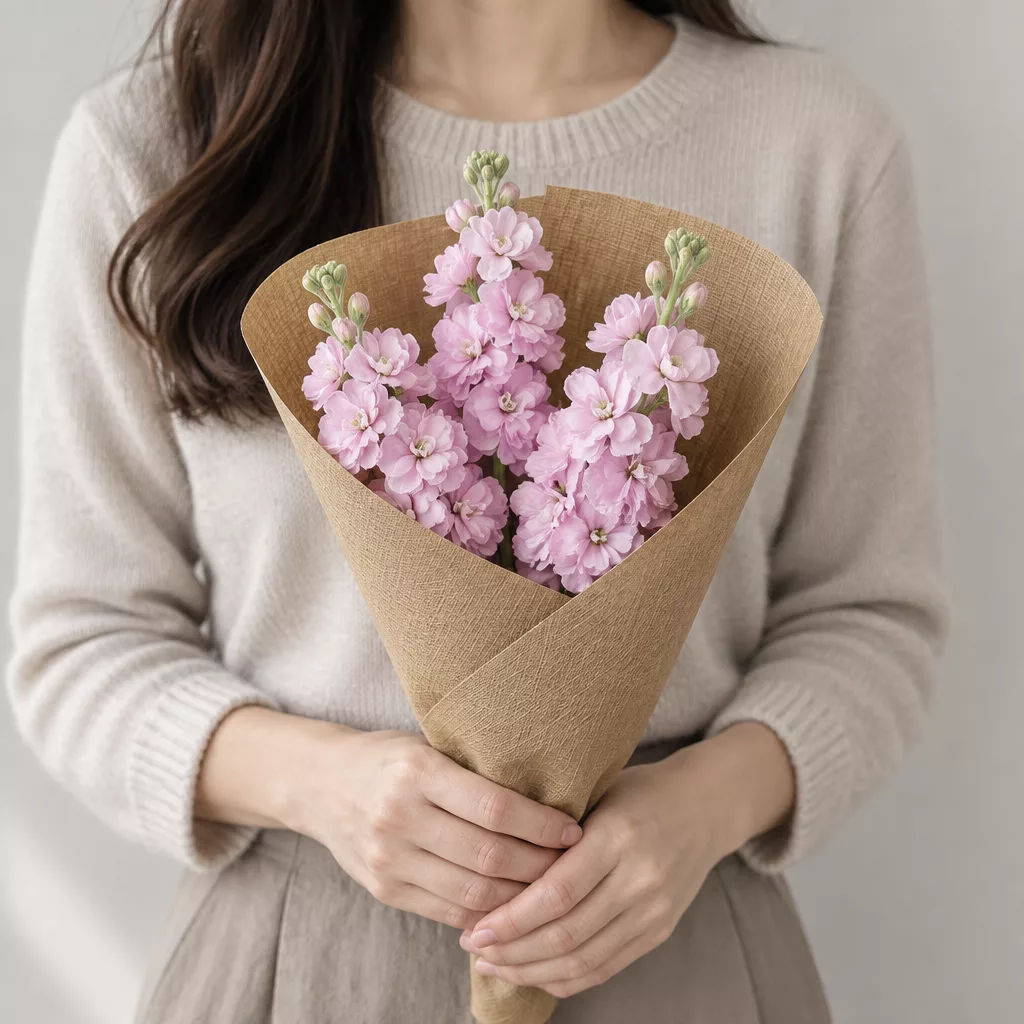
When Matthiola Is Actually Available Across Russia
Availability is the first practical question, and the honest answer is that matthiola has a real season rather than a year-round window. In Russia, greenhouse-grown matthiola begins appearing in florist supply from roughly late February, but the quality and quantity improve significantly through March and into April. Peak season — when stems are longest, most fragrant, and most consistent — runs from mid-April through mid-May.
By late May, temperatures begin to climb, and matthiola is genuinely sensitive to heat. Warm nights shorten the vase life before the flower even reaches the customer, which is why experienced florists become cautious with it as June approaches. If you are ordering in early spring, you are in the sweet spot. If you are ordering in late May, ask about the current batch and trust the florist's assessment.
Imported matthiola from the Netherlands arrives in Russia throughout the season and tends to be more consistent in stem length and bloom density than domestically grown material, though Russian greenhouse production has improved considerably. The domestic crop, particularly from farms in the south, can have an even stronger scent because the growing conditions are slightly warmer and the harvest is faster from field to vase.
For deliveries within Saint Petersburg and across Russia, timing matters practically. Matthiola ships best when temperatures are between four and ten degrees Celsius. A bouquet that travels in a chilled delivery vehicle in April will arrive in far better condition than one sent during a warm May afternoon. This is not a reason to avoid it — it is simply a reason to order from someone who handles cold-chain delivery seriously.
Choosing Matthiola for the Person and the Occasion
Before you think about color or quantity, think about who is receiving the flowers and what their space is like. Matthiola is an intensely fragrant flower, and while most people find the scent wonderful, it is worth considering whether the recipient has allergies or sensitivity to strong smells. For the vast majority of people, the fragrance is the whole point — but it is a thoughtful detail to keep in mind.
For a teacher receiving flowers at the end of a school year — a very common Russian tradition in May — matthiola in white or pale lilac paired with greenery looks elegant and feels appropriately celebratory without being over the top. For a mother or grandmother, deep rose or purple matthiola combined with ranunculus or soft peonies creates something genuinely luxurious. For a colleague or new acquaintance, a single-color bunch of cream or white matthiola is understated and sophisticated.
Matthiola also works beautifully for someone moving into a new home, because the scent helps a space feel lived-in and welcoming almost immediately. In Russian culture, bringing flowers when visiting someone's home for the first time is standard practice, and matthiola is a particularly thoughtful choice for this because it keeps giving after the visit ends.
If the recipient has a preference for garden-style or cottage-style arrangements rather than formal florist designs, matthiola is ideal. It has a natural, slightly wild look even when it is perfectly fresh, and it combines effortlessly with other spring stems like tulips, muscari, anemones, and flowering branches.
Building Bouquets Around Matthiola: Combinations That Work
Matthiola is a supporting character that occasionally steals the scene. Its vertical spike shape means it works best when paired with rounder or more horizontal forms that create contrast. A bouquet of matthiola alone can look a little one-dimensional; add three or four peonies or garden roses and suddenly the matthiola reads as lush, textural background that makes the round blooms look even fuller.
One of the most effective spring combinations is matthiola with tulips and eucalyptus. The tulips provide the visual focal point, the eucalyptus adds a silver-green softness, and the matthiola fills the middle with both texture and scent. This trio works in almost any color palette — try white tulips with white matthiola and silver eucalyptus for a clean, modern look, or mix coral tulips with deep pink matthiola and regular eucalyptus for something warmer.
Another combination worth knowing is matthiola with muscari and ranunculus. Muscari — the small blue grape hyacinth — is also at its peak in April and May in Russia, and the two together create a cottage-garden feeling that is very popular right now. The ranunculus adds a papery, layered center bloom that contrasts beautifully with the dense matthiola spike.
From a presentation standpoint, matthiola stems are tall — often fifty to seventy centimeters — so they need either a tall vase or to be cut down significantly for a compact arrangement. In a tall cylindrical vase, a few matthiola stems with minimal greenery make an architectural statement. In a wide, low bowl arrangement, they need to be shortened and used as filler rather than feature stems. Knowing this before you order helps you describe what you want clearly.
Vase Life and the Honest Reality of a Short-Lived Stem
Here is where honesty matters more than salesmanship. Matthiola is not a two-week flower. Under good conditions — a cool room, clean water changed every two days, stems recut at an angle — you can expect five to seven days of quality display. In a warm apartment, that window shortens to four or five days. This is simply the nature of the flower, and it is worth knowing before you order rather than being disappointed afterward.
The most common mistake people make with matthiola is placing it near a heat source — a radiator, a sunny windowsill, or directly above a kitchen stove. Heat accelerates the opening of the lower blooms and causes the upper buds to fail before they have a chance to open. The ideal spot is a cool room, away from direct sun, with good air circulation.
Stripping the lower leaves before placing the stems in water is essential. Matthiola leaves decompose quickly underwater and cloud the water within a day, which shortens vase life significantly. Remove everything below the waterline, recut the stems at a forty-five degree angle with a sharp knife rather than scissors, and use a clean vase. Florist preservative sachets genuinely help with matthiola more than with many other flowers because the sugar content feeds the upper buds as they open.
The short vase life does not diminish the value of matthiola as a gift. A bouquet that fills a room with fragrance for five days and then fades gracefully has done its job. The memory of the scent often lasts longer than the flowers themselves, which is a different kind of lasting impression.
Ordering Matthiola for Delivery Across Russia: What to Expect
When you order matthiola for delivery within Saint Petersburg or to another Russian city, the key variable is transit time and temperature. Turboflora delivers within one to two hours across Saint Petersburg, which means matthiola arrives in excellent condition — the stems have not been sitting in a warm van for half a day, and the blooms have not had time to stress. For deliveries to other cities across Russia, the flowers are packed with care to maintain temperature during transit.
When placing an order, it helps to specify whether you want the matthiola as the main feature of the bouquet or as a supporting element. If it is the feature, the florist will select the longest, most fully budded stems and build the arrangement around their height and density. If it is a supporting element, shorter stems with slightly more open blooms can be used to add fragrance and texture to a mixed composition.
It is also worth mentioning the delivery environment if you know it. A recipient who lives in a warm apartment with no air conditioning in May will have a shorter vase life than someone in a cooler home. This does not change the order, but it might change the care instructions the florist includes with the bouquet.
Finally, if you are sending matthiola as part of a birthday or celebration bouquet and the recipient will not be home immediately, ask about timing. Matthiola left in a warm hallway for several hours before being put in water will lose a day or two of vase life. A two-hour delivery window means you can time the arrival precisely, which is one of the most practical advantages of fast local delivery.
Matthiola is one of those flowers that earns its place not through drama but through presence — the steady, generous scent that fills a room and stays in memory long after the stems have been composted. It belongs to a narrow window of the Russian spring, which is part of what makes it feel special when it arrives. Choose it for someone who will be at home to enjoy it, pair it with something round and soft, keep it away from the radiator, and change the water every two days. Do those simple things and you will get the best of what this flower has to offer.
Frequently asked questions
Is matthiola available year-round in Russia?
No. Matthiola has a genuine season in Russia, running roughly from late February through May, with peak quality in April and early May. By late May the heat begins to affect stem quality and vase life. Outside of this window, availability drops significantly and the quality is rarely worth ordering.
How strong is the scent — will it be overwhelming indoors?
The fragrance is genuinely strong, described as warm, spicy, and clove-like. A few stems in a small room will scent it thoroughly. Most people find this deeply pleasant, but if the recipient is sensitive to strong floral scents or has respiratory sensitivities, it is worth considering a less fragrant alternative.
What is the best color of matthiola to give as a gift in Russia?
White and pale lilac are the most versatile and are appropriate for almost any occasion. Deep rose and purple feel more romantic or celebratory. Cream works beautifully for elegant, understated arrangements. Avoid red matthiola if you want to stay away from overly romantic associations — it is less common and can read as very intense.
Can matthiola be combined with other spring flowers in a bouquet?
Absolutely — it combines especially well with tulips, peonies, ranunculus, muscari, and anemones. Its tall spike shape provides vertical structure that contrasts beautifully with round or cupped blooms. Eucalyptus and soft greenery work well alongside it. Avoid combining it with other very strongly scented flowers, as the fragrances can compete.
Why did my matthiola wilt so quickly after delivery?
The most common causes are a warm room, a sunny windowsill, or leaves left below the waterline decomposing in the water. Recut the stems at an angle, remove all leaves below the water surface, place the vase somewhere cool and away from direct sun, and change the water every two days. Florist preservative sachets make a noticeable difference with matthiola.
Ready to send flowers?
Pick the city, choose the bouquet, and a local florist takes it from there.
Choose a city →