Pink Flowers in Russia: What They Mean and Who They Suit
A pink bouquet can say a dozen different things depending on who opens the door. In Russia, where flower-giving follows unspoken rules that most people absorb without ever being taught them, the shade, the variety, and even the number of blooms carry weight. Understanding those signals lets you send something that lands exactly right — not just pretty, but genuinely felt.
Why Pink Carries So Much Meaning in Russian Flower Culture
In Russia, flowers are rarely a casual gesture. They mark moments — a first meeting, a school milestone, a birthday with a round number, a reconciliation. Within that culture, pink sits in a particularly interesting position. It is neither the passionate declaration of red nor the pure friendship of white. It occupies the warm middle ground: affection, admiration, tenderness, and a kind of hopeful sincerity.
Russian recipients read colour intuitively. A woman who receives deep crimson roses from a colleague will feel uncomfortable; the same woman receiving blush-pink spray roses feels appreciated without pressure. That distinction matters enormously in a country where social signals around flowers are taken seriously at every age.
Pink also travels across gender more easily than many other colours in the Russian context. While it remains most commonly given to women and girls, pale pink peonies or dusty-rose lisianthus appear in congratulatory bouquets for men in creative or academic fields without raising an eyebrow. The key is composition: structured, architectural arrangements read as less romantic regardless of colour.
Finally, pink is seasonal in the Russian imagination. Peonies bloom in June and feel like summer abundance. Pale pink tulips arrive in March and carry the energy of renewal. Matching the variety to the season is not just practical — it tells the recipient you thought carefully, which in Russian gift culture is itself a meaningful message.
Bouquets we can deliver



Sending Pink to a Young Girl: School Events and Childhood Milestones
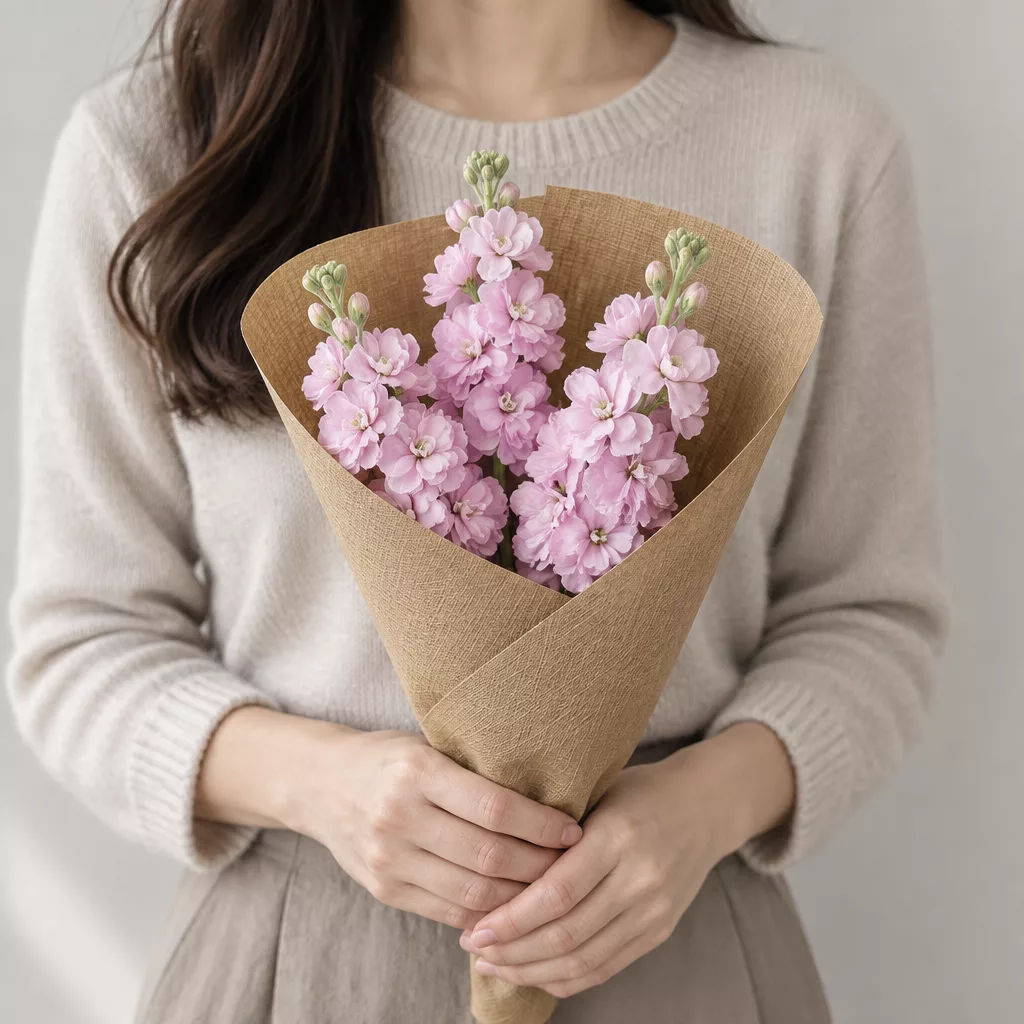
For a child between five and twelve, a pink bouquet is pure delight — but the composition should be light and playful rather than formal. Spray roses in soft pink mixed with white gypsophila and a few stems of pink matthiola create something that feels like a celebration rather than a ceremony. Avoid large single-headed roses for young recipients; they look stiff and are harder for small hands to hold during a school performance.
The most significant flower occasion for Russian schoolchildren is the First Bell on September 1st, when first-graders carry bouquets to their new teacher. Pink is one of the most popular choices for this day, and for good reason. It reads as warm and respectful without the formality of white or the intensity of red. Chrysanthemums in pale pink or dusty rose hold up well in the late-summer heat — September in Saint Petersburg can still reach 20 degrees Celsius, and chrysanthemums are far more heat-tolerant than tulips or peonies at that time of year.
For a girl's birthday in the seven-to-twelve range, think volume and texture over single varieties. A rounded bouquet mixing pink gerbera, pink alstroemeria, and a few stems of pink statice gives a sense of abundance that children respond to. Alstroemeria is particularly practical: it lasts ten to fourteen days in a vase with proper care, meaning the flowers stay beautiful long after the party is over. Keep the arrangement compact enough that she can carry it herself — that small detail means a great deal to a child.
Pink for Teenagers and Young Women: Reading the Relationship Correctly
Between thirteen and twenty-five, the meaning of pink shifts considerably depending on who is giving and who is receiving. A mother sending pink roses to her daughter at university graduation is expressing pride and love. A young man sending the same bouquet to a woman he has just started seeing is making a romantic overture — but a measured, respectful one, which is often exactly the right tone for an early relationship in Russia.
For this age group, the variety matters as much as the colour. Garden roses in blush pink — varieties like Keira or Juliet, with their layered petals and soft fragrance — feel romantic and considered. Standard greenhouse roses in hot pink read as more casual and energetic, better suited to a birthday among friends than a first romantic gesture. Lisianthus in pale pink is an excellent choice for a young woman who appreciates something less expected: it has the look of a peony but is available year-round and lasts up to two weeks in a vase.
One common mistake is choosing bouquets that are too large for a young recipient. A towering arrangement can feel overwhelming or even ironic when given to someone in their late teens. A compact, well-structured bouquet of fifteen to seventeen stems reads as more sincere than a grand display. In Russian flower culture, restraint at the right moment communicates taste and genuine feeling rather than a desire to impress. Pair pink roses with eucalyptus or soft green pittosporum to add depth without competing with the colour.
Pink for Women in Their Thirties and Forties: Elegance Over Sweetness
By the time a woman reaches her thirties, her relationship with pink often becomes more sophisticated. The candy-bright pinks of a childhood bouquet give way to a preference for dusty rose, antique blush, and the deep warm tones of mauve-edged peonies. This is not a rule, but it is a pattern florists notice consistently: the palette shifts toward complexity.
For a colleague's promotion, a friend's significant birthday, or a thank-you gesture, a monochromatic bouquet in three or four tones of pink — from pale blush to deep rose — makes a strong and elegant impression. Combining garden roses with ranunculus and a few stems of pink astilbe creates texture and visual movement without relying on contrasting colours. This approach suits professional contexts particularly well, where a bouquet that is clearly beautiful but not overtly romantic allows the recipient to display it at her desk without ambiguity.
Peonies deserve special mention for this age group. In Russia, peonies carry associations of abundance, femininity, and a certain gracious maturity. A bouquet of ten to fifteen pink peonies, presented simply with minimal foliage, is considered one of the most generous and tasteful gifts a woman in her thirties or forties can receive. They are available fresh from late May through June. Outside that window, garden roses in a similar full-headed form — Yves Piaget or Miyabi varieties — provide a comparable look year-round. Store peonies in a cool room, ideally between 15 and 18 degrees Celsius, to extend their vase life to seven or eight days.
Pink for Older Women: Warmth, Respect, and Lasting Varieties
For a grandmother, a beloved teacher nearing retirement, or a woman celebrating a significant decade — her sixtieth, seventieth, or beyond — a pink bouquet carries warmth and deep respect when chosen thoughtfully. The most important shift here is toward varieties with longevity and fragrance. Older recipients often appreciate flowers they can enjoy for a full week or more, and they are more likely to notice and value a beautiful scent.
Alstroemeria in pale pink and cream is one of the most practical choices: it lasts twelve to fourteen days with simple care, the stems are easy to handle, and the flower heads are light enough to arrange without effort. Combined with pink carnations — which have experienced a genuine design revival in Russia and are no longer considered old-fashioned when used in modern arrangements — you get a bouquet that is both generous and long-lasting.
Avoid arrangements that are too heavy or unwieldy. A bouquet that a woman in her seventies cannot comfortably carry or place in a vase herself defeats its purpose. Compact, upright arrangements with sturdy stems work better than cascading designs. Pink spray chrysanthemums are excellent here: they hold their form for two weeks, tolerate a range of indoor temperatures, and their many small heads create a full, abundant look without bulk.
In Russian culture, giving flowers to an older woman is a gesture of honour. The act itself communicates that she is seen and valued. Pink, with its warmth and its distance from the severity of white, reinforces that message in exactly the right register — tender without being sentimental, beautiful without being showy.
Choosing Pink for Specific Occasions: Birthdays, Graduations, and New Arrivals
The occasion shapes the bouquet as much as the recipient does. Three moments in Russian life call for pink particularly naturally: birthdays, graduations, and the arrival of a new baby.
For a birthday, the bouquet should feel celebratory and personal. If you know the recipient loves fragrance, pink matthiola mixed with blush roses creates an intensely scented combination that fills a room. If she prefers something more architectural, pink anthurium with white orchid stems makes a dramatic statement that lasts three to four weeks. The number of flowers matters in Russia: always choose an odd number for a living recipient — nine, eleven, fifteen, or twenty-five stems are all appropriate depending on the scale you want.
For a graduation — and Russia marks both school graduation in late June and university graduation with considerable ceremony — pink conveys pride and forward momentum. A bouquet that mixes pink with white or pale yellow reads as optimistic and bright, suited to the moment of stepping into something new. Spray roses, lisianthus, and sweet peas in season make a light, joyful combination that photographs beautifully, which matters to a twenty-two-year-old.
For a new baby, pale pink is the obvious choice for a girl, but the bouquet is for the mother, not the child. Choose something she can enjoy from her bed or a hospital room windowsill: compact, not heavily scented (strong fragrances can be overwhelming in the first days after birth), and long-lasting. Pink alstroemeria with white gypsophila is ideal — gentle, cheerful, and reliably fresh for ten days or more with a simple water change every two days.
Pink is not a simple colour, and in Russia it is never a simple gesture. It stretches from the delighted face of a seven-year-old holding her first school bouquet to the quiet dignity of flowers placed in a grandmother's hands on her birthday. What makes it work across all those moments is attention — to the person, to the occasion, to the variety and the palette. When those elements align, a pink bouquet does something that words often cannot: it tells someone exactly how you see them, without having to explain a thing.
Frequently asked questions
Is pink an appropriate colour for a male recipient in Russia?
It depends on the shade and the arrangement. Pale blush or dusty rose in a structured, architectural bouquet — think garden roses with eucalyptus — works well for men in creative or academic fields. Bright candy pink reads as more feminine in the Russian context and is rarely chosen for male recipients. When in doubt, combine pink with white or deep green to balance the palette.
What pink flowers are available year-round for delivery in Russia?
Spray roses, standard roses, alstroemeria, lisianthus, carnations, and pink chrysanthemums are reliably available throughout the year. Peonies are seasonal from late May through June. Pink tulips are plentiful from February through April. Planning around availability means your bouquet arrives at its freshest rather than being forced out of season.
How long do pink peonies last in a vase, and how should they be stored?
Fresh pink peonies last seven to eight days in a vase when kept in a cool room between 15 and 18 degrees Celsius, away from direct sunlight and fruit bowls. Change the water every two days and trim the stems at an angle. If they arrive as tight buds, place them in warm water in a slightly warmer room to encourage them to open within a day.
What is the right number of stems for a pink birthday bouquet in Russia?
Always choose an odd number for a birthday bouquet — this is a firmly held convention in Russian flower culture. Nine, eleven, fifteen, or twenty-five stems are all appropriate depending on the scale of the gesture. Even numbers are traditionally reserved for mourning occasions, so sticking to odd numbers ensures your gift reads as purely celebratory.
Can I send pink flowers to a new mother in hospital in Russia?
Yes, but choose wisely. Avoid heavily scented varieties like matthiola or oriental lilies, which can feel overwhelming in a small hospital room in the first days after birth. Pale pink alstroemeria, spray roses, or lisianthus are ideal — gentle in fragrance, long-lasting, and compact enough to sit comfortably on a windowsill without taking up too much space.
Ready to send flowers?
Pick the city, choose the bouquet, and a local florist takes it from there.
Choose a city →