Potted Plants or Cut Flowers for Your Office Reception Area?
The reception desk is the first thing a client sees, and that first impression settles into the subconscious before a single word is spoken. Whether you choose a living potted plant or a weekly fresh bouquet says something about how the company thinks — about permanence, about care, about the small details. Both choices work, but they work differently, and the wrong one for your situation will either die quietly in a corner or wilt before Friday. Here is an honest comparison from a florist who has seen both succeed and both fail.
What the Reception Area Actually Demands From Any Plant or Flower
Before picking between a monstera and a bunch of spray roses, it helps to read the space honestly. Most Russian office receptions share a few challenging conditions: air conditioning or central heating running most of the year, which pulls humidity down to between thirty and forty percent, fluorescent or LED lighting that mimics daylight poorly, and a temperature that rarely drops below twenty degrees Celsius but can spike near windows in summer. These are not ideal conditions for anything living.
Cut flowers placed near an air conditioning vent will lose moisture through their petals two to three times faster than flowers kept in a cooler corner. Potted plants set on a windowsill facing south in a Saint Petersburg summer can scorch within days. Neither option is maintenance-free, and any supplier or colleague who tells you otherwise is setting you up for disappointment.
The second thing to consider is foot traffic. A reception desk that sees dozens of visitors a day needs something visually confident — a statement rather than a whisper. A small succulent in a terracotta pot disappears against a marble counter. A tight, structured bouquet of white lisianthus and eucalyptus reads clearly from three metres away. Scale matters as much as species, and the right choice depends on the counter size, the ceiling height, and the colour palette of the room itself.
Bouquets we can deliver

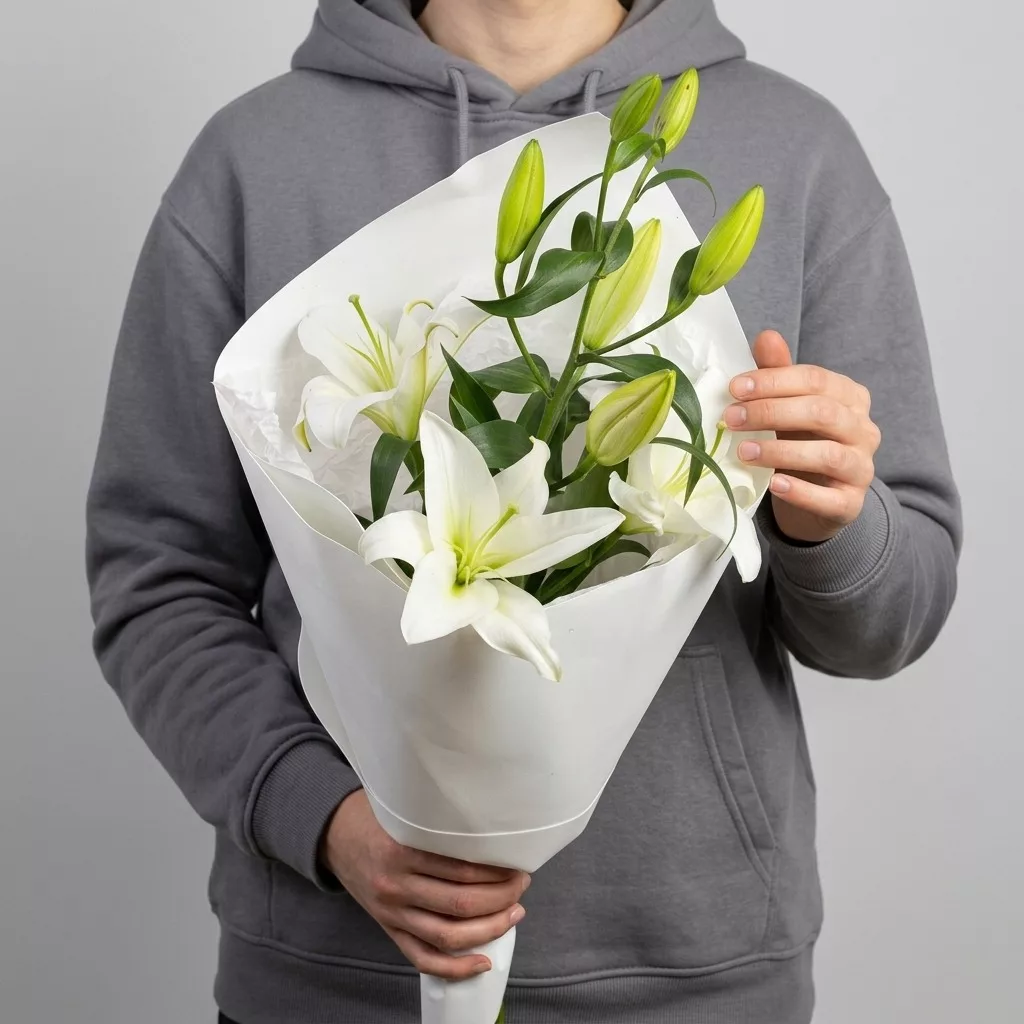
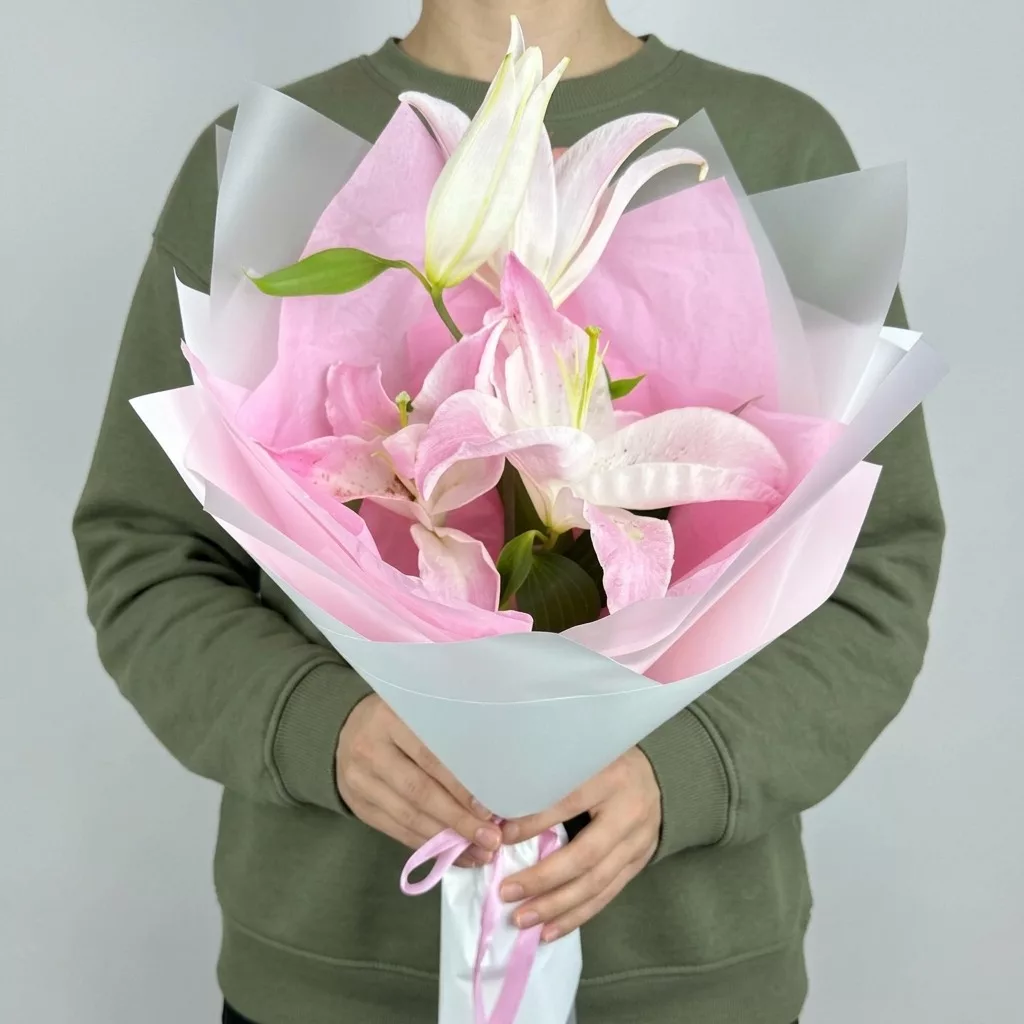

Longevity: The Honest Numbers for Both Sides
Potted plants, when chosen correctly for an indoor office environment, can live for years. A Zamioculcas zamiifolia, commonly called a ZZ plant, tolerates low light and infrequent watering and will look almost identical in January as it does in July. A Sansevieria trifasciata — the classic snake plant — survives neglect that would kill most houseplants and asks for water only once every two to three weeks in winter. These are not exciting choices, but they are reliable ones, and reliability in a reception area is worth a great deal.
Cut flowers tell a different story. A well-conditioned bouquet of chrysanthemums can hold for ten to fourteen days with proper care. Alstroemeria regularly reaches twelve days. Roses, which many offices reach for first, typically last five to seven days in a warm indoor environment, and closer to four if the vase water is not changed every two days. Tulips, popular in Russia from February through April, are beautiful but brief — expect five to seven days at most, and they will droop toward any available light source, which can look untidy by day three.
The longevity gap between potted plants and cut flowers is real, but it does not automatically make plants the better choice. A fresh bouquet replaced every week sends a signal of ongoing attention and investment. A dusty potted plant that has not been repotted in three years sends the opposite signal. Longevity only counts when the upkeep matches it.
Maintenance: Who Actually Waters It on a Tuesday Morning
This is the section most offices skip, and it is the one that determines whether the whole project succeeds. Potted plants require a consistent person — not a rota, not a vague understanding that someone will handle it, but one named individual who knows the specific needs of each variety. Overwatering kills more office plants than neglect does. A Ficus benjamina that receives a full glass of water every Monday from a well-meaning receptionist will develop root rot within two months. The same plant watered only when the top two centimetres of soil feel dry will thrive.
Cut flowers require different but equally specific care. The vase must be cleaned before each new arrangement — old bacterial residue in an unwashed vase will shorten a fresh bouquet's life by two to three days. The water should be changed every two days, and the stems recut at an angle each time. Flower food sachets, which most florists include with delivery, genuinely extend vase life when used at the correct dilution. Many offices tip the entire sachet into a small vase, which creates a concentration that can damage stems rather than feed them.
For offices without a dedicated person to handle plant care, cut flowers delivered on a regular schedule are often the more manageable option. The maintenance task is clear, time-limited, and tied to a specific delivery event rather than an ongoing daily responsibility. For offices with a facilities team or an engaged office manager who genuinely enjoys plants, a curated collection of low-maintenance potted varieties can run smoothly for years with minimal intervention.
Visual Impact: First Impressions and Seasonal Feeling
Potted plants offer consistency. A well-placed Ficus lyrata — the fiddle-leaf fig — in a large white ceramic pot creates a strong architectural presence that anchors a reception area and photographs beautifully for company websites and social media. The visual effect does not change week to week, which is an advantage for brand consistency but a disadvantage for energy. After six months, the eye stops registering what has always been there.
Cut flowers introduce change, and change is what keeps a space feeling alive and attended to. A reception that shifts from deep burgundy dahlias in September to white narcissus and willow branches in March communicates that someone is paying attention to the calendar. In Russia, this seasonal sensitivity carries particular cultural weight. Flowers are given and noticed throughout the year — on the eighth of March for International Women's Day, in early May around Victory Day, in September at the start of the school year. A reception bouquet that reflects the current season feels current and warm rather than static.
The combination approach, which many offices eventually arrive at, uses a permanent potted plant as the structural anchor and adds a smaller fresh arrangement nearby that changes weekly or fortnightly. A large Monstera deliciosa in the corner provides the green backdrop; a low vase of seasonal stems on the desk provides the colour and freshness. This layering gives you the permanence of plants and the vitality of flowers without asking either to carry the full visual weight alone. It is also easier to budget, since the potted plant is a one-time investment and only the fresh element recurs.
Choosing by Office Size, Light, and Reception Style
A compact reception in a converted apartment building — common in central Saint Petersburg — has different constraints from a purpose-built corporate lobby. Low ceilings and limited counter space make tall arrangements impractical. A single compact bouquet in a short, wide vase, or one well-chosen potted plant no taller than sixty centimetres, will read better than an ambitious arrangement that crowds the space.
Light is the factor most offices misjudge. If the reception has no natural light at all, the plant options narrow significantly. Aglaonema varieties tolerate genuinely low light and come in shades from deep green to pink-edged, which adds colour without flowers. Pothos, known in Russian as epipremnum, is nearly indestructible in low light and can be trained to trail along a shelf edge for a relaxed, contemporary effect. Cut flowers in a windowless reception will still perform adequately because they are already cut and drawing water rather than photosynthesising, but they will lean toward any artificial light source, so the vase position matters.
The style of the reception also guides the choice. A law firm or financial institution often favours clean, structured arrangements — white or cream flowers with minimal foliage, or a single architectural plant in a stone or ceramic pot. A creative agency or tech office tends to welcome looser, more expressive bouquets with mixed textures, or unusual plant varieties like Calathea orbifolia, whose patterned leaves are visually interesting without being distracting. Matching the floral style to the company's visual identity is not a luxury detail — it is the difference between decoration that feels considered and decoration that feels random.
Russian Office Culture and What Visitors Expect to See
For anyone unfamiliar with Russian professional culture, it is worth knowing that fresh flowers carry significant social meaning here. They are not a casual gesture. Receiving flowers, or walking into a space decorated with them, signals respect and occasion. An office reception with a fresh, well-arranged bouquet communicates that the company values the visit of whoever is walking through the door. This is not an exaggeration — it is a genuinely felt cultural signal, particularly for first meetings with new clients or partners.
This context makes the case for cut flowers stronger in client-facing reception areas than it might be in, for example, a Northern European office culture where a potted plant would carry equivalent weight. The freshness of cut flowers signals that the arrangement was made recently, specifically for this period, which implies ongoing effort rather than a one-time setup.
At the same time, Russian office environments tend toward the formal in their aesthetic, particularly in established industries. Very avant-garde arrangements — flowers laid flat on a mirrored surface, stems left unnaturally long, blooms mixed in deliberately clashing colours — can feel out of place in a traditional professional context. A structured, generous bouquet in harmonious tones, with clean foliage and a well-chosen vase, is almost always the safer and more appreciated choice. Potted plants in sleek, neutral containers follow the same logic: the plant itself can be interesting, but the presentation should feel intentional and tidy rather than experimental.
Building a Year-Round Plan That Works Without Constant Decisions
The offices that handle this best are the ones that set a system and then let the system run. For cut flowers, this means deciding on a delivery frequency — weekly is ideal for roses and seasonal mixed bouquets, fortnightly works for longer-lasting varieties like chrysanthemums or alstroemeria — and choosing a colour palette or tone that stays consistent through the year even as the specific flowers change. Cream and white with seasonal greenery works in any month. Burgundy and copper tones carry autumn beautifully and transition into the winter period without feeling out of place.
For potted plants, the annual task is repotting. Most office plants need to move into a slightly larger container once a year, typically in spring, when growth resumes after the low-light winter months. Failing to repot means the roots become compacted, the plant stops growing, and the foliage begins to look stressed even with correct watering. A facilities manager who schedules a spring repotting day — or arranges for a florist to handle it — will have noticeably healthier plants through the summer.
The most practical long-term approach for most Russian offices is a standing order for fresh flowers delivered on a fixed day each week or fortnight, combined with two or three carefully chosen potted plants that are maintained as a separate, lower-frequency task. This separates the two responsibilities clearly, prevents either from being neglected, and ensures that the reception area always has at least one living, well-presented element even if a delivery is delayed or a plant needs temporary replacement. Consistency, in a reception area, is its own form of professionalism.
There is no universal answer to whether potted plants or cut flowers serve a Russian office reception better — there is only the right answer for your specific space, your team, and the impression you want to leave. What both options share is that they reward attention. A plant that is genuinely cared for and a bouquet that is genuinely fresh both communicate the same thing to anyone who walks in: that this place is looked after. Turboflora delivers fresh bouquets across Russia within one to two hours, which means a standing weekly order for your reception can be as reliable as any permanent plant — and a great deal more seasonal.
Frequently asked questions
How often should a reception area bouquet be replaced in a typical Russian office?
For most offices, once a week is the right rhythm. Roses and tulips need replacing by day five to seven. Chrysanthemums and alstroemeria can stretch to ten to twelve days. A weekly delivery ensures the flowers always look fresh for Monday client meetings, which tend to be the highest-traffic day in most Russian professional environments.
Which potted plants survive best in an office with no natural light?
Zamioculcas zamiifolia, Sansevieria trifasciata, and Aglaonema varieties are the most reliable choices for genuinely low-light offices. Pothos will also trail attractively along shelves without any natural light. Avoid Ficus and Calathea in windowless rooms — both will decline within weeks despite attentive watering.
Is it appropriate to have flowers in a Russian office reception year-round, or only for specific occasions?
Year-round is entirely appropriate and increasingly common in professional settings. In Russian culture, fresh flowers signal ongoing respect for visitors rather than marking only special occasions. Many companies align their colour palette with the season — lighter tones in spring and summer, richer tones in autumn and winter — which keeps the display feeling current throughout the year.
What is the most common mistake offices make with potted plants in reception areas?
Overwatering is by far the most frequent problem. Well-meaning staff water on a fixed schedule rather than checking whether the soil actually needs moisture. Most indoor office plants — particularly ZZ plants and snake plants — prefer to dry out slightly between waterings. Root rot from excess water is almost always irreversible and is the leading cause of office plant death.
Can Turboflora deliver fresh flowers to offices outside Saint Petersburg?
Yes. Turboflora delivers fresh flowers across Russia within one to two hours of ordering. This makes standing weekly or fortnightly deliveries to office receptions in other Russian cities entirely practical, with the same freshness guarantee that applies to same-day personal orders.
Ready to send flowers?
Pick the city, choose the bouquet, and a local florist takes it from there.
Choose a city →