Wrapping and Presentation: Why Russian Bouquets Look Different
If you have ever received a bouquet from Russia — or seen one in a photograph — you may have noticed something immediately: it looks nothing like the loosely wrapped, cone-shaped bunches common in Western Europe or North America. The flowers sit in a perfectly round dome, encased in layers of kraft paper or soft film, often tied with a wide satin ribbon at the stem. This is not an accident of style. It is the result of a very deliberate tradition, shaped by climate, occasion, and a deep cultural belief that a gift should arrive looking as though it was assembled moments ago, with nothing left to chance.
The Round Shape: Where It Comes From and Why It Matters
In Russian floristry, symmetry is not a preference — it is a standard. A well-made bouquet is expected to be perfectly round when viewed from above, every bloom sitting at roughly the same height, the whole arrangement forming a tight, even dome. This shape is achieved through a technique called spiral binding, where each stem is added at a consistent angle and rotated slightly before the next one goes in. The result is a natural fan of stems that holds the flowers in place without any foam or hidden mechanics.
This matters to the recipient because it signals effort. A round bouquet takes considerably longer to build than a gathered bunch. Roses, peonies, ranunculus, and chrysanthemums are all common choices precisely because their round flower heads reinforce the dome shape naturally. Flat-faced flowers like gerberas work well too, while irregular blooms such as lisianthus or matthiola are used as accents rather than the structural core.
For someone ordering from outside Russia, this shape can be surprising if you are used to a more casual, hand-tied style. But recipients in Saint Petersburg or Moscow recognise it immediately as a mark of quality. When a bouquet arrives looking perfectly round, it tells the person holding it that somebody thought carefully about this gift — and that the florist took the time to do it properly.
Bouquets we can deliver

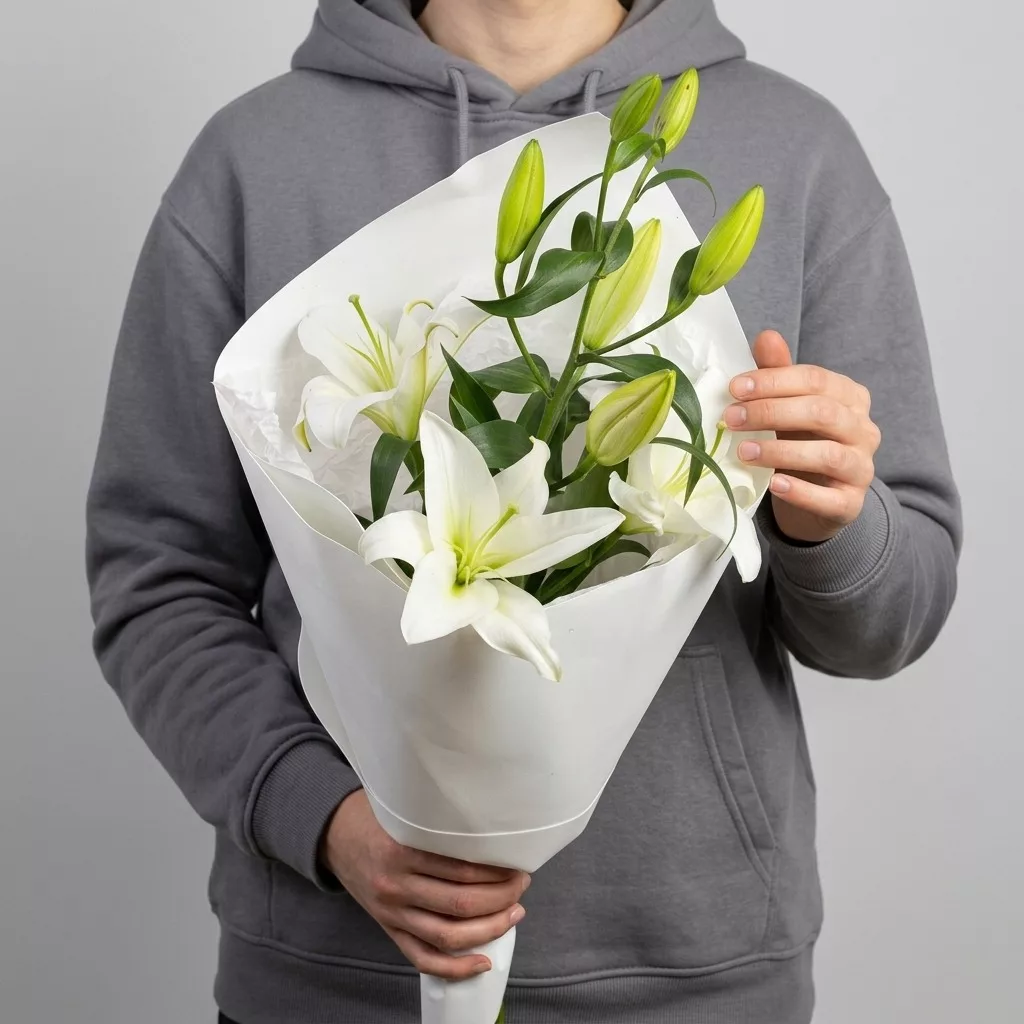
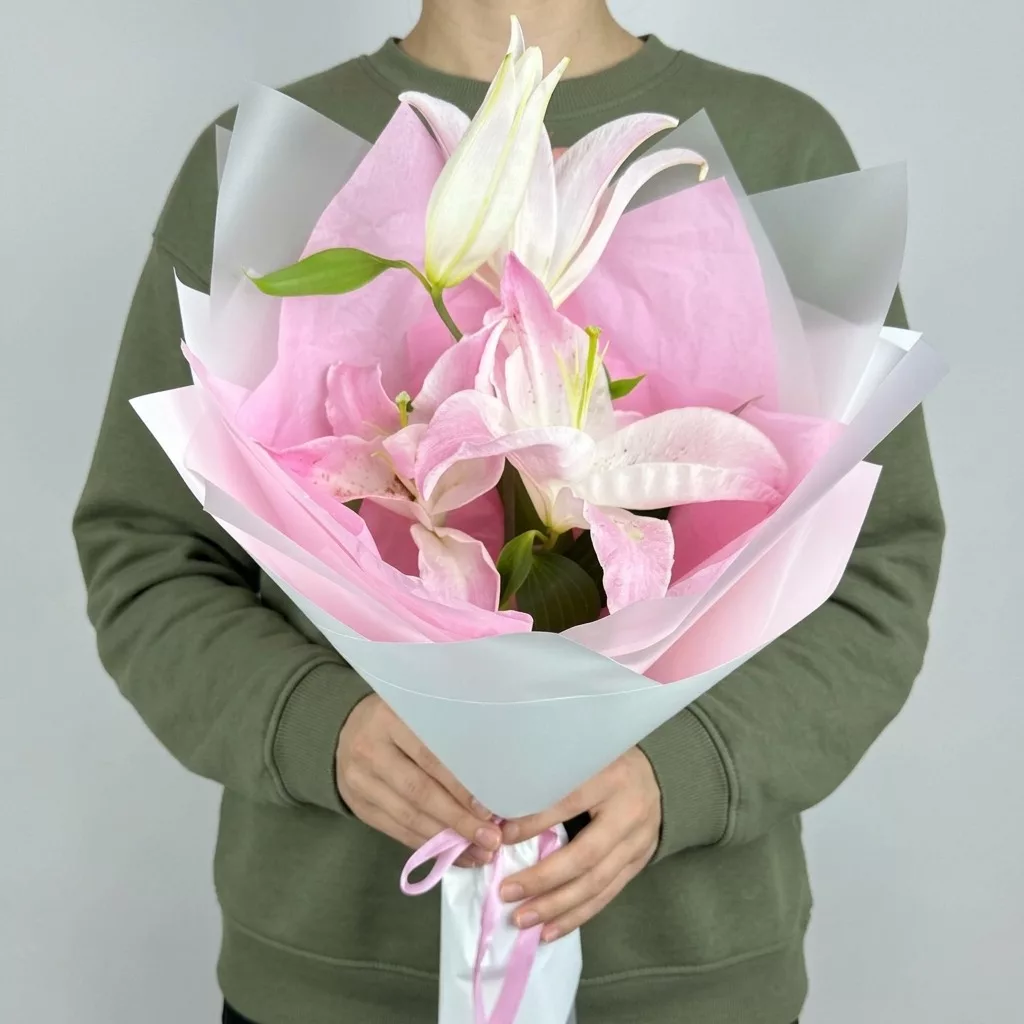

Kraft Paper, Film, and the Logic of Russian Wrapping
Russian bouquets are almost always fully wrapped — not just around the stems, but around the entire flower head as well. This is partly practical and partly aesthetic. Saint Petersburg winters can drop well below freezing, and even a short journey from a car to a door can damage exposed petals. Wrapping protects the flowers during transit, acting as a microclimate that traps a small amount of warmth and humidity around the blooms.
Kraft paper is the most traditional choice. It comes in natural brown, white, or black, and it has a texture that photographs beautifully and feels substantial in the hand. Many florists layer two or three sheets at different angles, creating a geometric collar around the bouquet that adds height and visual drama. The paper is folded deliberately, not crumpled, and the folds themselves become part of the presentation.
Soft matte film — sometimes called floral film or sleeve wrap — has become increasingly popular for bouquets that will be photographed or displayed indoors. It is translucent, which means the flowers remain visible through the wrapping, and it holds its shape even after the ribbon is tied. Some arrangements combine both materials: a layer of film close to the stems for structure, then an outer layer of kraft paper for warmth and texture.
The wrapping is never removed before delivery. Part of the experience of receiving a Russian bouquet is unwrapping it yourself, which is treated almost like opening a gift box. The ribbon is tied tightly enough to hold everything in place but loosely enough to pull free with a single tug.
Ribbon, Twine, and the Details That Signal Occasion
The finishing details of a Russian bouquet are chosen to match the occasion, and a florist who knows their craft will adjust them without being asked. A birthday bouquet for a young woman might be tied with a wide blush satin ribbon, finished in a full bow. The same flowers going to a colleague for a professional anniversary would be tied with narrow grosgrain in a simple knot — elegant but restrained. These distinctions are understood instinctively by Russian recipients, even if they are invisible to someone from outside the tradition.
Natural twine has become more common in recent years, especially for rustic or garden-style arrangements featuring tulips, anemones, or mixed seasonal stems. It gives a lighter, less formal impression while still holding the spiral stem structure firmly together. For very large or elaborate bouquets — the kind given at graduations or significant anniversaries — double ribbons in complementary colours are used, sometimes with a small decorative element tucked into the bow.
The stem ends are always cut cleanly and left visible below the wrapping. In Russian presentation, the stems are considered part of the bouquet's beauty, not something to hide. They are often trimmed to a consistent length and sometimes wrapped in a small band of matching paper to keep them tidy during transit. When the recipient places the bouquet in a vase, the stems should already be the right length — a good florist accounts for this during assembly, cutting them slightly longer than the final vase height requires so the recipient can make a fresh cut at home.
Choosing Flowers That Suit the Russian Presentation Style
Not every flower performs equally well in a tightly wrapped, dome-shaped Russian bouquet. The best choices are varieties that hold their form under gentle compression, tolerate a short period without water during transit, and look their best at the moment the wrapping comes off rather than requiring time to open.
Roses are the obvious foundation. Russian florists use them at a tight bud stage for bouquets that will be gifted immediately, knowing they will open over the following two to three days. Spray roses add texture and fill gaps between larger heads beautifully. Peonies, when in season from late May through June, are extraordinarily well suited to this style — their large, soft heads create an instant dome without much additional structure needed.
For winter and early spring, tulips require more care. They continue to grow after cutting and will shift position within a wrapped bouquet if held for more than a few hours. A florist managing same-day delivery in Saint Petersburg — where the distance between the studio and the recipient might be thirty minutes or two hours depending on the district — needs to account for this. Tulips are best wrapped loosely and delivered quickly.
Ranunculus, with their layered petals and perfectly round heads, have become one of the most popular choices for premium Russian bouquets in recent years. They hold their shape well, come in a wide range of colours, and layer naturally into the spiral structure. Eucalyptus, ruscus, and pittosporum are the most common greenery choices, used sparingly around the edges of the dome rather than mixed through the centre.
What Happens to the Bouquet During Delivery
A wrapped Russian bouquet is designed to survive the journey from studio to recipient in good condition — but the wrapping only does its job if the transit time is short and the temperature is managed correctly. This is why same-day delivery within one to two hours matters so much: it is not simply a convenience, it is what the presentation style requires to arrive as intended.
In summer, when Saint Petersburg temperatures can reach thirty degrees Celsius or above, flowers are kept in a cooled environment right up until the moment of dispatch. Roses and peonies are particularly sensitive to heat during transit; even fifteen minutes in a warm car can cause petals to soften and lose their structure. The kraft paper wrapping provides a small degree of insulation, but it is not a substitute for temperature control during the journey itself.
In winter, the risk runs the other way. Flowers taken from a cold vehicle into a warm apartment can develop condensation on the petals, which leads to spotting on light-coloured varieties like white roses or cream ranunculus. The solution is to allow the bouquet to acclimatise before unwrapping — leaving it in the entrance hall for five to ten minutes before removing the paper. This simple step, which experienced recipients in Russia often do automatically, makes a significant difference to how the flowers look once they are in the vase.
The recipient should be told this if they are unfamiliar with the custom. A short note with the bouquet explaining the acclimatisation step is a small detail that protects the presentation and shows that the sender thought of everything.
Care After Unwrapping: Making the Presentation Last
The moment the ribbon is pulled and the paper falls away is when the bouquet makes its strongest impression — and good care in the first hour determines how long that impression lasts. Russian bouquets are built to be placed directly into a vase, and the spiral stem structure means the flowers will hold their dome shape in water without any rearranging needed. This is one of the quiet pleasures of the format: it moves from wrapping to vase as a single intact object.
The vase should be filled with cool, clean water — not cold, not warm. Stems should be recut at a forty-five-degree angle before placing them in the water, removing the last centimetre or two that may have dried during transit. This reopens the vascular tissue and allows the flowers to drink immediately. Any leaves that would sit below the waterline should be removed to prevent bacterial growth, which is the single most common cause of shortened vase life.
Roses and ranunculus in a cool room with fresh water changed every two days will typically last seven to ten days. Tulips are shorter — five to seven days is realistic, and they will continue to open and lean toward the light, which changes the shape of the arrangement gradually. Peonies, if received as tight buds, can take two full days to open completely and then last another five or six days at their best.
Keep the vase away from direct sunlight, heating radiators, and fruit bowls — ethylene gas released by ripening fruit accelerates petal drop noticeably in roses and ranunculus. A cool windowsill away from direct sun is ideal in most Saint Petersburg apartments.
Russian bouquet wrapping is not decoration for its own sake — every layer of kraft paper, every fold, every length of ribbon is there to protect the flowers, honour the recipient, and make the moment of unwrapping feel like something worth remembering. When you order a bouquet from Turboflora, you are sending something assembled with this tradition in mind: a round dome of carefully chosen flowers, wrapped to survive a Saint Petersburg winter or summer, built to move from delivery bag to vase without losing a single petal. The person receiving it may not be able to name the technique, but they will feel the difference immediately.
Frequently asked questions
Why does my Russian bouquet arrive fully wrapped instead of open like a Western bunch?
Full wrapping protects the flowers during transit in Russia's extreme temperatures — both the summer heat and winter cold can damage exposed petals quickly. The wrapping also preserves the dome shape built by the florist, so the bouquet arrives looking exactly as it left the studio. Unwrapping it yourself is considered part of the gift experience.
Should I remove the wrapping immediately or let the bouquet sit first?
In winter, let the bouquet rest in a cool entrance hall for five to ten minutes before unwrapping. This allows the flowers to acclimatise gradually, preventing condensation from forming on the petals — which can cause spotting on light-coloured roses or ranunculus. In summer, unwrap promptly and place the stems in cool water straight away.
Can I ask for a different wrapping style when I order?
Yes. When placing your order with Turboflora, you can specify preferences — a more minimal wrap, a particular ribbon colour, or a rustic twine finish rather than satin. The florist will adjust the presentation to suit the occasion and recipient while keeping the structural integrity of the bouquet intact.
Why are the stems left visible and not hidden in Russian bouquets?
In Russian floristry, the stems are considered part of the bouquet's beauty. The spiral binding technique creates an attractive fan of stems below the flower heads, and showing them signals to the recipient that the bouquet was hand-built properly. They are trimmed to a consistent length so the bouquet can go straight into a vase without adjustment.
How long will a wrapped Russian bouquet last once I put it in a vase?
Roses and ranunculus typically last seven to ten days with cool, clean water changed every two days and stems recut on arrival. Tulips last five to seven days. Peonies, received as buds, take up to two days to fully open and then last another five or six days. Avoid placing any bouquet near radiators, direct sunlight, or fruit bowls.
Ready to send flowers?
Pick the city, choose the bouquet, and a local florist takes it from there.
Choose a city →