Sending Flowers to Abaza from Abroad? Here Is What to Expect
Abaza sits in the Republic of Khakassia, tucked into the foothills of southern Siberia, and when you are calling or messaging someone there from London, Berlin, or New York, the distance can feel enormous. A bouquet that arrives at the right moment closes that gap in a way that no video call quite manages. The key is understanding a few practical realities — the climate, the timing difference, and the local customs around flowers — so that what reaches your person feels thoughtful rather than accidental.
Why Abaza Is Different from Ordering Flowers in a Big City
Most people ordering flowers internationally picture a large metropolis with same-day florists on every corner. Abaza is a smaller city, and that changes the logistics in ways worth knowing before you place an order. The town sits at roughly 800 kilometres from Krasnoyarsk and is surrounded by a continental climate that swings hard between seasons. Summer afternoons can be genuinely hot, and winters bring temperatures that would shock a tulip stem within minutes of leaving a warm vehicle.
This means the courier route and the packaging both matter more than they would in, say, Moscow. Flowers travelling the final stretch in winter need insulating wrap and a vehicle with controlled temperature. In summer, the concern reverses — heat wilts roses fast, so timing the delivery to avoid the midday peak is a real consideration, not a detail.
For the sender abroad, the practical consequence is that you should choose a florist who understands these conditions and builds them into how they pack and route each order. Asking whether the bouquet is wrapped for the temperature that day is a completely reasonable question, and any experienced florist will have a clear answer. The good news is that when logistics are handled well, the flowers arriving in Abaza look just as fresh as anything delivered in a capital city. The effort simply has to be deliberate rather than assumed.
Bouquets we can deliver



Reading the Time Zone Before You Order
Abaza follows Moscow Time plus seven hours, which puts it in UTC+10. If you are ordering from Western Europe, that is a nine-hour difference. From the East Coast of the United States, you are looking at thirteen hours. This is not a small gap, and it is the single most common reason international senders end up with flowers arriving at an awkward moment — late at night, during a work meeting, or the morning after a birthday rather than on it.
The best approach is to work backwards from the moment you want the recipient to open the door. Decide on that moment first: mid-morning on a birthday, just before a family dinner, right after work on an anniversary. Then convert that local Abaza time to your own timezone and place the order with enough lead time to account for payment processing and confirmation.
For most international orders, placing the request at least twenty-four hours ahead gives the clearest margin. For significant dates like a major anniversary or New Year, forty-eight hours is more comfortable. Russian New Year, which falls on the first of January, and the eighth of March — International Women's Day — are the two dates when demand spikes hardest across Russia. If either of those is your occasion, ordering three to four days early is not excessive caution, it is simply experience. Your recipient will never know you planned it carefully; they will only feel that the flowers arrived at exactly the right time.
What Russian Flower Customs Mean for Your Order
If you have not sent flowers to Russia before, a few conventions will help you avoid the most common mistakes. The most important one is the odd-number rule. Bouquets in Russia are given in odd numbers — three stems, five, seven, nine, eleven — because even numbers are associated with funerals. This is not a superstition that only older generations follow; it is observed across age groups and regions, including Khakassia. A florist who knows their craft will automatically assemble odd-number arrangements, but if you are building a custom order, keep this in mind.
Colour carries meaning too, though it is less rigid than the number rule. Red roses read as romantic love, which is perfect for a partner but can feel odd for a colleague or a mother. White flowers are elegant and suit almost any relationship. Yellow flowers, once considered unlucky in Soviet-era Russia, are now widely accepted and cheerful, particularly sunflowers, which have always been beloved. Pink and peach tones work beautifully for birthdays across all ages.
Wrapping style also signals care. A bare bunch handed over without paper or ribbon feels unfinished in the Russian gifting context. Kraft paper with a ribbon, or a linen wrap with dried accent flowers, communicates that the arrangement was composed with intention. When ordering remotely, specifying that you want a wrapped presentation rather than a simple bouquet ensures the recipient receives something that looks like a real gift the moment the door opens.
Choosing Flowers for the Siberian Climate and the Season
Abaza's continental climate means you need to think about what the flowers will face after delivery. In January or February, a recipient may carry a bouquet from a warm apartment lobby into minus-twenty-degree air and back again within seconds, but that brief exposure can still damage delicate petals. Varieties with robust, thick petals survive this better: spray roses, chrysanthemums, alstroemeria, and carnations all hold up well in cold conditions. Lisianthus is another excellent winter choice — its ruffled petals look luxurious and it is more cold-tolerant than it appears.
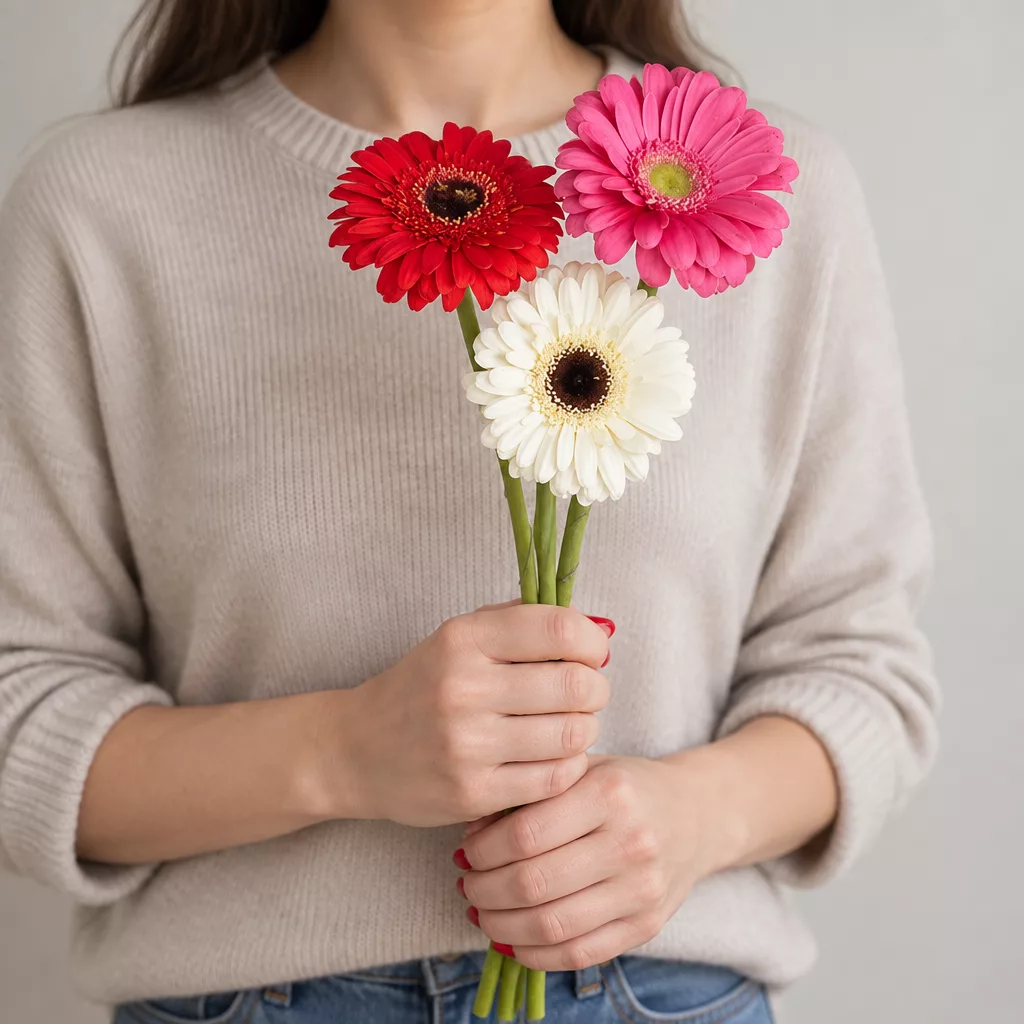
In summer, the concern shifts to heat and water uptake. Sunflowers, gerberas, and dahlias are joyful summer choices that handle warmth better than cool-loving varieties. Garden roses in peach or coral tones photograph beautifully in summer light and feel seasonal rather than generic. Avoid ordering heavily tropical arrangements in July or August unless you are confident the delivery window is early morning.
Spring is perhaps the most romantic season for flower orders in this region. From late April onward, tulips, ranunculus, and hyacinths feel perfectly matched to the mood of someone watching the snow finally leave the hills. These are also the flowers that tend to surprise recipients most — a lush arrangement of blush ranunculus arriving in a city that has been grey for months is genuinely moving. Autumn calls for richness: burgundy dahlias, orange spray roses, and eucalyptus branches create arrangements that feel warm against the shortening days.
Writing a Message That Lands Across the Distance
The card that comes with the flowers is often the part that matters most, and international senders sometimes underestimate it. A few lines written thoughtfully do more than an elaborate bouquet with a generic greeting. The message does not need to be long — three or four sincere sentences are more powerful than a paragraph that trails off.
If you are writing in English for a recipient who reads English, that is perfectly fine and often feels personal in a way that a translated phrase does not. If you want the message in Russian, write it in English and ask the florist to translate it faithfully rather than substituting a standard phrase. The difference between a genuine message in the recipient's language and a template that says only Happy Birthday is significant.
For occasions like a promotion, a new home, or a graduation, be specific. Name what they achieved. Flowers paired with a message that says I know how hard you worked for this carry a completely different weight than flowers with a generic congratulations. For a birthday, mentioning something real about the person — a shared memory, an inside reference — makes the bouquet feel like it came from someone who was present even across twelve time zones.
Avoid very long messages on the card itself; if you have a lot to say, send a voice note separately and let the card say simply that you are thinking of them. The flowers do much of the emotional work on their own.
Confirming Delivery When You Cannot Be There
One of the genuine anxieties of ordering flowers from abroad is not knowing whether they arrived. You cannot knock on a neighbour's door or drive past to check. Setting up a simple confirmation loop before you place the order removes most of that anxiety.
The most reliable method is to ask the recipient's household if someone will be home during the delivery window, without revealing the surprise if there is one. You can frame this as a general question — something arriving for you, please make sure someone is in — without giving away the flowers. If the recipient lives alone and works during the day, providing a secondary contact number for a trusted neighbour or family member ensures the florist can reach someone if the door goes unanswered.
For surprise deliveries, it is worth considering a slightly wider delivery window rather than a very precise time. A two-hour window gives the courier flexibility to reach the address when someone is actually present. A rigid request for eleven o'clock exactly increases the chance of a missed delivery, which then requires a second attempt and delays the moment you have been planning.
Once the order is placed, a confirmation message from the florist with an estimated delivery time lets you follow along from wherever you are. After delivery, most recipients message or call within minutes — flowers tend to produce an immediate reaction. If you have not heard anything within a couple of hours of the expected window, a quick message to the recipient is completely natural and gives you the chance to share in the moment directly.
Helping Your Flowers Last Once They Arrive
Flowers sent with care deserve a good home once they arrive, and a few simple instructions make a real difference to vase life. If you include a brief note with the bouquet about basic care, it reads as thoughtful rather than instructional — most recipients genuinely appreciate knowing how to keep the arrangement looking its best.
The first step is always a fresh cut. Stems should be cut at an angle under water or immediately before being placed in a vase, removing the bottom two centimetres with a sharp knife or scissors rather than tearing. This opens the stem's water channels properly. Leaves that would sit below the waterline should be removed entirely, because submerged foliage rots quickly and clouds the water, which shortens the life of every stem in the vase.
Water temperature matters more than most people realise. Roses and most cut flowers prefer cool to room-temperature water rather than cold. Changing the water every two days and re-cutting the stems each time adds three to five days of vase life in practice. Placing the vase away from direct sunlight, heating vents, and fruit bowls — ethylene gas from ripening fruit accelerates petal drop — keeps the arrangement looking fresh significantly longer.
In Abaza's dry continental air, the water level drops faster than in more humid climates. Reminding the recipient to top up the vase daily is a genuinely useful piece of advice rather than an obvious one. Spray roses and alstroemeria tend to last ten to fourteen days with good care. Gerberas and tulips are shorter-lived but intensely beautiful during their five to seven days.
Sending flowers to Abaza from another country is not complicated when you understand the variables — the time zone, the climate, the customs, and the small details that turn a delivered bouquet into a real moment. The distance that makes a gift feel necessary is the same distance that makes it land with force when it is done well. Plan the timing with care, choose varieties suited to the season, write something genuine on the card, and the flowers will do exactly what you are hoping for.
Frequently asked questions
Can I order flowers for Abaza from outside Russia without a Russian phone number?
Yes. You can place an order using an international phone number or email address. Provide the recipient's local Abaza number as the delivery contact so the courier can reach them directly. Most international senders communicate with the florist in English, and confirmation details are sent to whatever contact you provide at checkout.
How far in advance should I order for International Women's Day on March 8th?
For the eighth of March, place your order at least three to four days ahead. This date is the single busiest flower occasion across Russia, and demand in all cities, including smaller ones like Abaza, rises sharply in the days before. Earlier ordering guarantees your preferred varieties are available and your delivery slot is confirmed.
Is it acceptable to send flowers to a male recipient in Russia?
Absolutely. While flowers are most commonly given to women in Russian tradition, sending a bouquet to a man for a birthday, promotion, or significant achievement is increasingly common and warmly received. Opt for structured, less overtly romantic arrangements — think architectural compositions with anthuriums, tropical foliage, or bold single-variety bunches of sunflowers or chrysanthemums.
What happens if the recipient is not home when the flowers arrive?
The courier will attempt to reach the recipient by phone using the number provided. If there is no answer, a secondary contact number helps significantly. For surprise deliveries, providing a trusted neighbour's number as backup ensures the bouquet is not left unattended. We recommend specifying a two-hour delivery window rather than an exact time to allow for flexibility.
Do flowers really survive delivery in Abaza's winter temperatures?
Yes, when packed correctly. Professional bouquets travelling in winter are wrapped in insulating layers and transported in temperature-managed vehicles. The exposure time between the vehicle and the recipient's door is brief enough that robust varieties — spray roses, chrysanthemums, alstroemeria, carnations — arrive in excellent condition. Avoid ordering very delicate tropical blooms in January or February.
Ready to send flowers?
Pick the city, choose the bouquet, and a local florist takes it from there.
Choose a city →