Sending Flowers to a Russian Office: What You Need to Know
Sending flowers to someone at their workplace feels like a generous, thoughtful gesture — and it is. But a corporate delivery in Russia has its own small rules, and knowing them in advance means the bouquet actually reaches the right person at the right moment, rather than sitting at a reception desk for three hours while someone tries to track down the recipient by first name alone.
Why the Address Format Matters More Than You Think
In Russia, postal addresses follow a specific order that differs from Western conventions, and getting it wrong can slow down or misdirect a delivery. The correct sequence runs from largest to smallest: city, then street, then building number, then office or floor number. For example: Saint Petersburg, Nevsky Prospekt, 28, office 412. If you reverse this and write it the Western way — office first, then street, then city — a courier may still find the building, but locating the right floor or suite inside a large business centre becomes genuinely difficult.
Building numbers in Russian cities also carry extra layers. You will often see combinations like 14, building 2, entrance 3. These refer to a secondary structure within a compound and a specific stairwell or lobby. Skipping any of these details in a large residential-turned-commercial block or a Soviet-era business complex can mean the courier circles the courtyard for twenty minutes. Always ask the recipient or their assistant for the full address string, including any korpus or stroenie designation, before placing the order.
For business centres with a managed reception area, the floor number matters less than the company name on the order. Most modern offices in Russian cities operate through a central lobby where a guard or receptionist logs visitors and deliveries. Including the company name alongside the recipient's full name — both first name and patronymic if you have it — removes almost all ambiguity and speeds up the handover considerably.
Bouquets we can deliver



Navigating Reception Desks and Security Protocols
Many Russian office buildings, particularly business centres built after 2000, operate a controlled-access system. A courier cannot simply walk to the fourth floor and knock on a door. There is usually a security desk or reception on the ground floor where all deliveries are logged, the recipient is called, and either an access pass is issued or the flowers are held for collection. This is completely standard and not a sign that anything has gone wrong.
The important thing is to make sure the recipient knows a delivery is coming, or at least is reachable by phone during the delivery window. If the person is in a meeting with their phone on silent and no one at reception knows their extension, the bouquet waits. For a surprise delivery, it helps to notify a colleague — a secretary, a team member, anyone who can receive the flowers and bring them to the person without spoiling the moment entirely.
Some older administrative buildings and government-adjacent offices have stricter protocols where even a courier needs to show identification and register with the guard. Our drivers carry the necessary documentation for this. What you can do on your end is include the recipient's direct phone number in the order notes. A quick call from the lobby resolves almost every access question in under two minutes. Reception staff in Russian offices are generally efficient; they handle deliveries every day. A clear name, a company name, and a working phone number are all they need to move things along smoothly.
Choosing the Right Time for a Corporate Delivery
Timing a flower delivery to an office is different from timing one to a home. At home, the recipient is either there or not. At an office, the recipient might be there but completely unavailable — presenting to a client, sitting in an all-hands meeting, or on a call they cannot leave. Flowers that arrive at the wrong moment can cause a small disruption and even mild embarrassment for someone who has to excuse themselves to sign for a delivery.
The sweet spots for corporate deliveries in Russian cities are mid-morning, roughly between ten and eleven-thirty, or early afternoon between two and three. These windows sit outside the typical morning rush of stand-ups and planning calls, and they land before the afternoon focus blocks that many teams protect. Avoid delivery right at nine in the morning, when people are still arriving and settling in, and avoid the noon hour when a large portion of office workers step out for lunch.
Friday afternoons are worth a separate note. Many Russian offices, particularly in the private sector, operate on a slightly shortened Friday schedule, and some employees leave early. If you are sending flowers to mark a birthday or a work anniversary that falls on a Friday, aim for delivery before two in the afternoon. For flowers that need to travel home — a large arrangement a colleague is planning to take on the metro — a lighter, more compact design in a handled box or a wrapped bouquet rather than a tall vase arrangement will make their commute much easier.
What Flowers Actually Work in an Office Setting
An office is a shared space, and that shapes which flowers are appropriate. Strong fragrance is the first thing to consider. Lilies, particularly Oriental varieties like Stargazer, release a scent that fills a room quickly. In a small open-plan office or a shared meeting room, this can genuinely bother colleagues, especially anyone with allergies or sensitivities. Freesias are similarly fragrant and beautiful, but better suited to a private office or a home. For a shared workspace, lower-fragrance choices are simply more considerate.
Roses, alstroemerias, chrysanthemums, and spray carnations are all excellent office flowers. They hold their shape well in a vase, they are not overpowering, and they photograph beautifully for the kind of social media moment that many recipients will want to share. Gerberas add a cheerful burst of colour without any scent at all. Eustoma, sometimes called lisianthus, has a refined look that suits corporate aesthetics without reading as overly romantic or informal.
Colour also carries meaning in a professional context. Deep reds can feel intensely personal and may not be the right choice for a colleague or a business partner. A palette of whites, creams, soft corals, and dusty pinks reads as celebratory and warm without any ambiguity. If you know the recipient's favourite colour, working it into the arrangement as an accent rather than the dominant tone is a good way to personalise without overwhelming. A white and blush bouquet with a few stems of deep burgundy ranunculus, for instance, feels both sophisticated and genuinely thoughtful.
Presentation and Packaging for a Professional Context
How a bouquet looks when it arrives at an office matters in a way it simply does not at home. At home, someone can unwrap flowers in the kitchen, trim the stems over the sink, and arrange them quietly. At an office, the flowers are often unwrapped at a desk or in a corridor, sometimes with colleagues watching. The packaging is part of the gift, and it should look intentional from the first moment.
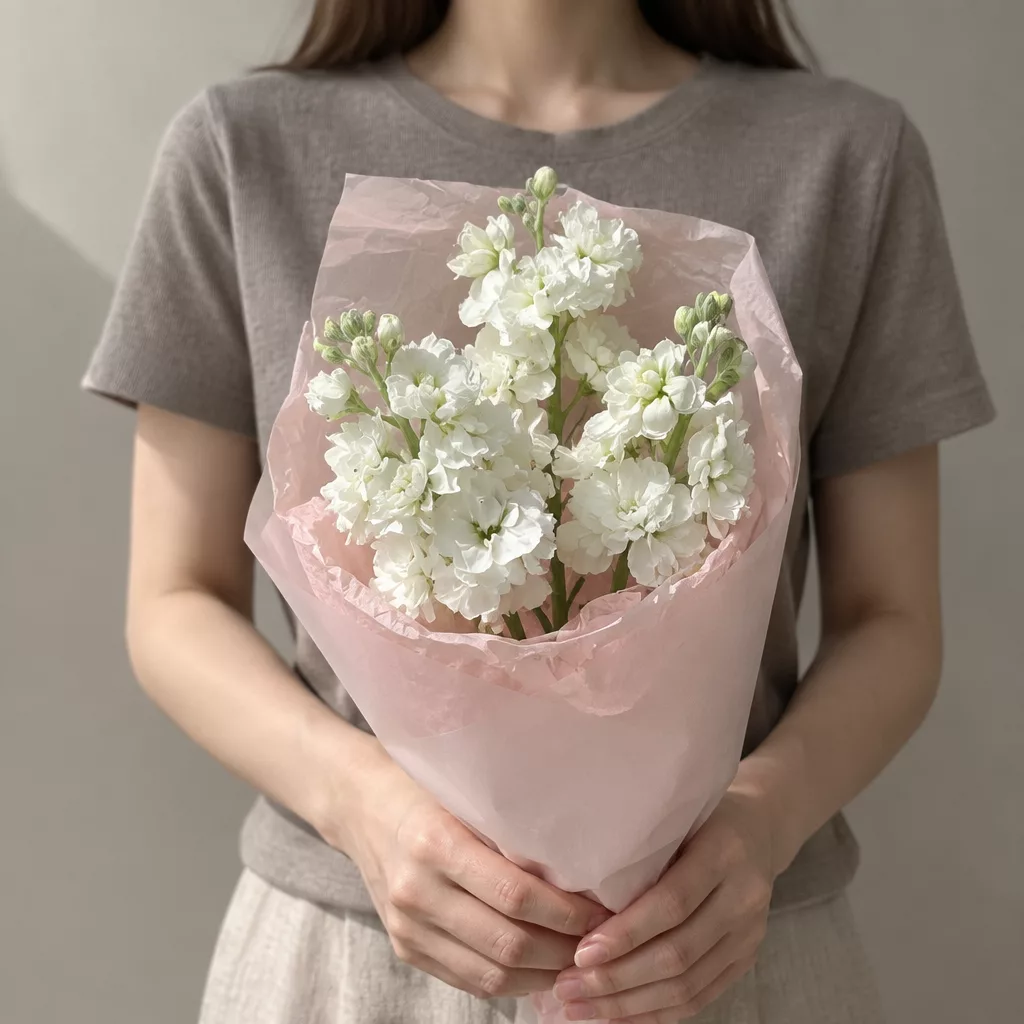
A well-wrapped bouquet in kraft paper with a satin ribbon, or flowers presented in a handled gift box, travels well and looks polished when handed over at a reception desk. Loose cellophane with tape that has come unstuck during transit does not. We wrap every arrangement with the journey in mind — the packaging holds its shape in a courier bag and opens cleanly without a struggle. For office deliveries, we also avoid oversized constructions that are difficult to carry. A bouquet that fits comfortably under one arm while the recipient holds their security card in the other hand is a practical kindness.
If you are sending flowers to mark a business milestone — a company anniversary, the opening of a new office, a successful deal — a small arrangement for a desk is a warm personal gesture, but a larger statement piece for a reception area or a conference table can also be appropriate. In that case, think about the vessel: a clean, modern vase in clear glass or white ceramic suits almost every office interior and does not clash with branded décor. We can discuss the right scale when you place your order.
The Card Message in a Professional Context
The card that comes with office flowers is read differently from one sent to a home. At home, a message is private. At an office, there is a reasonable chance that a colleague, a receptionist, or an assistant will see it before the recipient does — either because they receive the delivery or because the recipient opens it in a shared space. This does not mean the message needs to be cold or formal, but it is worth a moment of thought.
A warm, genuine message works perfectly well. Something like congratulating a colleague on a promotion, thanking a business partner for their collaboration, or wishing a client a happy birthday reads appropriately in any professional setting. What tends to land awkwardly is something very intimate or inside-joke-heavy that requires context the recipient's colleagues do not have. It puts the recipient in the position of having to explain, which can feel uncomfortable.
In Russia, it is common to address someone by their first name and patronymic in a formal or semi-formal context, particularly if there is a significant age difference or a senior-junior dynamic. If you know the recipient's patronymic, using it on the card — even just in the greeting line — signals respect and cultural awareness that will be noticed and appreciated. If you do not know it, a first name alone is entirely fine. Avoid overly casual English-language abbreviations or slang on cards going to recipients who may not be fully fluent in English; a simple, clear message is always more effective than a clever one that needs translating.
Keeping Flowers Fresh After They Arrive at the Office
Office environments are not always kind to cut flowers. Air conditioning runs constantly in most Russian business centres, and while it keeps people comfortable, it dries out petals and stems faster than a home environment would. A bouquet that might last ten days on a kitchen windowsill may show stress after six or seven days on a desk directly under an air conditioning vent. Positioning matters: a spot near a window with indirect light and away from the direct airflow is ideal.
Water quality and stem care are the other factors the recipient can control. When flowers arrive, stems should be cut at an angle — about two centimetres off the bottom — and placed immediately in a clean vase with fresh, cool water. Warm or stagnant water accelerates bacterial growth and shortens vase life noticeably. Changing the water every two days and re-trimming the stems each time makes a real difference. We include a small sachet of flower food with every delivery; it is not decorative — it genuinely extends the life of the arrangement.
Roses and alstroemerias are among the most resilient varieties for office conditions, typically lasting seven to ten days with basic care. Gerberas are slightly more sensitive to stem blockage and benefit from shallow water rather than a deep vase. Eustoma is surprisingly long-lasting and handles dry air better than many people expect. If the recipient wants to take the flowers home at the end of the week, a quick re-trim before they travel will help the arrangement recover and continue opening at home. Most flowers that look tired after a journey perk up within an hour of fresh water.
Sending flowers to a Russian office is genuinely straightforward once you understand the small customs that shape how deliveries work here. A complete address, a reachable phone number, a sensible delivery window, and flowers chosen with the shared workspace in mind — these four things together make almost every corporate delivery smooth and memorable. The recipient gets a moment of real warmth in the middle of a working day, which is exactly what flowers at the office are for.
Frequently asked questions
Can you deliver flowers to a business centre with a security checkpoint?
Yes. Our couriers are experienced with controlled-access buildings and carry the documentation they need. Including the recipient's direct phone number in your order notes helps enormously — a quick call from the lobby is the fastest way to clear any security question. If the recipient knows a delivery is coming, the process is usually very smooth.
What if the recipient is not at their desk when the flowers arrive?
Reception staff in most Russian offices will hold the flowers and call the recipient. We recommend notifying a colleague in advance for surprise deliveries so someone can receive the bouquet and keep it in water. If no one is reachable, our courier will contact you directly to arrange a second delivery attempt or discuss alternatives.
Is it appropriate to send flowers to a male colleague or business partner in Russia?
Absolutely. Flowers for men are common in Russian professional culture, particularly for birthdays, promotions, or significant milestones. Choose a structured, less overtly romantic arrangement — think bold single-colour roses, architectural greenery, or a mix of sunflowers and alstroemerias. Avoid anything that reads as a romantic gesture unless that is genuinely your intention.
How far in advance should I order for a timed office delivery?
For a specific delivery window — say, arrival between ten and eleven in the morning — placing your order at least two to three hours ahead gives us the best flexibility. Same-day orders are our standard, and we deliver within one to two hours across Saint Petersburg and to other Russian cities. The more specific your timing requirement, the earlier it helps to order.
What flowers should I avoid sending to a shared office space?
Avoid strongly fragrant varieties like Oriental lilies, freesias, and hyacinths in open-plan offices, as the scent can overwhelm colleagues and trigger sensitivities. Also consider size — a very tall or wide arrangement is difficult to transport home and may not fit comfortably on a standard office desk. Compact, low-fragrance bouquets with good vase life are the most practical and appreciated choice.
Ready to send flowers?
Pick the city, choose the bouquet, and a local florist takes it from there.
Choose a city →