How to Check Alstroemeria in a Bouquet for Damage
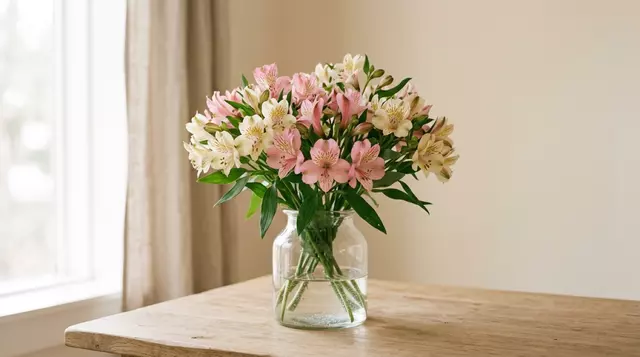
Check alstroemeria for crushed or translucent petals, soft brown buds, broken flower stalks and slimy stems. Fine stripes and speckles inside the flowers are normal; irregular patches with softened tissue, mould or an unpleasant smell are signs to investigate.
Look at the whole stem before judging a single bloom. Alstroemeria carries several flowers and buds on branching stalks, so one damaged flower does not necessarily mean the entire stem needs discarding.
Petals and buds: normal markings or damage?
Natural markings usually appear as distinct streaks or freckles within the petals. Bruising looks more like an irregular patch that is flattened, translucent or turning brown. Check the texture as well as the colour: a darker marking alone does not establish damage.
A mixture of open flowers and closed buds is normal. Check whether the buds feel firm and remain securely attached. Brown, shrivelled or soft buds are concerning, although a closed bud by itself is not proof of poor condition. Avoid squeezing buds or pulling petals apart to inspect them.
Check the branching stalks, leaves and stem bases
Follow each small flower stalk back to the main stem. A flower hanging at an unusual angle may have a crease or break hidden beneath neighbouring blooms. A sharply folded or split stalk is physical damage; adding water will not repair it.
Look for limp leaves alongside drooping flowers, which can suggest water stress. Yellow leaves alone cannot tell you how old the bouquet is. At the stem bases, check for slime, softened tissue and an unpleasant smell; cloudy vase water is also a reason to clean the vase and refresh the water.
Alstroemeria bouquets
What to do after you find a problem
Before trimming anything, photograph the whole bouquet and take close-ups of affected flowers, stalks and stem ends. If it arrived damaged, keep the order details and contact the manager through WhatsApp, explaining what you noticed and when. These details help the manager assess the situation.
Remove the transport wrapping carefully, supporting the branching stems as you work. Our guide to unpacking a bouquet without damaging it explains how to avoid catching flower heads in the packaging.
For intact but drooping stems, use a clean vase, fresh water and freshly cut stem ends; remove leaves that would sit underwater. Keep the bouquet away from direct sun, heaters and ripening fruit, then reassess after a few hours. Remove individual broken or decaying flowers with clean scissors. If soft, decaying tissue affects the main stem, discard that stem.
Checking a bouquet you are sending to Russia
If you are ordering from abroad, browse the bouquets catalogue and ask the manager on WhatsApp for help choosing and a photo of the bouquet before delivery. A photo can show its overall appearance and visible breakage, but it cannot confirm stem firmness or smell.
We deliver flowers across Russia. You can agree the address, delivery time and free card text with the manager. Online payment uses CloudPayments; check the options displayed at checkout for your card. Check our delivery information; confirm the timing for your order.
Frequently asked questions
Does pollen on alstroemeria petals mean the flower is damaged?
Loose pollen is not itself a sign of decay. Check the tissue beneath it for bruising, softness or mould, and avoid rubbing pollen into the petals or nearby fabric.
Will a drooping alstroemeria recover in water?
It may recover if water stress is the cause and the stem is intact. A snapped stalk or soft, decaying tissue will not recover through hydration.
Ready to send flowers?
Pick the city, choose the bouquet, and a local florist takes it from there.
Choose a city →