What Is the Difference Between a Flower Arrangement and a Bouquet?
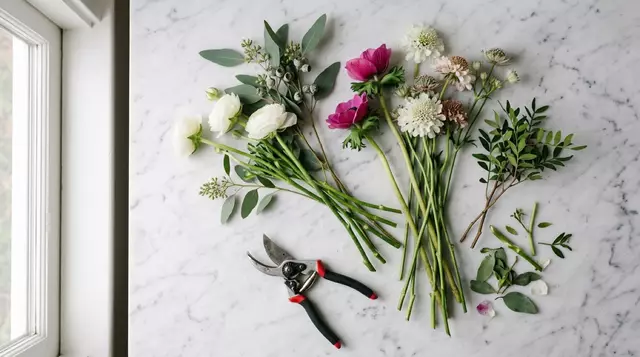
The main difference between a flower arrangement and a bouquet is how the flowers are supported and presented: a bouquet has stems gathered together, while an arrangement usually has flowers positioned in a container. A bouquet normally needs a vase after it arrives; a container arrangement generally stays in its original base. Technically, a bouquet is also a type of floral arrangement, but gift descriptions often use the terms to distinguish these two formats.
For you as the sender, that distinction affects more than appearance. Think about where the flowers will stand, whether your recipient has a suitable vase, and how much handling is convenient for them. A wrapped bouquet makes a generous presentation when handed over, while a container design can be easier to place straight on a table. Neither format is automatically larger, longer-lasting or more thoughtful: the particular design and the recipient’s circumstances matter more.
What you receive: tied stems or a supported design
In a bouquet, the florist groups the stems into a shape and usually secures them at a binding point. Wrapping protects and presents the flowers, but it is not necessarily a permanent water container. Some bouquets travel with a temporary water supply; others need attention soon after arrival. Once the bouquet is home, the recipient normally removes its transport packaging, prepares the stems and places them in a clean vase. Check the care instructions before undoing anything that holds the design together.
A container arrangement has its stems positioned within a vase, box, basket or another base. Depending on the design, the flowers may sit directly in water or in a water-holding support such as floral foam. The visible outer container does not tell you which method is inside: a decorative box may conceal a separate liner. Look at the product description and photograph, and clarify anything unclear before choosing. You need to know whether a vase is required, what supports the stems and how the recipient should add water.
Choose for the space and the moment of giving
A bouquet works well when you will hand over the flowers personally and the recipient can put them in water shortly afterwards. It also gives them freedom to choose a vase and adjust the display to their home. For a birthday dinner, consider whether the host will have time to find a vase while welcoming guests. For someone receiving flowers at work, think about the journey home: a tall bouquet and a wide container present different carrying challenges, so neither is universally the easier option.
A container arrangement is useful when you want the gift to arrive with its display already established. Check the footprint as well as the height: a broad design can occupy much of a small desk, while tall flowers can interrupt conversation across a dining table. A low arrangement often suits a table where people will sit opposite one another. When browsing the bouquets catalogue, judge the actual shape, dimensions and contents rather than assuming that a box is compact or that elaborate wrapping means more flowers.
Bouquets we can deliver




Care for a bouquet: clean water and a suitable vase
Prepare a clean vase before placing a bouquet on display. Remove transport wrapping that would sit in the water, then remove any leaves below the intended waterline. Use clean, sharp scissors or secateurs to refresh the stem ends, following any flower-specific instructions supplied with the gift. Add water and flower food according to the packet directions, if food is provided. Choose a vase that supports the stems without forcing them tightly together; an opening that is too wide can let the bouquet lose its intended shape.
Check the water every day and replenish it as needed. Replace cloudy water, clean the vase and remove deteriorating leaves or flowers rather than leaving them among healthy stems. Keep the display away from direct sunlight, heaters and ripening fruit, and avoid putting it in a busy spot where it will be knocked. Different flowers age at different rates, so a mixed bouquet may benefit from small adjustments over time. Our guide to arranging a mixed bouquet in a vase at home covers the next steps if you want to reshape it.
Care for an arrangement: identify what holds the water
A container arrangement still needs water, even when its stems are hidden. First establish whether it uses a vase, an internal water vessel or floral foam. For flowers standing in water, check the level and top it up carefully. For a foam-based design, follow the supplied instructions and add water slowly to the support, avoiding the flower heads and decorative outer packaging. Do not assume that a cardboard box or basket is watertight, and protect the furniture beneath it while you learn how much water the inner container holds.
Keep stems in their original positions unless the care instructions say otherwise. Pulling flowers out of foam and pushing them back repeatedly can damage the support and leave stems with poor contact. Remove spent blooms carefully and keep the design away from heat and direct sun, just as you would a bouquet. Neither format has an inherent lifespan advantage: flower condition, the varieties used, access to water and conditions in the room all matter. Choose for convenience and appearance, then care for the actual design you receive.
Match the message, colour and presentation to the occasion
The container alone does not make flowers romantic, formal or suitable for sympathy. The flower selection, colours, scale and card text carry much of the message. Red roses often suggest romance, but personal associations vary; your recipient’s preferences are a better guide than a rigid colour code. If you are sending a celebratory gift in Russia, an odd number is customary when individual stems are clearly counted. Even numbers are traditionally associated with mourning, although large mixed designs are not usually read as a simple stem count.
Presentation can change how the same flowers feel. Substantial wrapping may create a dramatic handover, while an exposed vase or compact container puts more emphasis on the finished display. Our guide to Russian bouquet wrapping and presentation explains this visual language. Add a short card that makes your intention clear, especially for a colleague, an apology or a relationship where romantic symbolism could be misunderstood. A specific personal sentence usually communicates more than asking the flowers to express everything on their own.
How to choose and order flowers for delivery in Russia
Start with your recipient’s city, the occasion and the place where the flowers will be displayed. Then choose the design and confirm whether it needs a separate vase. You can contact a manager on WhatsApp for help choosing a bouquet, agreeing the delivery time, address and card text, and arranging a photo of the bouquet before delivery. We deliver across Russia. City delivery costs 500 RUB; for remote districts and suburbs, the operator confirms the delivery price when confirming the order.
In large cities, express delivery is available within 1–2 hours after order confirmation. Other timing options include an exact time with a tolerance of plus or minus 30 minutes, the windows 09–12, 12–15, 15–18 or 18–21, and pre-ordering 1–30 days ahead. Choose a time when the recipient can receive the flowers and attend to them. Online checkout uses CloudPayments; check the payment options displayed there rather than assuming a particular foreign card will be accepted. See delivery and payment when planning your order.
Delivery is anonymous by default: the courier does not name the sender, and a card with your text is free. Include your name in the card if you want the recipient to know who sent the gift. The courier calls the recipient about 15 minutes before arrival, so take that call into account when planning a surprise. If the recipient is absent, we agree a second delivery the same day or, with your consent, hand the flowers to a neighbour or concierge. A container design may simplify placing the gift, but receiving it still needs coordination.
Frequently asked questions
Is a bouquet a flower arrangement?
Yes, in the broad sense: its flowers have been deliberately arranged. In gift catalogues, however, “bouquet” usually means gathered stems, while “arrangement” often refers to flowers supported in a container.
Which lasts longer: a bouquet or a flower arrangement?
Neither format automatically lasts longer. Flower condition, varieties, water supply and care have more influence than whether the flowers arrive wrapped or in a container.
Do flowers in a box need watering?
Yes, cut flowers in a box still need access to water. Check whether the design contains a water vessel or floral foam, then follow its care instructions and avoid soaking the outer box.
Which should I send if the recipient has no vase?
Choose a design confirmed to include its own suitable water container or support. A decorative box alone does not establish how the flowers are held, so check the description or ask before ordering.
Can I order flowers for someone in Russia while I am abroad?
You can arrange delivery to a recipient in Russia and agree the address, timing and card text with a manager. Checkout uses CloudPayments; check the options shown at checkout, as acceptance of every foreign card is not guaranteed.
Ready to send flowers?
Pick the city, choose the bouquet, and a local florist takes it from there.
Choose a city →