Flowers and Roses: What Is the Difference?
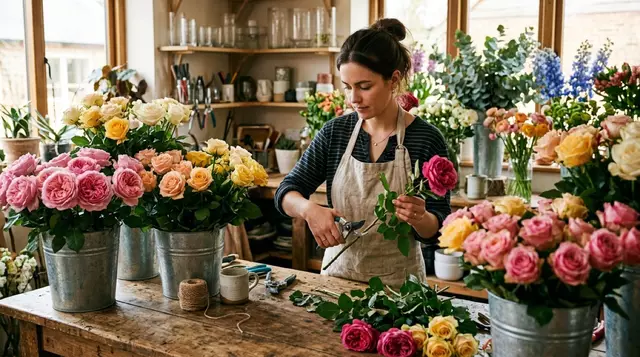
The difference between flowers and roses is that “flowers” is a broad category, while roses are one particular type within it. All roses are flowers, but not all flowers are roses: tulips, lilies, carnations and chrysanthemums are other examples. When you choose between “flowers” and “roses” for a gift, the useful comparison is usually a rose bouquet versus a bouquet of other flowers or a mixed arrangement.
Neither choice is automatically more thoughtful, more romantic or longer lasting. The right bouquet depends on the recipient’s taste, the message you want to send and how the flowers will be displayed. If you are ordering for someone in Russia from abroad, stem count and the delivery arrangements also deserve attention. Here is how to make those decisions without relying on vague flower symbolism.
1. What makes a rose different from other flowers?
Botanically, roses belong to the genus Rosa. The word “flower” describes the reproductive structure of a flowering plant; in everyday shopping, it also means the cut stems sold in bouquets. Comparing roses with flowers is therefore like comparing apples with fruit. To make a meaningful choice, name the alternative: roses versus tulips, for example, or roses versus a mixed bouquet.
Many familiar florist roses have layered petals arranged around a central bud, but roses vary considerably. Some open into broad cups or rosettes; others retain a more pointed centre. Standard roses usually present one main flower on each stem, while spray roses carry several smaller blooms. Our guide to spray roses versus standard roses explains how that changes the look of a bouquet.
Other flowers contribute different shapes. Tulips give a bouquet a simpler outline, chrysanthemums can add rounded fullness, and lilies have prominent, open blooms. Roses do not all have a strong scent, and neither do other cut flowers. If fragrance matters, ask about the particular flowers being considered instead of assuming that every rose will smell like a garden rose.
2. Choose the bouquet by its shape and the recipient’s taste
A bouquet made entirely of roses draws attention to repetition: similar flower heads, a consistent petal texture and a clear colour choice. This can suit someone who likes an orderly, focused arrangement. A mixed bouquet offers more variation in shape and texture. It can be equally restrained if the colours are coordinated, so “mixed” does not have to mean bright or busy.
Stem count alone tells you little about visual size. Several small spray-rose flowers can occupy a different amount of space from the same number of standard rose heads, and open blooms look different from tight buds. Stem length, foliage and the arrangement also affect the silhouette. Compare the overall proportions in the bouquet image rather than treating the number of stems as a size measurement.
Think about where the gift will go. A tall bouquet needs a suitably stable vase and room above it; a shorter arrangement may be easier to place on a small table. If you know the recipient’s favourite flower or colour, use that as your starting point. Browse the bouquets catalogue with those preferences in mind, then compare the listed composition as well as the photograph.
Bouquets we can deliver




3. Rose meanings and Russian flower etiquette
Red roses commonly suggest romantic love, especially when the whole bouquet is red. Pink roses can express affection or appreciation, while white roses often suggest simplicity or formality. These are familiar associations, not fixed rules. A recipient who loves red roses may welcome them from family, while someone who dislikes roses will not necessarily enjoy them because the symbolism seems appropriate.
For a birthday, a thank-you or a gift to a colleague, the relationship and card text help establish the meaning. Yellow flowers are sometimes associated with separation in Russian popular culture, but that interpretation is not universal. If you do not know how the recipient feels about yellow, choose a colour you know they like. Personal preference is more useful than an elaborate explanation of flower language.
In Russia, an odd number of stems is customary for gifts on happy occasions; even numbers are traditionally associated with mourning. This is particularly relevant when individual stems are easy to count. If you are unsure how the convention applies to your chosen arrangement, ask before ordering. A short, specific card message also helps: name the occasion or say what you appreciate about the person.
4. Care differences: roses and mixed bouquets
Start any cut bouquet with a clean vase and fresh water. Recut the stem ends with a sharp, clean tool, remove foliage that would sit below the waterline and use cut-flower food according to its instructions if supplied. Keep the arrangement away from direct sunlight, heaters and ripening fruit. Check the water daily: a vase can still look full while leaves or damaged stems are making the water dirty.
With roses, pay attention to water uptake and crowded foliage. Remove submerged leaves without stripping all the healthy leaves above the vase rim. A few outer guard petals may look rougher than the inner petals; that alone does not establish that the rose is old. Remove visibly damaged petals gently if needed, and avoid squeezing the flower head or peeling away successive layers to make every bloom look identical.
A mixed bouquet needs care for its individual components as well as the arrangement as a whole. Remove fading stems so they do not remain in the vase with healthier ones, and allow space for flowers to open. No flower type has a guaranteed vase life: variety, condition and home care all matter. For a practical rose-care routine, see rose vase life.
5. Plan delivery around when the recipient can receive flowers
A thoughtful delivery time is one when the recipient can take the bouquet indoors and put it in water. Before ordering from another country, check the date and time in the Russian destination city rather than using your own clock. Have the delivery address ready, and consider whether a home or workplace delivery best suits the person’s schedule and the occasion.
We deliver flowers across Russia. City delivery costs 500 RUB; for remote districts and suburbs, the operator confirms the price when confirming the order. Express delivery in large cities is 1–2 hours after order confirmation. Other options include an exact time with a tolerance of plus or minus 30 minutes, or the windows 09–12, 12–15, 15–18 and 18–21. You can also pre-order 1–30 days ahead.
The courier calls the recipient about 15 minutes before arrival, so plan a surprise with that contact in mind. If the recipient is absent, we agree a second delivery the same day or, with the sender’s consent, hand the flowers to a neighbour or concierge. Delivery is anonymous by default: the courier does not name the sender. A card with your text is free, so include your name there if you want it revealed.
6. How to order the right flowers to Russia
Begin with the recipient, then choose the flower. For someone who specifically loves roses, compare rose type, colour and the bouquet’s overall dimensions. For someone with broader tastes, compare mixed arrangements by their dominant flowers and colour palette. Read the composition rather than relying on the title alone: a bouquet’s name does not tell you every flower it contains.
If you need help choosing, contact a manager on WhatsApp. You can agree the delivery time, address and card text, and ask for a photo of the bouquet before delivery. Give a clear brief, such as “pink roses for my mother’s birthday, delivered to her home in Kazan”, then provide the details needed to confirm the order. Mention any known flower or fragrance preferences at this stage.
Online checkout uses CloudPayments. Check the payment options displayed there, particularly if you are paying from abroad; acceptance of every foreign card is not guaranteed. Before completing the order, review the recipient details, destination date and time, bouquet composition and card message. That final check helps the flowers carry the message you intended, whether you choose roses or another kind of bouquet. Availability and timing of delivery across Russia are confirmed for the chosen city, address, date and bouquet.
Frequently asked questions
Are roses flowers, or are they a separate category?
Roses are flowers belonging to the genus Rosa. “Flowers” is the broader term and also includes tulips, lilies, carnations and many other types.
Are roses always more romantic than other flowers?
Red roses have a widely recognised romantic association, but context matters. The recipient’s preferences, your relationship and the card message all influence how a bouquet is understood.
Do roses last longer than mixed bouquets?
There is no reliable rule that roses always last longer. Vase life depends on the flowers’ variety and condition, as well as water, cleanliness and where you display them.
Should a gift bouquet in Russia have an odd number of flowers?
An odd number of stems is customary for happy occasions in Russia, while even numbers are traditionally associated with mourning. If the count in a particular arrangement is unclear, ask about it before ordering.
Can I send flowers to Russia without revealing my name?
Yes, delivery is anonymous by default, and the courier does not name the sender. Check your free card text too, since a signature or personal detail may reveal who sent the flowers.
Ready to send flowers?
Pick the city, choose the bouquet, and a local florist takes it from there.
Choose a city →