Florist’s Chrysanthemum: What It Looks Like and How to Choose It
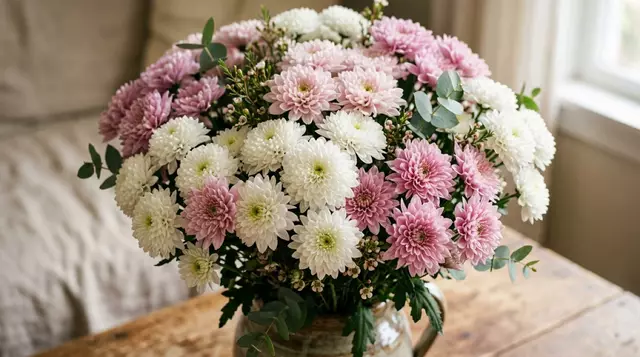
The florist’s chrysanthemum is a cultivated flowering plant grown for cut flowers and pot displays, with firm stems, lobed leaves and flower heads ranging from open daisies to dense pompoms. Its colours include white, yellow, pink, purple, bronze and green, with the shape and size depending on the cultivar.
For a bouquet, the most useful distinction is between spray stems carrying several smaller heads and stems grown to carry one large bloom. That choice affects the bouquet’s outline, texture and how prominent each flower looks.
Recognising the flower: centres, petals and leaves
What looks like one chrysanthemum flower is actually a head made up of many tiny florets. Daisy forms have a visible central disc surrounded by petal-like ray florets; densely double forms have so many ray florets that the centre is concealed.
Pompon forms look rounded and compact. Spider forms have long, narrow florets that give the head a spiky outline, while incurved forms curl inward into a fuller shape. The leaves are usually lobed or toothed, adding a distinct leafy texture beneath the flowers.
Choosing spray or single-headed chrysanthemums
Choose spray chrysanthemums when you want clusters of smaller flowers distributed through the bouquet. They create a branching, textured appearance and work well when you prefer several small points of colour.
Choose single-headed, often called disbud, chrysanthemums when you want individual blooms to stand out. Growers remove side buds so the retained flower can develop prominently. When comparing bouquets, look at the flower heads and overall dimensions as well as the stem count: one spray stem can carry several heads.
Bouquets we can deliver




Colour and gift etiquette
Start with the recipient’s preferences: yellow gives a bright colour accent, pink creates a softer palette, and white works with many other flowers. These are visual choices rather than fixed messages. Chrysanthemum symbolism varies between cultures, and white chrysanthemums have mourning associations in some traditions; if that could matter to your recipient, check their customs.
A short card makes your intention clear, whether the flowers mark a birthday, express thanks or simply say you are thinking of someone. You can explore shapes and colour combinations in the bouquets catalogue.
Caring for cut chrysanthemums
Use a clean vase and remove leaves that would sit below the waterline. Recut the stem ends with a clean, sharp tool, then place them in fresh water. If you have cut-flower food, follow its dilution instructions.
Check the water daily, replenish it as needed and change it when it becomes cloudy. Keep the bouquet away from direct sun, radiators and ripening fruit, and remove fading material. For the full routine, see our cut-flower care guide.
Sending a chrysanthemum bouquet to Russia
Turboflora delivers flowers across Russia. City delivery costs 500 RUB; the operator confirms the price for remote districts and suburbs when confirming the order. Contact a manager on WhatsApp for help choosing a bouquet, agreeing the address, delivery time and card text, or arranging a photo of the bouquet before delivery.
In large cities, express delivery is available 1–2 hours after order confirmation. You can also pre-order 1–30 days ahead. Delivery is anonymous by default: the courier does not name the sender, and a card with your text is free. Online checkout uses CloudPayments; check the payment options displayed there. Check our delivery information; confirm the timing for your order.
Frequently asked questions
Is a florist’s chrysanthemum the same as a garden chrysanthemum?
The names overlap, but they do not tell you whether a particular plant suits outdoor growing in your climate. For a garden, choose a cultivar with suitable growing guidance; a cut bouquet does not establish a plant’s winter hardiness.
Ready to send flowers?
Pick the city, choose the bouquet, and a local florist takes it from there.
Choose a city →