Sending Birthday Flowers in Russia? Here Is What to Get Right
A bouquet arriving at the wrong moment, or with the wrong number of stems, can turn a generous gesture into an awkward one — even if the flowers themselves are beautiful. Russian birthday customs around flowers are specific enough that senders unfamiliar with them make the same small mistakes again and again. This guide walks you through the traditions plainly, so your order arrives exactly as it should: joyful, well-timed, and impossible to misread.
Why Timing Matters More Than You Might Think
In Russia, birthdays are celebrated on the day itself — not the evening before, not the morning after. Sending flowers early, even by a few hours on the wrong date, can feel presumptuous or even unlucky to the recipient. The tradition comes from a broader cultural belief that celebrating ahead of time invites misfortune, so most Russians will not open gifts or accept congratulations before midnight of their actual birthday.
This means your delivery window matters enormously. If the birthday falls on a weekday and the person is at work by nine in the morning, a bouquet arriving at the office at ten is perfect. If they are working from home, midday delivery gives them time to arrange the flowers properly before guests arrive in the evening. Avoid scheduling anything for the day before, even if it feels more convenient for logistics.
The good news is that same-day delivery within one to two hours removes most of the timing stress. You can wait until the morning of the birthday, confirm the recipient's location — home, office, or somewhere else — and send the order at the right moment. Turboflora delivers across Russia within that window, so there is no need to order a day ahead and risk arriving early. Precision here is not fussiness; it is respect for a custom the recipient almost certainly holds.
Bouquets we can deliver


The Odd-Number Rule and Why It Is Not Negotiable
If you take away one single fact from this article, let it be this: in Russia, even numbers of flowers are given only at funerals. A bouquet of ten roses, twelve tulips, or six peonies sends exactly the wrong message at a birthday. The rule applies regardless of how beautiful the arrangement is or how expensive the flowers are. Recipients notice the count, and so does everyone else in the room.
Odd numbers — five, seven, nine, eleven, fifteen, twenty-one, and so on — are the correct choice for any celebratory occasion. The most popular counts for birthdays are seven, nine, and fifteen stems for a moderate arrangement, and twenty-five or thirty-one for something grander. The number one is also acceptable for a single statement bloom, such as a large-headed peony or a garden rose, presented on its own.
When you order from a florist, always specify the stem count explicitly rather than leaving it to a standard bundle. Many international florists package by the dozen as a default, which creates exactly the problem described above. If you are ordering a mixed bouquet where individual stem counts are harder to track, ask the florist to confirm the total before the arrangement is finished. A good florist will do this automatically for Russian delivery, but it is worth raising yourself. The rule is so consistent across Russian culture that even younger generations who consider themselves less traditional still notice and feel the difference.
Which Flowers Russians Actually Associate With Celebration
Not every beautiful flower reads as celebratory in the Russian context. Chrysanthemums, for example, are widely associated with mourning and cemetery visits in Russia, so they are almost never given at birthdays — even though they are cheerful and long-lasting in other cultural settings. White lilies carry a similar ambiguity for many recipients, particularly older generations. It is safer to avoid both unless you know the recipient well and are confident they do not share this association.
The flowers that genuinely signal joy and occasion in Russia are roses, peonies, tulips, and eustoma. Roses are the most universal — red for romantic feeling, coral and peach for warmth and affection, white and cream for elegance. Peonies, available fresh from late May through July, are considered deeply festive and luxurious. Tulips peak in spring and are especially popular for women's birthdays in March and April. Eustoma, sometimes called lisianthus, adds a soft, layered texture to mixed bouquets and is very well regarded.
For a birthday bouquet that feels genuinely Russian in character, a combination of garden roses with ranunculus and eucalyptus reads as both contemporary and appropriate. Alstroemeria mixed with spray roses is a practical choice for longevity. Hydrangea works beautifully as a base flower in summer arrangements. The key is to build around one hero bloom — the flower the eye goes to first — and support it with textures that extend the bouquet's life and visual depth rather than compete with the centrepiece.
Choosing by Budget Without Losing the Gesture
A smaller bouquet done with intention always lands better than a large one that feels assembled carelessly. At a modest budget, seven or nine stems of a single variety — spray roses, alstroemeria, or ranunculus — presented with quality wrapping and a handwritten note create a complete and meaningful gift. The restraint reads as confidence rather than economy when the flowers are fresh and the presentation is clean.
At a mid-range budget, mixing a hero flower with supporting blooms gives the arrangement depth. Seven garden roses with three stems of eucalyptus and two stems of wax flower, for example, gives you eleven stems total — correct count, visual variety, and good longevity. Adding a ribbon in a colour that suits the recipient's taste lifts the whole thing without adding cost.
For a significant birthday — a fortieth, a fiftieth, or a milestone that deserves real ceremony — a bouquet of twenty-one or thirty-one stems of premium roses makes an immediate impression. Peonies in season at this quantity are genuinely spectacular. If the birthday falls outside peony season, large-headed garden roses such as David Austin varieties offer a similar sense of abundance and softness. At any budget level, freshness is the non-negotiable factor. Flowers delivered within hours of cutting last noticeably longer and open more beautifully than those that have sat in cold storage for days, which is why delivery speed matters as much to the flowers as it does to the timing of the gesture.
What the Presentation Says Before the Flowers Are Unwrapped
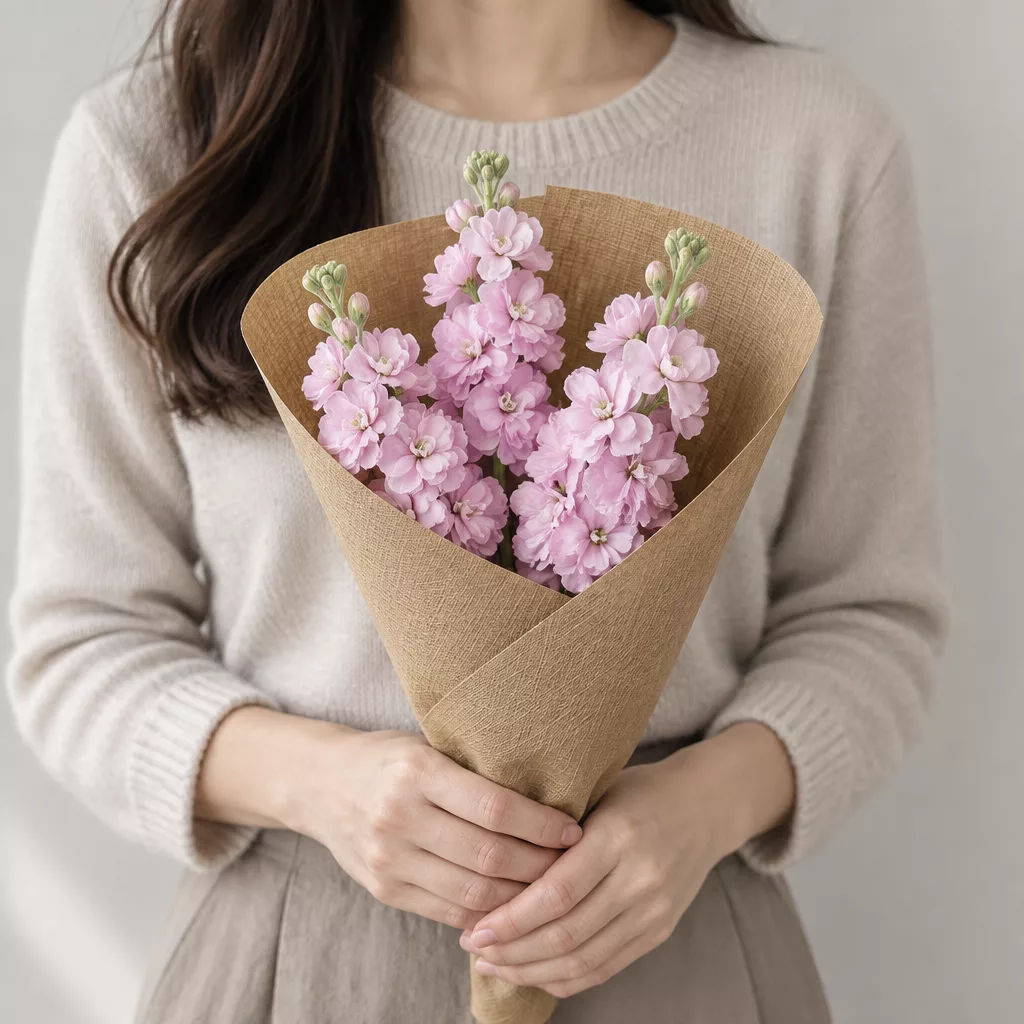
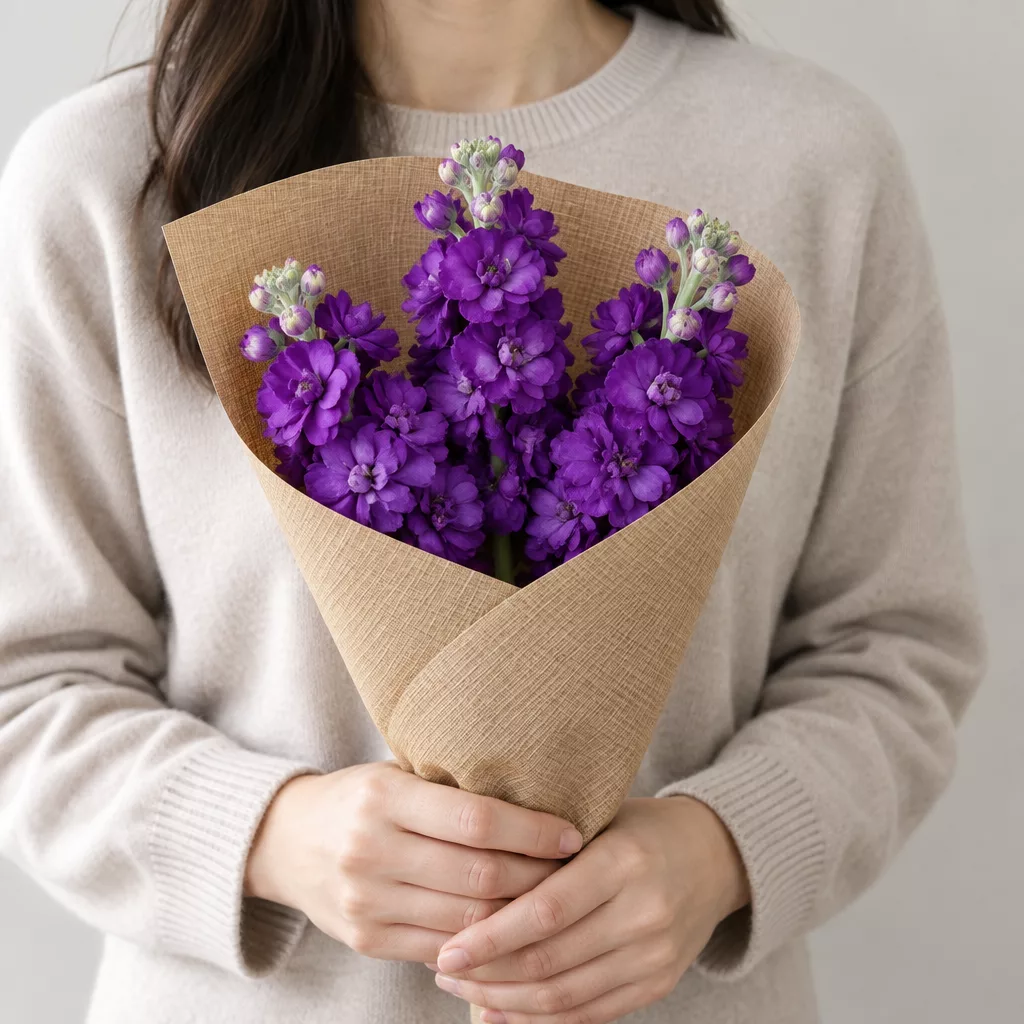
Russians pay close attention to how a bouquet is wrapped, and the packaging is considered part of the gift rather than just protective material. A bare cellophane cone with a sticker is read as perfunctory. Kraft paper with a satin ribbon, or layered wrapping in complementary colours, signals that the sender thought carefully about the whole object, not just the flowers inside.
For a birthday, round bouquets — where all stems radiate from a central point and the shape is symmetrical — are the most traditional and universally appreciated. Flat, one-sided arrangements are more common for table displays and feel slightly less personal as a hand-delivered gift. If you are ordering for delivery to a home where the recipient will answer the door themselves, a round bouquet is almost always the right shape.
Colour coordination in the wrapping matters too. A pastel bouquet wrapped in deep burgundy paper creates a strong contrast that photographs beautifully and feels considered. Neutral kraft with a white ribbon suits almost any flower colour and never clashes. Avoid wrapping that competes visually with the flowers — very busy printed paper or clashing colours undermine the arrangement rather than supporting it.
If you are adding a card, keep the message warm and specific to the person rather than generic. A florist delivering on your behalf can include a handwritten card with your message, which feels far more personal than a printed label. This small detail is consistently what recipients remember and mention when they thank the sender.
Care Instructions to Pass Along With the Bouquet
Flowers delivered in Russian city temperatures vary enormously by season. In January and February, Saint Petersburg can drop to minus fifteen or colder, and flowers need to be transported quickly from vehicle to interior to avoid cell damage. In July, the challenge reverses — heat accelerates wilting, and bouquets left in a warm car for even thirty minutes lose hours of vase life. Reputable same-day delivery services account for both extremes, but the recipient needs to know what to do once the flowers arrive.
The first step is always a fresh diagonal cut — about two centimetres from the bottom of each stem — made with a sharp knife rather than scissors. Scissors crush the vascular tissue and reduce water uptake. The stems should go immediately into a clean vase with cool, fresh water. Warm or stagnant water promotes bacterial growth and shortens vase life significantly.
Remove any leaves that would sit below the waterline, as submerged foliage rots quickly and clouds the water. Change the water every two days and re-cut the stems each time. Keep the vase away from direct sunlight, radiators, and fruit bowls — ethylene gas from ripening fruit accelerates petal drop in roses and tulips especially.
With proper care, roses and eustoma last seven to ten days. Tulips last five to seven but continue to grow in the vase, which many people find charming. Peonies, once fully open, are spectacular for four to six days. Alstroemeria is the endurance champion of the birthday bouquet — it regularly reaches twelve to fourteen days with basic care, making it a practical choice when longevity matters.
Common Mistakes Senders Make and How to Avoid Them
The most frequent mistake is ordering by visual appeal alone without checking the stem count. A sender sees a photograph of a lush arrangement, orders it, and does not notice that the standard version contains twelve stems. The florist should catch this, but the safest approach is to confirm the count yourself when placing the order and ask for it to be adjusted to the nearest odd number if needed.
The second common mistake is choosing flowers the sender personally loves rather than flowers appropriate for the recipient's taste and age. Bright tropical arrangements with bird of paradise and anthuriums are striking, but they can feel impersonal or even jarring to a recipient who prefers soft, classic blooms. If you do not know the recipient's taste well, a bouquet of roses or mixed garden flowers in a warm palette is universally safe and genuinely appreciated.
Senders who order from outside Russia sometimes underestimate how seriously the timing rule is observed. Scheduling delivery for the evening before because it feels safer logistically is a real cultural misstep. Same-day delivery within a one-to-two-hour window removes the need for this compromise entirely.
Finally, skipping the card is a mistake more often than senders realise. A bouquet without any message can feel anonymous, especially when delivered to an office where colleagues may see it arrive. Even a single sentence — something specific and warm — transforms the gesture from a transaction into a communication. The flowers carry the emotion; the card confirms who sent it and why.
Russian birthday flower customs are specific, but they are not complicated once you know them. Odd stem counts, same-day delivery, the right choice of blooms, and thoughtful presentation cover almost everything. The recipient on the other end of that delivery — whether they are in Saint Petersburg, Kazan, Novosibirsk, or anywhere else across Russia — will feel immediately that the sender understood the occasion. That sense of being genuinely considered is what makes a bouquet memorable long after the flowers have faded. We deliver bouquets across Russia in 1–2 hours.
Frequently asked questions
Is it really important to send flowers on the birthday itself and not the day before?
Yes, this is taken seriously across Russia and across generations. Sending flowers before the birthday is considered bad luck by many recipients, even those who think of themselves as unsuperstitious. Same-day delivery within one to two hours makes it easy to send on the correct date without any logistical compromise.
What if I want to send a large bouquet — do I still need to count every stem?
Absolutely. The odd-number rule applies regardless of the size of the arrangement. For a large bouquet, common counts are twenty-five, thirty-one, or fifty-one stems. When ordering a mixed bouquet, ask the florist to confirm the total stem count across all varieties before the arrangement is finalised. It takes thirty seconds and prevents an awkward situation.
Can I send white flowers for a Russian birthday, or are they only for sad occasions?
White flowers are fine for birthdays as long as they are not white chrysanthemums, which carry strong funeral associations in Russia. White roses, white eustoma, white ranunculus, and white peonies are all considered elegant and celebratory. Mixing white blooms with a warm accent colour — peach, blush, or coral — makes the arrangement feel unambiguously festive.
How long will the birthday bouquet last if the recipient looks after it properly?
Roses and eustoma typically last seven to ten days with fresh water every two days and a re-cut of the stems. Alstroemeria can reach twelve to fourteen days. Peonies are shorter at four to six days once open, but the display is spectacular. Freshness at the point of delivery matters enormously — flowers delivered within hours of cutting always outlast those from cold storage.
What is the safest flower choice if I do not know the recipient's personal taste?
Garden roses in a warm palette — peach, coral, soft red, or cream — are the universally safe choice for a Russian birthday. They are unambiguously celebratory, available year-round, and appreciated across all ages and tastes. A mono-variety bouquet of nine or fifteen roses with clean wrapping and a handwritten card is consistently one of the most warmly received gifts a florist delivers.
Ready to send flowers?
Pick the city, choose the bouquet, and a local florist takes it from there.
Choose a city →