Russian Flower Meanings: A Florist's Guide to What Flowers Say in Russia
In Russia, flowers carry meaning through three things at once: the type of flower, its colour and the number of stems. Red roses speak of love, carnations are tied to memory and Victory Day, chamomile stands for family and simple happiness, and yellow flowers were long read as a sign of parting. Above all, a bouquet for a living person always has an odd number of stems, while even numbers are reserved for funerals and graves.
These rules are older than most of the people who still follow them, and plenty of young Russians bend them. But if you are sending flowers to a grandmother in Samara, a business contact in Moscow or a friend's mother in Kazan, knowing the code helps you avoid an awkward moment and choose something that feels personal. Below, flower by flower, is how Russians tend to read a bouquet, and what we recommend as florists when you want the message to land exactly as you intend.
The number rule comes before any flower
Before you think about species or colour, count the stems. Three, five, seven, nine, eleven, fifteen: any odd number is right for birthdays, dates, anniversaries and thank-yous. Two, four, six and other even numbers are what people carry to a cemetery or lay at a memorial, so a dozen roses, standard in many countries, can make an older Russian recipient visibly uncomfortable.
The rule relaxes once a bouquet gets large. Above roughly fifteen stems most people stop counting, and a lush arrangement of 25 or 51 roses is simply read as generous. Mixed bouquets with greenery and several varieties are also judged as a whole rather than stem by stem. Still, if the bouquet is small and made of one flower, we always make sure the count is odd, and you can mention the number you want when you order.
Even numbers have one respectful use: two red carnations or four roses laid at a war memorial on Victory Day, 9 May, or at a family grave. That is why the number rule is felt so strongly. It is not about luck, but about not mixing the language of celebration with the language of mourning.
Roses: love, respect and the meaning of each colour
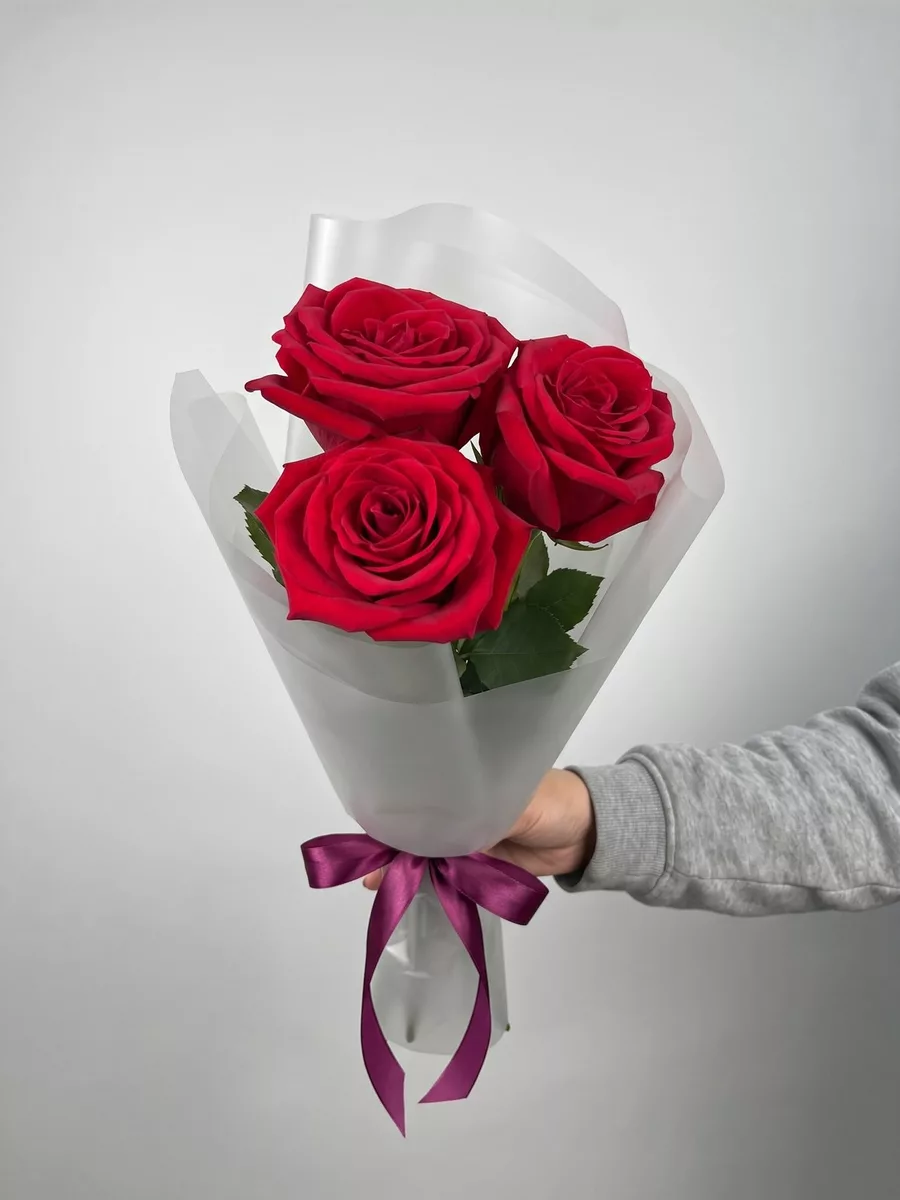
Roses are the default gift in Russia and the most widely understood. Deep red means passion and romantic love, so it suits a partner, a wife or a sweetheart, but can feel too intimate for a colleague or a friend's mother. White roses read as tenderness and sincerity and are a common choice for brides, young women and new mothers. Pink is the safe middle ground: warm, admiring and appropriate for almost anyone, from a teacher to an aunt.
Cream, peach and coral roses have become the florist's favourite for neutral occasions such as a work anniversary or thanking a doctor. Burgundy is associated with maturity and deep respect, which makes it a good fit for an older woman's jubilee birthday. For a longer guide to shades, see our article on roses by colour in Russia, and for the romantic side specifically, the piece on red roses and their signals.
One practical note: Russians tend to admire long, straight stems and large heads, so a tall rose bouquet looks generous, while very short garden-style roses are read as cosy and informal. Both are fine, but choose deliberately depending on the tone you want.
Bouquets we can deliver


Carnations and chrysanthemums: flowers with a Soviet past
Few flowers in Russia carry as much history as the carnation. In Soviet times red carnations were the flower of parades, official holidays and veterans, and today they are still laid at eternal flames and memorials on 9 May. Because of that, many Russians see red carnations as solemn rather than romantic. Spray carnations in pastel shades are a different story: florists use them freely in modern mixed bouquets, where they look light and fresh. Our article on carnations in Russia goes deeper into this shift.
Chrysanthemums are where foreigners are most often surprised. In France, Italy or Belgium they belong to cemeteries, but in Russia they are an ordinary, cheerful gift. Large single-headed chrysanthemums and bushy spray varieties are especially popular in autumn, for teachers on Teachers' Day in October and for older relatives who value a bouquet that lasts. A good chrysanthemum easily stands two weeks in a vase, which Russians appreciate.
So if you come from a culture where chrysanthemums mean mourning, you can relax: a Russian recipient will not read them that way. Just keep the stem count odd if the bouquet is small.
Seasonal favourites: tulips, mimosa, chamomile and peonies
Spring flowers in Russia are tied to one date above all: 8 March, International Women's Day. Tulips are the classic choice, bought by the armful for mothers, wives, colleagues and teachers, and they mean renewal, warmth and attention. Yellow mimosa, with its fluffy scented sprigs, is the nostalgic Soviet-era symbol of the holiday, and many women over fifty still smile at the sight of it.
Lily of the valley stands for purity, modesty and quiet tenderness. It blooms briefly in May and appears in Russian songs, poems and perfume history, so a small bunch feels romantic in an old-fashioned way. Forget-me-nots and violets carry similar gentle meanings of remembrance and shy affection.
The chamomile, or romashka, is the flower many Russians think of as their own. It grows in every summer field, children pull its petals to the words 'loves me, loves me not', and since 2008 it has been the emblem of the Day of Family, Love and Fidelity on 8 July. A chamomile bouquet says simplicity, sincerity and family warmth. It suits a mother, a grandmother or a long-married couple far better than an expensive arrangement would.
Cornflowers, with their pure blue colour, are linked to the Russian countryside and summer harvest, and they pair beautifully with chamomile and wheat in rustic bouquets. Peonies are the luxury of early summer: lush, fragrant and associated with prosperity, romance and weddings. Their season is short, roughly late May to early July, which makes a peony bouquet feel like a special event.
Yellow flowers, lilies and other choices to handle with care
The old belief that yellow flowers mean separation, betrayal or an end to a relationship is fading, but it has not disappeared. A popular Soviet song even calls yellow tulips 'messengers of parting'. Younger people happily receive sunflowers and yellow roses as a sign of joy, while some older recipients still hesitate. If you want sunny colours for a grandmother or a sensitive situation, mix yellow with white, peach or blue rather than sending a solid yellow bouquet.
White lilies and callas are elegant but double-edged: they are used at weddings and also at funerals, and lilies have a strong scent that can be too much in a small flat or a hospital ward. They are a good choice for an experienced, confident adult, less so for a new mother or someone unwell. Artificial flowers and potted plants are not considered a substitute for a bouquet on a celebration day; cut flowers are what count.
When in doubt, describe the person and the occasion to us on WhatsApp and we will help you choose a bouquet that sends the right message. We can also send you a photo of the finished bouquet before delivery.
Sending a bouquet with the right meaning to Russia
Once you know what you want to say, ordering is simple. Choose a bouquet in our catalogue, specify the number of stems if it matters, and add a card with your own words; the card is free. Delivery is anonymous by default, so the courier will not name you unless you write your name on the card, which is useful for surprises and first gestures.
We deliver across Russia. City delivery costs 500 RUB; for remote districts and suburbs the operator confirms the price when confirming the order. In large cities express delivery takes 1 to 2 hours after the order is confirmed, or you can pick an exact time (plus or minus 30 minutes) or a window of 09-12, 12-15, 15-18 or 18-21. The courier calls the recipient about 15 minutes before arriving, and if nobody is home we arrange a second delivery the same day or, with your consent, leave the flowers with a neighbour or concierge.
You can pay online on the site by bank card, SBP or Yandex Pay. If you would like to agree the address, time or wording of the card first, message a manager on WhatsApp. We deliver bouquets across Russia in 1–2 hours.
Frequently asked questions
Why must flowers be an odd number in Russia?
Even numbers of flowers are traditionally brought to funerals and graves, so they are associated with mourning. For any happy occasion Russians give an odd number of stems. Large bouquets of more than about fifteen stems are rarely counted.
Do yellow flowers mean something bad in Russia?
Traditionally yellow flowers were linked to separation and jealousy, and some older people still remember this. Younger Russians mostly see yellow as cheerful. For a cautious choice, mix yellow with other colours.
Are chrysanthemums funeral flowers in Russia?
No. Unlike in several European countries, chrysanthemums in Russia are an ordinary gift, especially popular in autumn and for teachers. They are valued because they last a long time in a vase.
What flower is a symbol of Russia?
There is no official national flower, but the chamomile is the one most Russians see as their own. It is the emblem of the Day of Family, Love and Fidelity on 8 July. Cornflowers are also strongly tied to the Russian countryside.
What do red carnations mean in Russia?
Red carnations are linked to Victory Day, veterans and memorials, so they feel solemn and respectful. They are laid at monuments on 9 May. Pastel spray carnations in mixed bouquets do not carry this association.
Ready to send flowers?
Pick the city, choose the bouquet, and a local florist takes it from there.
Choose a city →