Eustoma Floare: A Practical Guide to Lisianthus Flowers
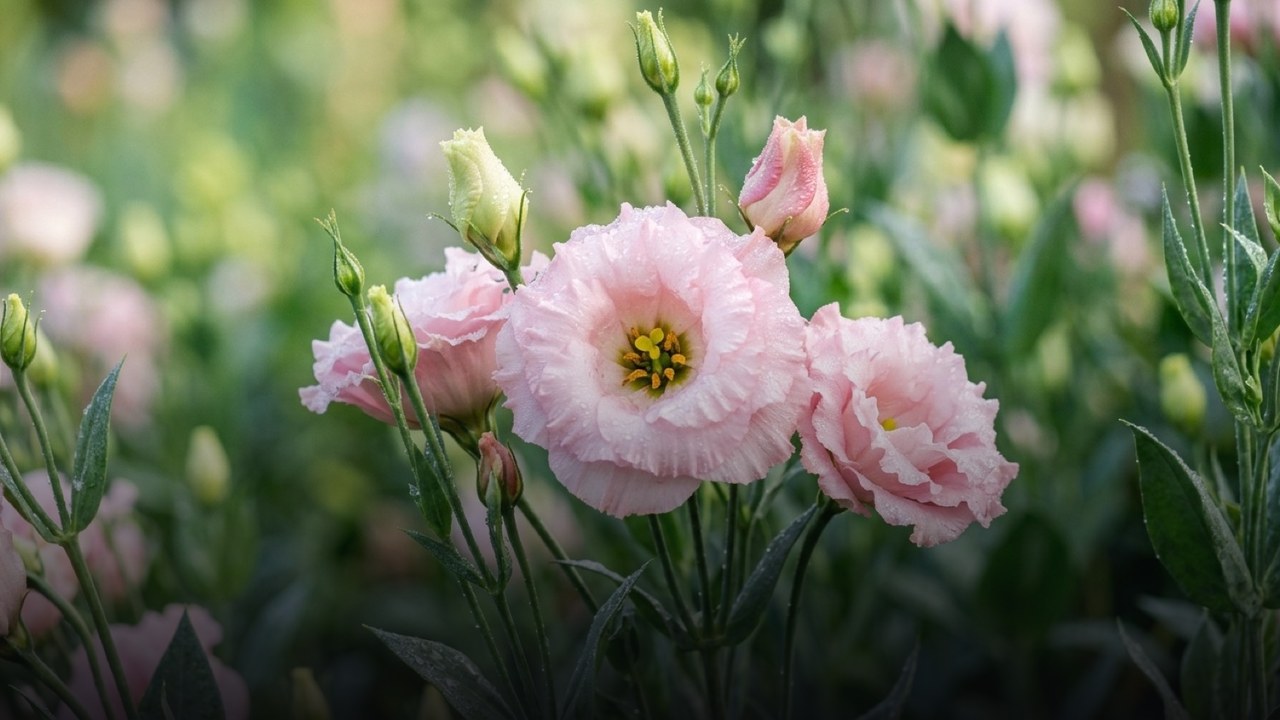
“Eustoma floare” means “eustoma flower”: floare is the Romanian word for flower, and eustoma is commonly called lisianthus in English. It is a cut flower with softly folded petals, branching stems and several buds, often chosen for bouquets with a light, gentle appearance. Some varieties have a single ring of petals; double varieties look fuller and can resemble small roses.
If you are choosing flowers for someone in Russia, eustoma is worth considering when you want softness without a very dense bouquet. The useful questions are practical: which colour suits the recipient, how open should the blooms be, and will someone be ready to receive them? Here is how to recognise the flower, choose it thoughtfully and help it last once it reaches the vase.
How to recognise eustoma and choose a good stem
Look at the whole branch rather than one flower head. Eustoma usually carries several blooms and buds at different heights, with smooth, oval leaves and slender stems. Its petals may be white, pink, purple or other shades, sometimes with contrasting edges. Colour alone will not identify it: the branching structure and the combination of open flowers with tapered buds are more useful clues.
When assessing cut stems, look for firm flower necks, intact petals and leaves that have not yellowed or become slimy. A few open blooms give a bouquet immediate presence, while developed buds add variation. Very small, tightly closed buds may never open after cutting, so do not judge a bouquet's future fullness simply by counting every green tip.
A double eustoma can look rose-like in a photograph, but the structure is different: several flowers can share one branching stem. This matters when you compare bouquet descriptions, because a stem count is not a flower-head count. Ask for clarification if the wording is unclear, and use a photograph to assess the overall shape rather than assuming all stems carry the same number of blooms.
What eustoma means, and which colour to choose
Eustoma is often associated with appreciation, gratitude and affection. These are customary interpretations rather than a fixed language that every recipient will read in the same way. If your message matters, put it into words: a simple sentence explaining what you appreciate about the person will communicate more clearly than relying on flower symbolism alone.
White gives a restrained, airy impression; pink feels warmer; lilac and purple can suit someone who enjoys cooler colours. None of these shades belongs exclusively to one occasion. Start with the recipient's preferences, then consider the setting: a quiet arrangement for a desk may call for a different colour balance from flowers intended to stand out at a birthday gathering.
For a romantic gift, eustoma can express tenderness without requiring a dramatic presentation. For a relative, friend or colleague, the same flower works with a direct note of thanks or congratulations. If soft purple is your starting point, our guide to choosing lilac eustoma explains how to think about that shade in a personal gift.
Bouquets we can deliver




Choosing a bouquet that suits the person and the occasion
Begin with where the flowers will go. A recipient with a small table may appreciate a manageable arrangement more than a wide bouquet that needs rearranging immediately. Eustoma's branching stems create width as well as height, so look at the outline and proportions in the image. A close-up of the petals tells you little about how much space the complete bouquet will occupy.
An eustoma-focused bouquet makes the flower's folds and buds easy to appreciate. In a mixed arrangement, check whether you can still see those details or whether larger blooms dominate them. Neither approach is inherently better: choose a clear focal flower for someone who loves eustoma, or a balanced mixture when their preferences are broader. You can use the bouquets catalogue as a starting point for your enquiry.
If you are following Russian gifting customs, an odd number of stems is the usual choice for a celebratory bouquet where the stems are counted individually; even numbers are traditionally associated with mourning. Eustoma's multiple blooms can make counting from a picture misleading. For an occasion where this matters to the recipient, clarify the stem count rather than counting visible flower heads.
How to care for cut eustoma at home
Start with a thoroughly washed vase and fresh water. Remove any leaves that would sit below the waterline, then trim the stem ends with a clean, sharp blade or secateurs before placing them in water. Work gently around the branches: trying to push a crowded bunch through a narrow vase opening can bend stems and damage flowers before they have had a chance to settle.
Use cut-flower food according to its packet instructions if you have it. Check the water each day, replenish it as needed and change it when it becomes cloudy, cleaning the vase and trimming the ends again. Remove spent blooms carefully, leaving healthy flowers and buds in place. If one stem deteriorates, take it out so decaying material does not remain in the shared water.
Keep the vase away from direct sun, radiators, heating vents and ripening fruit. Choose a position where the petals will not be brushed repeatedly by people passing. Vase life varies with the stems' condition, the room and daily care, so a fixed lifespan would be misleading. For growing a living plant rather than caring for cut flowers, see our eustoma plant guide.
Planning delivery when you are sending flowers from abroad
Turboflora delivers flowers across Russia. City delivery costs 500 RUB; for remote districts and suburbs, the operator confirms the delivery price when confirming the order. Give the full destination and the intended delivery date at the start of your enquiry. If you are ordering from another country, state the timing in the recipient's local time so the intended arrival is clear.
Express delivery in large cities is available in 1–2 hours after the order is confirmed. Other options are an exact time within a margin of plus or minus 30 minutes, the windows 09–12, 12–15, 15–18 or 18–21, or a preorder 1–30 days ahead. Choose a window when the recipient can receive the flowers and put them in water, especially if their day includes travel or meetings.
For help choosing a bouquet and agreeing the time, address and card text, contact a manager on WhatsApp. You can also arrange a photo of the bouquet before delivery there. Describe what matters most—such as eustoma as the main flower or a particular colour—and agree the details before proceeding; a guide to the flower does not establish availability for a particular order.
Card text, payment and what happens at the door
Delivery is anonymous by default: the courier does not name the sender. A card with your text is free, so include your name in the message if you want the recipient to know immediately who sent the flowers. For a colleague, a brief reason for the gift prevents ambiguity; for someone close, a specific personal sentence usually means more than a formal greeting copied from elsewhere.
Online checkout uses CloudPayments. Check the payment options displayed at checkout, particularly if you are paying with a card issued outside Russia; acceptance of every foreign card cannot be guaranteed. Keep the order details consistent with what you agreed, including the recipient's contact information, delivery address, date and message. Review the card text for names and spelling before submitting it.
The courier calls the recipient about 15 minutes before arrival, so allow for that contact when planning a surprise. If the recipient is absent, we agree a second delivery the same day or handing the flowers to a neighbour or concierge with the sender's consent. An unattended handover is not something to assume in advance: choose a realistic arrival window and make sure the recipient can be reached. We deliver bouquets across Russia in 1–2 hours.
Frequently asked questions
What does “eustoma floare” mean in English?
It means “eustoma flower”; floare is Romanian for flower. In English, eustoma is also commonly called lisianthus.
Is eustoma the same flower as a rose?
No, although double eustoma flowers can resemble small roses. Eustoma typically has branching stems carrying several blooms and buds.
Will every eustoma bud open in a vase?
Not necessarily: very small, immature buds may remain closed. Choose stems with some open flowers and developed buds rather than relying on a large number of tight green tips.
Can I arrange flower delivery to Russia while abroad?
Yes, Turboflora delivers across Russia, and you can agree the bouquet and delivery details with a manager. Online checkout uses CloudPayments; check the displayed payment options because acceptance of every foreign card is not guaranteed.
Can I send the bouquet without revealing my name?
Yes, delivery is anonymous by default, and the courier does not name the sender. A card with your text is free, so leave your name out of the message if you want to preserve that anonymity.
Ready to send flowers?
Pick the city, choose the bouquet, and a local florist takes it from there.
Choose a city →